tencent cloud

Chat

News and Announcements
Release Notes
Announcements
Product Introduction
Overview
Basic Concepts
Scenarios
Features
Account System
User Profile and Relationship Chain
Message Management
Group Related
Official Account
Audio/Video Call
Use Limits
Purchase Guide
Billing Overview
Pricing
Purchase Instructions
Renewal Guide
Service Suspension Explanation
Refund Policy
Development Guidelines
Demo Zone
Activate Service
Free Demos
Quick Run
Download
SDK and Demo Source Code
Update Log
Chat Interaction (UI Included)
TUIKit Introduction
Getting Started
Full-feature Integration
Single-function Integration
Build with AI
Build Basic Interfaces
More Features
Customizing Appearance
Internationalization
Push Service
Overview
Noun explanation
Activate the Service
Quick Start
Manufacturer Channel
Statistics
Troubleshooting Tool
Client APIs
REST API
Push Callback
Advanced Features
Release Notes
Error Codes
FAQS
Desk
Overview
Quick Start
Integration Guide
Admin Operation Manual
Agent Manual
More Practices
Live Streaming Setup Guide
AI Chatbot
Super Large Entertainment and Collaboration Community
Discord Implementation Guide
How to Integrate Chat into Games
WhatsApp Channel-style Official Account Integration Solution
Send Red Packet
Firewall Restrictions
No UI Integration
Quick Start
SDK Integration
Initialization
Login and Logout
Message
Conversation
Group
Community Topic
User Profile and Relationship Chain
Offline Push
Cloud Search
Local Search
Official Channel Management
Client APIs
JavaScript
Android
iOS & macOS
Swift
Flutter
Electron
Unity
React Native
C APIs
C++
Server APIs
Secure authentication with UserSig
RESTful APIs
Webhooks
Console Guide
New Console Introduction
Creating and Upgrading an Application
Basic Configuration
Feature Configuration
Account Management
Group Management
Official Channel Management
Webhook Configuration
Usage
Viewing Guide for Resource Packages
Real-Time Monitor
Auxiliary Development Tools
Access Management
Advanced Features
FAQs
uni-app FAQs
Purchase
SDK
Account Authentication
User Profile and Relationship Chain
Message
Group
Audio-Video Group
Nickname and Profile Photo
Security Compliance Certification
Service Level Agreement
Security Compliance Certification
Chat Policies
Privacy Policy
Data Privacy and Security Agreement
Migration
Migration Solutions
Migration Solutions Lite
Error Codes
Contact Us

Login Authentication

PDF
Focus Mode
Font Size
Last updated: 2025-08-22 15:53:05

Login Authentication Overview

Instant Messaging (Chat) evolved from the QQ instant messaging system. We extracted QQ’s common modules and integrated them to build the integration-friendly Chat SDK and backend service.
The Chat SDK can be viewed as QQ without the user interface. Integrating the Chat SDK into your app is similar to integrating the QQ kernel.
You must log in to QQ before you can use it for messaging. While you log in to QQ with your QQ ID and password, you must log in to the Chat SDK with the specified username (UserID) and password (UserSig).
UserID: Formerly known as Identifier. This is the username for users to log in to Chat. It is actually the user ID in your app.
For example, if a user in your app has the ID of 27149, you can use 27149 as the UserID to log in to Chat.
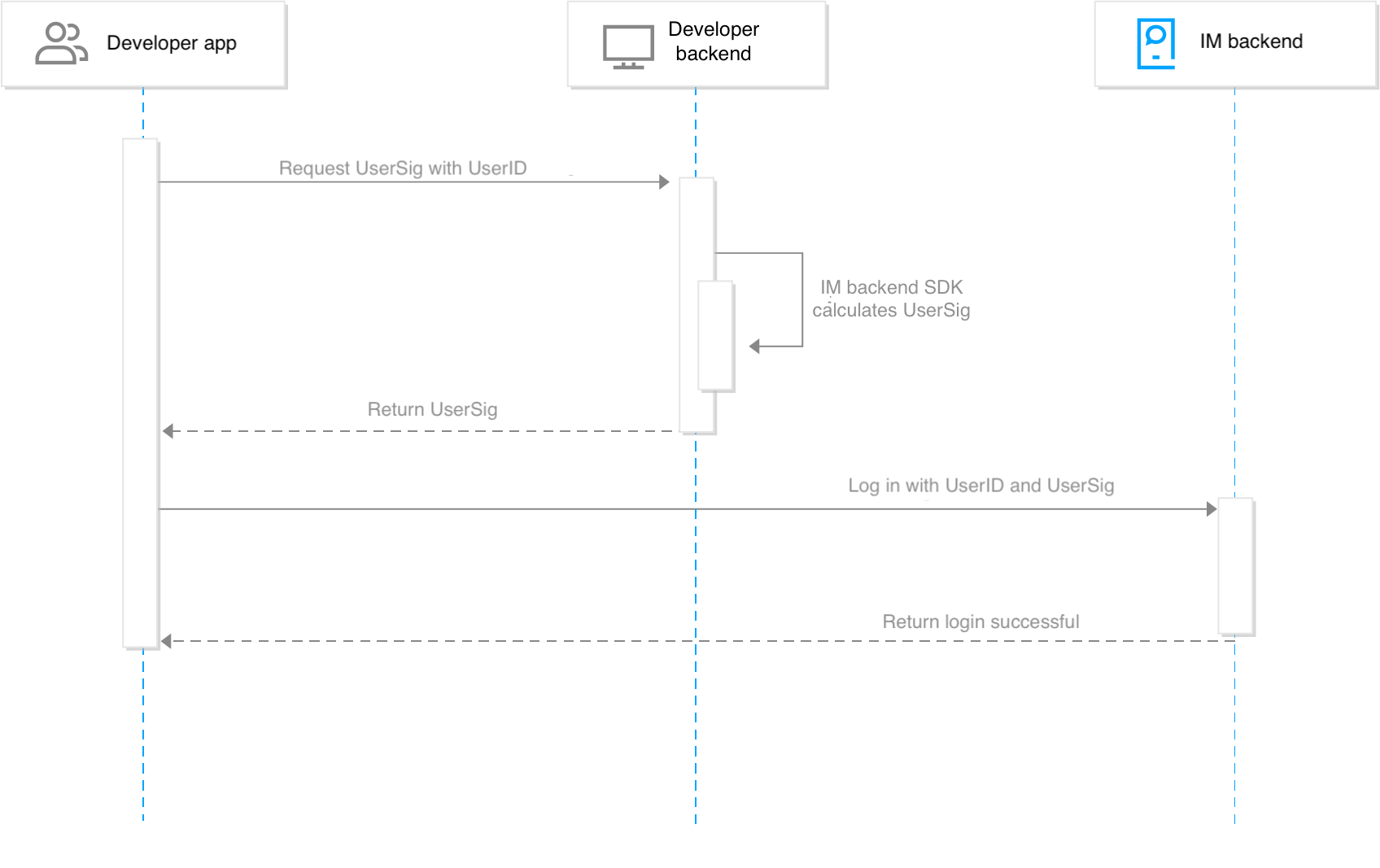
UserSig: This is the password with which the user logs in to Chat. It is the data generated after App Server uses the key to encrypt information such as UserID. For more information, see Generating UserSig.

App Login Process

We recommend that apps log in to Chat as follows:


Caution:
The Chat backend completely trusts UserSig. To avoid affecting your data and business, you must ensure the security of the private key.
UserSigs generated by the default API of the Chat backend SDK are valid for 180 days. Developers can use the API with the validity parameter to customize the validity period. Developers must obtain a new UserSig from the developer backend before the original UserSig expires.
For more information on the Chat backend SDK that is used to generate UserSig, see Generating UserSig.

App Admin


Some Chat services requi
re admin permissions, for example, calling RESTful APIs, disbanding a group, and pushing to all users. Compared with ordinary accounts, the role of app admin has the highest level of privileges:
It has higher read permissions. For example, it can obtain all groups within the app and any group profile of any group.
It has higher operation permissions. For example, it can send messages to any user and add or delete members in any group.
You can only set app admins in the console. For more information on the procedure, see Configuring Account Admins.

Help and Support

Was this page helpful?

Help us improve! Rate your documentation experience in 5 mins.

Feedback