Strengths
Download
Focus Mode
Font Size
The cloud native database TDSQL-C for MySQL provides an easier way to configure, operate, and extend database services on the cloud, boasting rapid elasticity, high performance, high availability, high reliability, and security among its advantages. This document introduces the product's strengths to help you better understand TDSQL-C for MySQL.
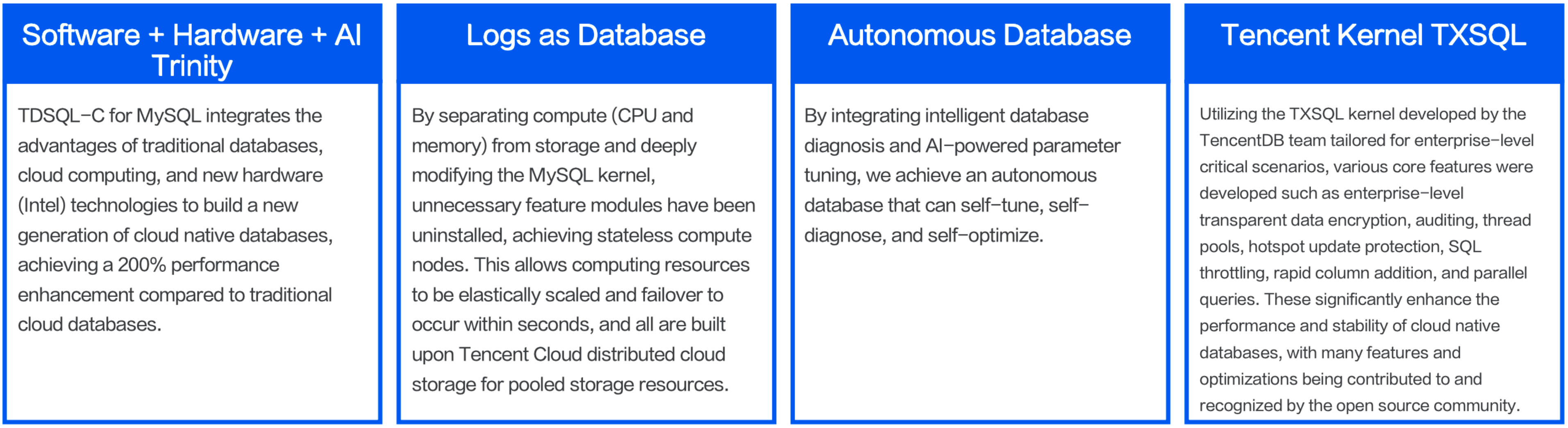
I. Core Features
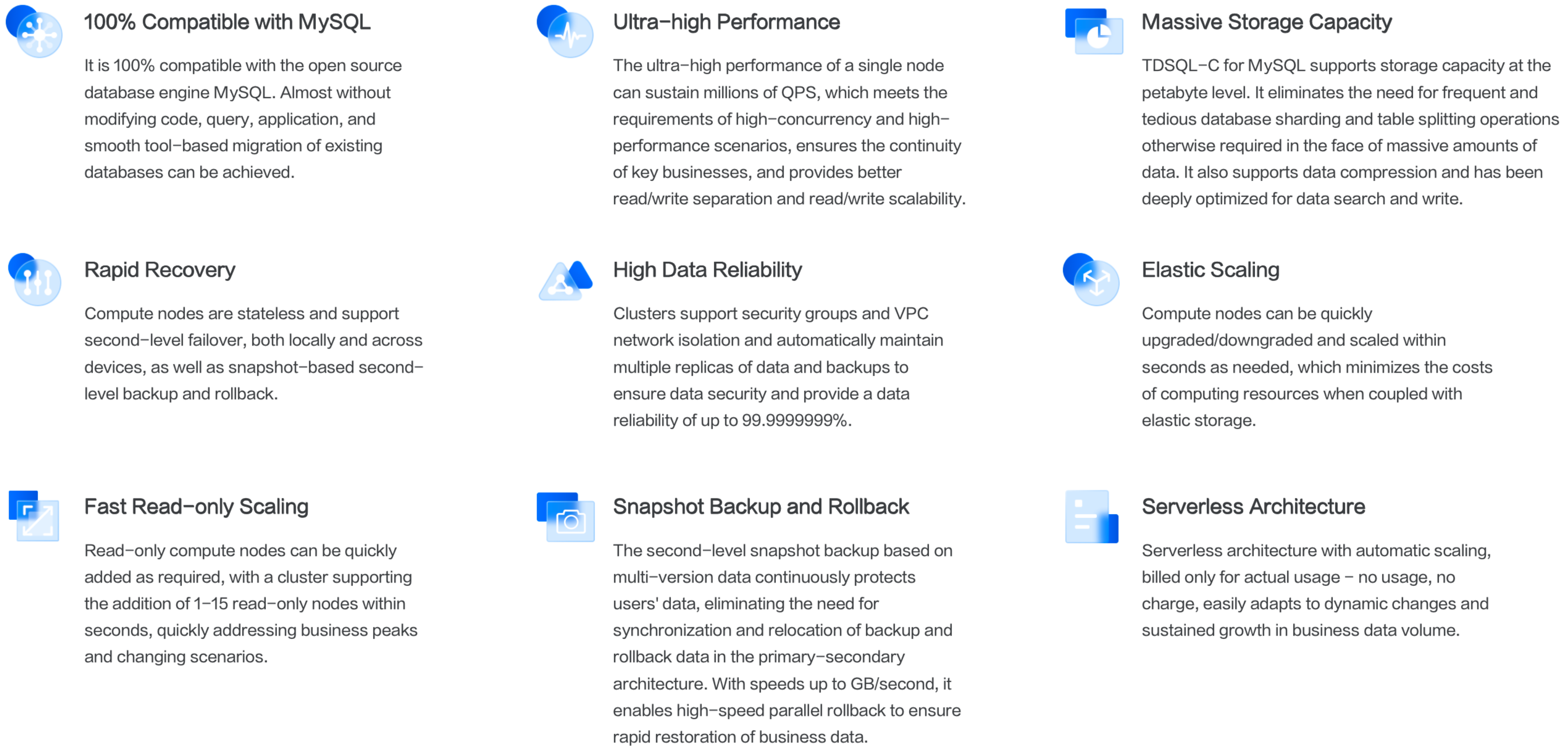
II. Product Features
III. Comparison with Self-built Databases
1. Feature Comparison
Comparison Item | TDSQL-C for MySQL | Database Built with CVM | Database Built with Self-purchased Server |
Availability | ✅ Second-level failover | No failover mechanism | No failover mechanism |
✅ Equipped with high availability architecture | Need to purchase the high availability system separately | Need to purchase the high availability system separately | |
✅ SLA guarantee of 99.99% | SLA cannot fully guarantee | SLA is low | |
✅ Read-only instances automatically implement CLB | CLB service needs to be implemented separately | CLB service needs to be implemented separately | |
Reliability | ✅ High reliability 99.9999999% | ✅ High reliability of underlying resources | Low reliability of underlying resources |
✅ Recovery Point Object (RPO) is 0, with no data loss ✅ Recovery Time Objective (RTO) is usually within 30 seconds | The cost of achieving RPO = 0 is extremely high, requiring the separate purchase of R&D services | The cost of achieving RPO = 0 is extremely high, requiring the separate purchase of R&D services | |
✅ Has automatic backup and rollback capabilities | Need to build the entire backup and rollback system on your own | Need to build the entire backup and rollback system on your own | |
Ease of use | ✅ Rapid deployment and cluster creation | ✅ Rapid deployment and cluster creation | Long deployment cycle |
✅ Supports data migration | Relies on manual data migration | Relies on manual data migration | |
✅ Equipped with visualized management tools | Requires self-installation of management tools | Requires self-installation of management tools | |
✅ Has monitoring and alarming capabilities | Need to separately purchase and configure a monitoring system | Need to separately purchase and configure a monitoring system | |
✅ Supports cross-region disaster recovery | Technical implementation is challenging | Technical implementation is challenging | |
Scalability | ✅ Elastic scaling supported | ✅ Elastic scaling supported | Elastic scaling not supported |
✅ Read-write separation architecture supported | Not supported, multi-machine self-deployment required | Not supported, multi-machine self-deployment required | |
Security | ✅ IP allowlist, security groups, VPC network isolation | ✅ IP allowlist, security groups, VPC network isolation | Costly allowlist and VPC network isolation |
✅ Database audit | Audit is difficult, and SQL logs must be saved separately | Audit is difficult, and SQL logs must be saved separately |
2. Hardware and Software Deployment Costs Comparison
Comparison Item | TDSQL-C for MySQL | Database Built with CVM | Database Built with Self-purchased Server |
Hardware and spare parts costs | The cost of a TDSQL-C for MySQL instance. For example, the cost of an instance with 4 CPUs, 8 GB memory, and 100 GB storage space is about 1392 USD per year. | At least two CVM instances are required as primary and replica instances. The cost of two CVM instances, each with 4 CPUs, 8 GB memory, and 100 GB storage space (with an IOPS capability of 4,800), is about 1392 USD per year. | At least two database servers are required. The cost of each server, with an IOPS capability of 8,000, is about 1114 USD. One private network switch is used for connecting to the front-end web server (a cheap 1U unmanaged switch costs about 139 USD). Subsequent hardware damage and replacement will incur at least an additional 30% in costs. Hardware cost: (1114 × 2 + 139) × 130% = 3077 USD. Annual cost: 3077 USD/3 = 1025 USD (hardware is depreciated over 3 years). |
Server room hosting costs | Covered by service provider, no charge. | Covered by service provider, no charge. | The hosting cost for 1U cabinet space is 417 USD/year. There are two 1U servers and one 1U private network switch that need to be billed. Server room hosting cost: 417 × 3 = 1025 USD. |
Bandwidth costs | Covered by service provider, no charge. | Within the same region, CVM instances can communicate through the private network without incurring charges.
If in different regions, CVM instances can communicate through the public network, and public network traffic fees will be charged. | For private network use only. There are no public network charges. |
Database O&M engineer costs | Managed O&M, quickly resolving various failures. AI tools assist in resolving optimization issues.
Database maintenance is covered by the service provider, with no personnel costs. | For a junior DBA engineer, assuming the current project occupies 30% of the engineer's workload, the personnel cost for one year would be around 2785 USD. | For a junior DBA engineer, assuming the current project occupies 30% of the engineer's workload, the personnel cost for one year would be around 2785 USD. |
3. Peripheral Ecosystem Service Costs Comparison
Comparison Item | TDSQL-C for MySQL | Database Built with CVM | Database Built with Self-purchased Server |
Database monitoring system | Second-level monitoring data for 79+ metrics is provided for free. | At least one CVM instance is required for monitoring, collection, storage, and display. The cost of one CVM instance with 4 CPUs, 8 GB memory, and 300 GB storage space (approximate storage capacity for one year's monitoring metrics) is about 975 USD per year. | At least one database server is required. The cost of the server is about 1114 USD. Subsequent hardware damage and replacement will incur at least an additional 30% in costs. Hardware cost: (1114 × 1) × 130% = 1448 USD. Annual cost: 1448 USD/3 = 482 USD (hardware is depreciated over 3 years). |
Database O&M system | Covered by service provider, no charge. | The annual cost of a professional database O&M system is about 5571 USD. | The annual cost of a professional database O&M system is about 5571 USD. |
Database backup system | Currently free | At least one CVM instance is required for backup system storage. The cost of one CVM instance with 4 CPUs, 8 GB memory, and 200 GB storage space (can only retain 200 GB of backup data) is about 835 USD per year, and you need to build the backup and recovery capabilities on your own. | At least one database server is required. The cost of the server is about 1114 USD. One private network switch is used for connecting to the backup server (a cheap 1U unmanaged switch costs about 139 USD). Subsequent hardware damage and replacement will incur at least an additional 30% in costs. Hardware cost: (1114 × 1 + 139) × 130% = 1628 USD. Annual cost: 1628 USD/3 = 542 USD (hardware is depreciated over 3 years). |
Help and Support
Was this page helpful?
You can also Contact sales or Submit a Ticket for help.
Help us improve! Rate your documentation experience in 5 mins.
Feedback