tencent cloud

TDSQL-C for MySQL

Release Notes and Announcements
Release Notes
Product Announcements
Beginner's Guide
Product Introduction
Overview
Strengths
Use Cases
Architecture
Product Specifications
Instance Types
Product Feature List
Database Versions
Regions and AZs
Common Concepts
Use Limits
Suggestions on Usage Specifications
Kernel Features
Kernel Overview
Kernel Version Release Notes
Optimized Kernel Version
Functionality Features
Performance Features
Security Features
Stability Feature
Analysis Engine Features
Inspection and Repair of Kernel Issues
Purchase Guide
Billing Overview
Product Pricing
Creating Cluster
Specification Adjustment Description
Renewal
Payment Overdue
Refund
Change from Pay-as-You-Go to Yearly/Monthly Subscription
Change from Pay-as-You-Go to Serverless Billing
Value-Added Services Billing Overview
Viewing Billing Statements
Getting Started
Database Audit
Overview
Viewing Audit Instance List
Enabling Audit Service
Viewing Audit Logs
Log Shipping
Post-Event Alarm Configuration
Modifying Audit Rule
Modifying Audit Service
Disabling Audit Service
Audit Rule Template
Viewing Audit Task
Authorizing Sub-User to Use Database Audit
Serverless Service
Serverless Introduction
Creating and Managing a Serverless Cluster
Elastic Scaling Management Tool
Serverless Resource Pack
Multi-AZ Deployment
Configuration Change
FAQs
Serverless Cost Estimator
Operation Guide
Operation Overview
Switching Cluster Page View in Console
Database Connection
Instance Management
Configuration Adjustment
Instance Mode Management
Cluster Management
Scaling Instance
Database Proxy
Account Management
Database Management
Database Management Tool
Parameter Configuration
Multi-AZ Deployment
GD
Backup and Restoration
Operation Log
Data Migration
Parallel Query
Columnar Storage Index (CSI)
Analysis Engine
Database Security and Encryption
Monitoring and Alarms
Basic SQL Operations
Connecting to TDSQL-C for MySQL Through SCF
Tag
Practical Tutorial
Classified Protection Practice for Database Audit of TDSQL-C for MySQL
Upgrading Database Version from MySQL 5.7 to 8.0 Through DTS
Usage Instructions for TDSQL-C MySQL
New Version of Console
Implementing Multiple RO Groups with Multiple Database Proxy Connection Addresses
Strengths of Database Proxy
Selecting Billing Mode for Storage Space
Creating Remote Disaster Recovery by DTS
Creating VPC for Cluster
Data Rollback
Solution to High CPU Utilization
How to Authorize Sub-Users to View Monitoring Data
White Paper
Security White Paper
Performance White Paper
Troubleshooting
Connection Issues
Performance Issues
API Documentation
History
Introduction
API Category
Making API Requests
Instance APIs
Multi-Availability Zone APIs
Other APIs
Audit APIs
Database Proxy APIs
Backup and Recovery APIs
Parameter Management APIs
Billing APIs
serverless APIs
Resource Package APIs
Account APIs
Performance Analysis APIs
Data Types
Error Codes
FAQs
Basic Concepts
Purchase and Billing
Compatibility and Format
Connection and Network
Features
Console Operations
Database and Table
Performance and Log
Database Audit
Between TDSQL-C for MySQL and TencentDB for MySQL
Service Agreement
Service Level Agreement
Terms of Service
TDSQL-C Policy
Privacy Policy
Data Privacy and Security Agreement
General References
Standards and Certifications
Glossary
Contact Us

Test Results for Large Data Sets

PDF
Focus Mode
Font Size
Last updated: 2025-12-25 09:45:59
This document introduces the performance test results for the compilation-optimized high-performance version of TDSQL-C for MySQL in read-only, mixed read-write, and write-only scenarios where the data set characteristic is large data set.

Definition of the Large Data Set

The large data set scenarios refer to the situations where all data cannot be fully stored in the cache (with capacity being twice the memory size), and disk read and write operations are required during queries to update the cache.

Test Scenarios and Read Types for Large Data Sets

Data Set Characteristic
Test Scenario
Read Type
Large data set
Read-only
range select
point select
Mixed read-write
range select
point select
Write-only
-

Test Results for Large Data Sets

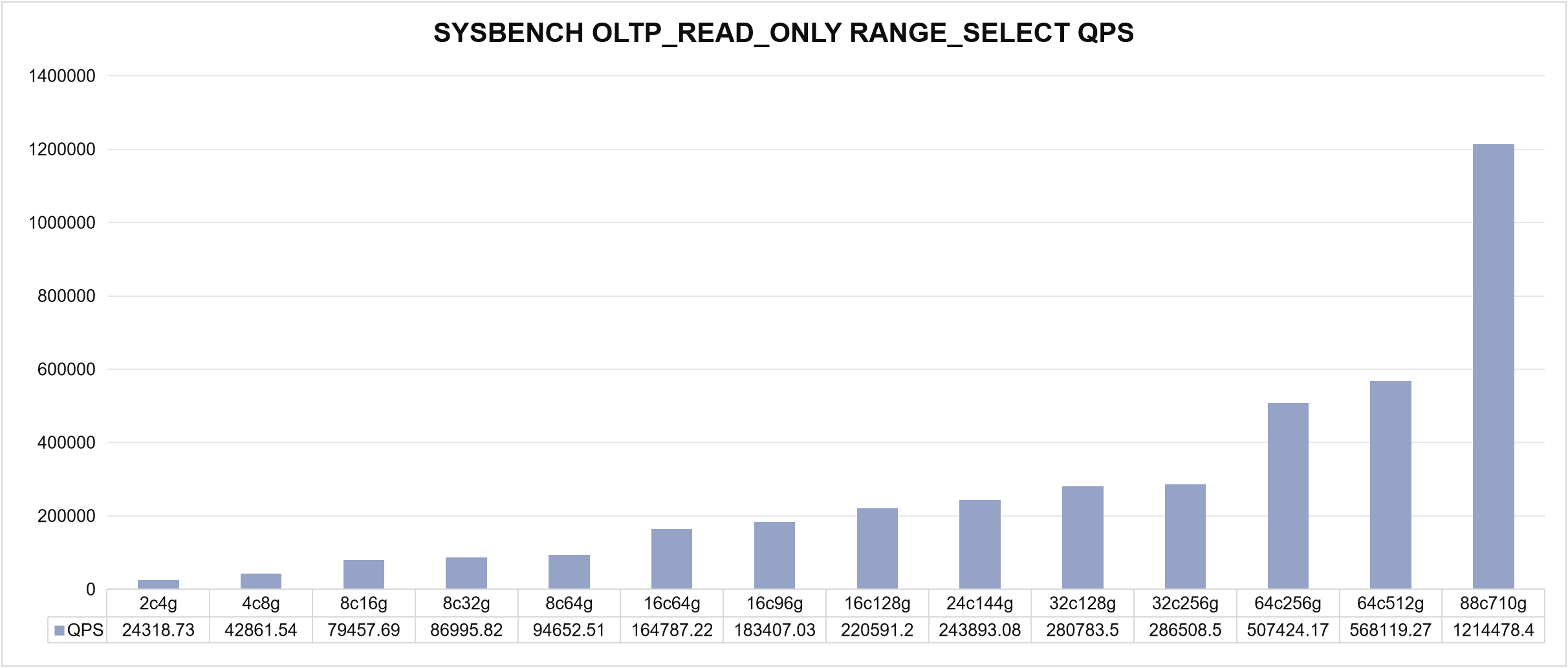
Scenario 1: Read-Only (range select)


Specifications
Concurrency
Data Volume of a Single Table (table_size)
Total Number of Tables (tables)
QPS
2 cores and 4 GB
64
800000
100
24318.73
4 cores and 8 GB
128
800000
100
42861.54
8 cores and 16 GB
128
800000
300
79457.69
8 cores and 32 GB
128
800000
300
86995.82
8 cores and 64 GB
256
800000
450
94652.51
16 cores and 64 GB
256
800000
450
164787.22
16 cores and 96 GB
256
800000
600
183407.03
16 cores and 128 GB
256
800000
600
220591.2
24 cores and 144 GB
512
5000000
300
243893.08
32 cores and 128 GB
128
5000000
300
280783.5
32 cores and 256 GB
128
5000000
400
286508.5
64 cores and 256 GB
1024
5000000
400
507424.17
64 cores and 512 GB
256
6000000
450
568119.27
88 cores and 710 GB
32
7000000
450
1214478.4

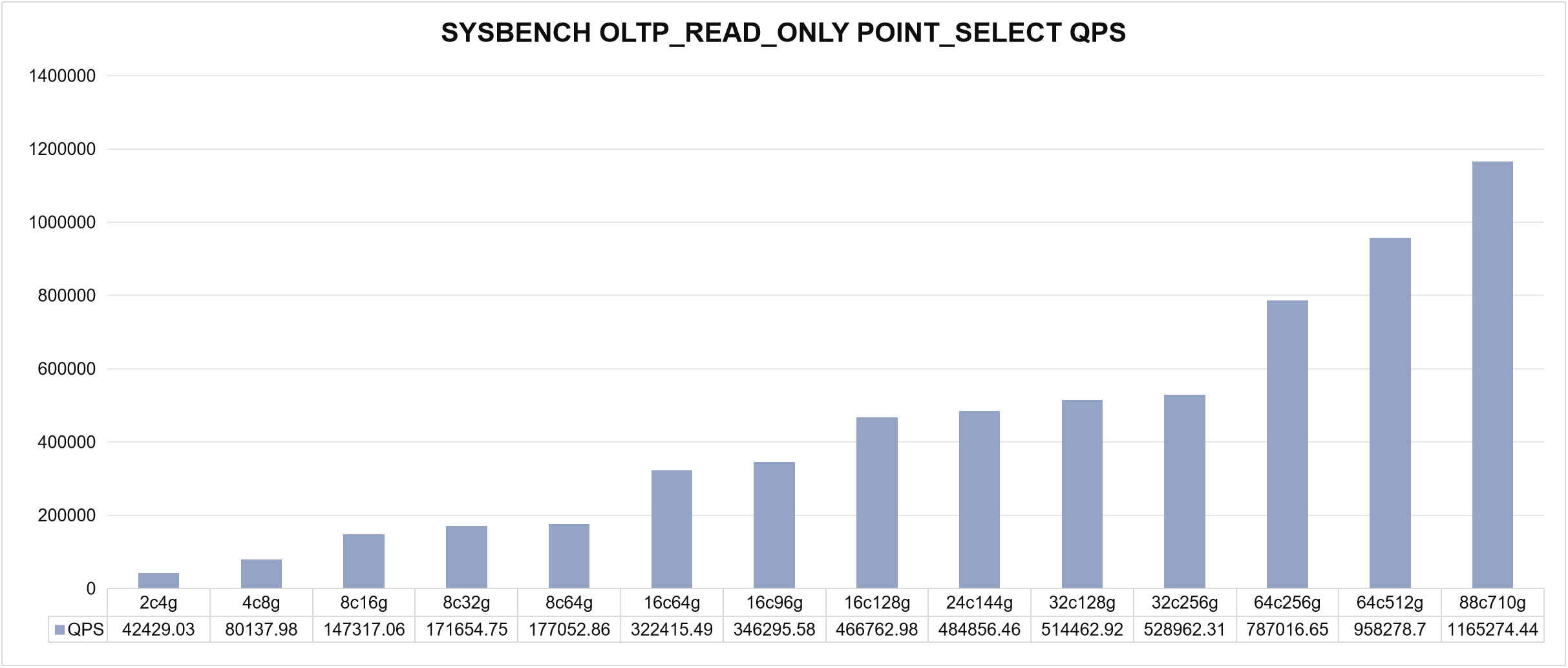
Scenario 2: Read-Only (point select)


Specifications
Concurrency
Data Volume of a Single Table (table_size)
Total Number of Tables (tables)
QPS
2 cores and 4 GB
64
800000
100
42429.03
4 cores and 8 GB
64
800000
100
80137.98
8 cores and 16 GB
128
800000
300
147317.06
8 cores and 32 GB
128
800000
300
171654.75
8 cores and 64 GB
256
800000
450
177052.86
16 cores and 64 GB
256
800000
450
322415.49
16 cores and 96 GB
256
800000
600
346295.58
16 cores and 128 GB
256
800000
600
466762.98
24 cores and 144 GB
512
5000000
300
484856.46
32 cores and 128 GB
128
5000000
300
514462.92
32 cores and 256 GB
1024
5000000
400
528962.31
64 cores and 256 GB
256
5000000
400
787016.65
64 cores and 512 GB
256
6000000
450
958278.7
88 cores and 710 GB
1500
7000000
450
1165274.44

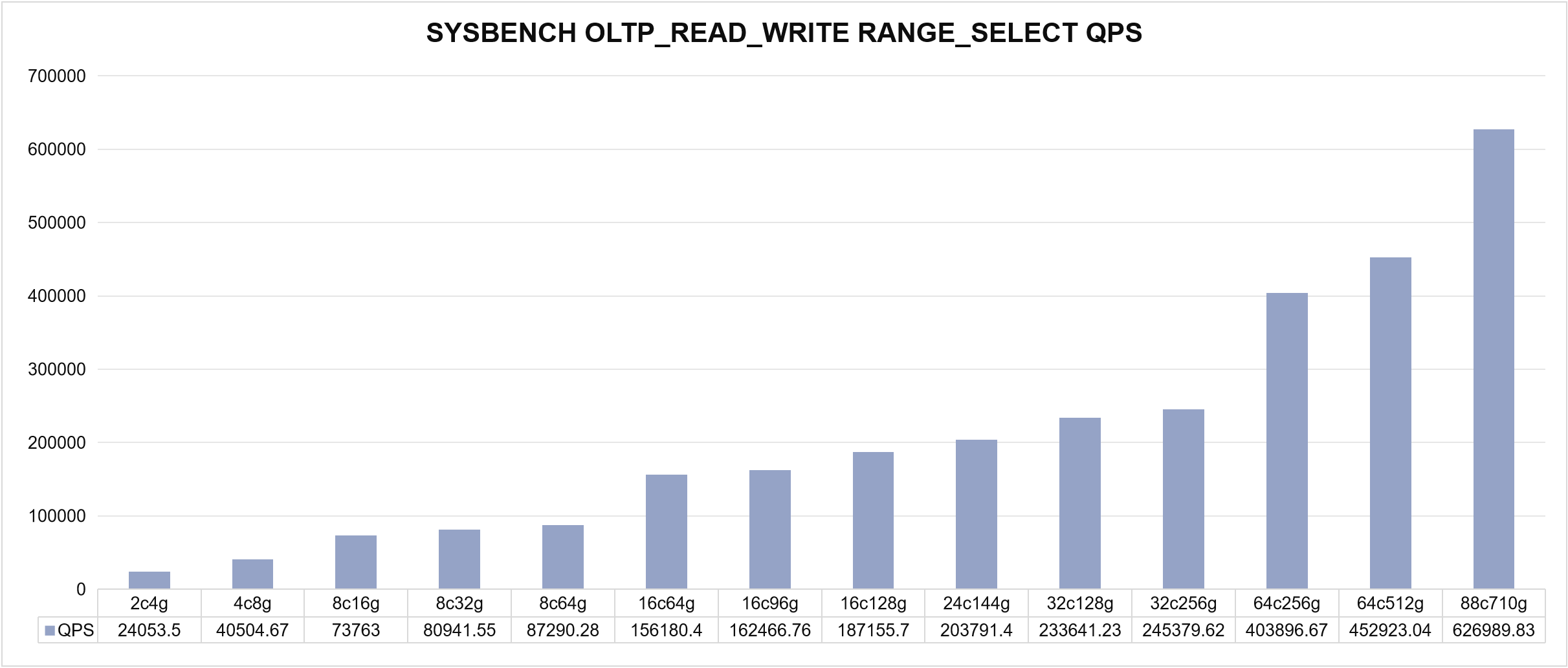
Scenario 3: Mixed Read-Write (range select)


Specifications
Concurrency
Data Volume of a Single Table (table_size)
Total Number of Tables (tables)
QPS
2 cores and 4 GB
64
800000
100
24053.5
4 cores and 8 GB
64
800000
100
40504.67
8 cores and 16 GB
256
800000
300
73763
8 cores and 32 GB
256
800000
300
80941.55
8 cores and 64 GB
128
800000
450
87290.28
16 cores and 64 GB
256
800000
450
156180.4
16 cores and 96 GB
256
800000
600
162466.76
16 cores and 128 GB
256
800000
600
187155.7
24 cores and 144 GB
512
5000000
300
203791.4
32 cores and 128 GB
256
5000000
300
233641.23
32 cores and 256 GB
256
5000000
400
245379.62
64 cores and 256 GB
256
5000000
400
403896.67
64 cores and 512 GB
256
6000000
450
452923.04
88 cores and 710 GB
256
7000000
450
626989.83

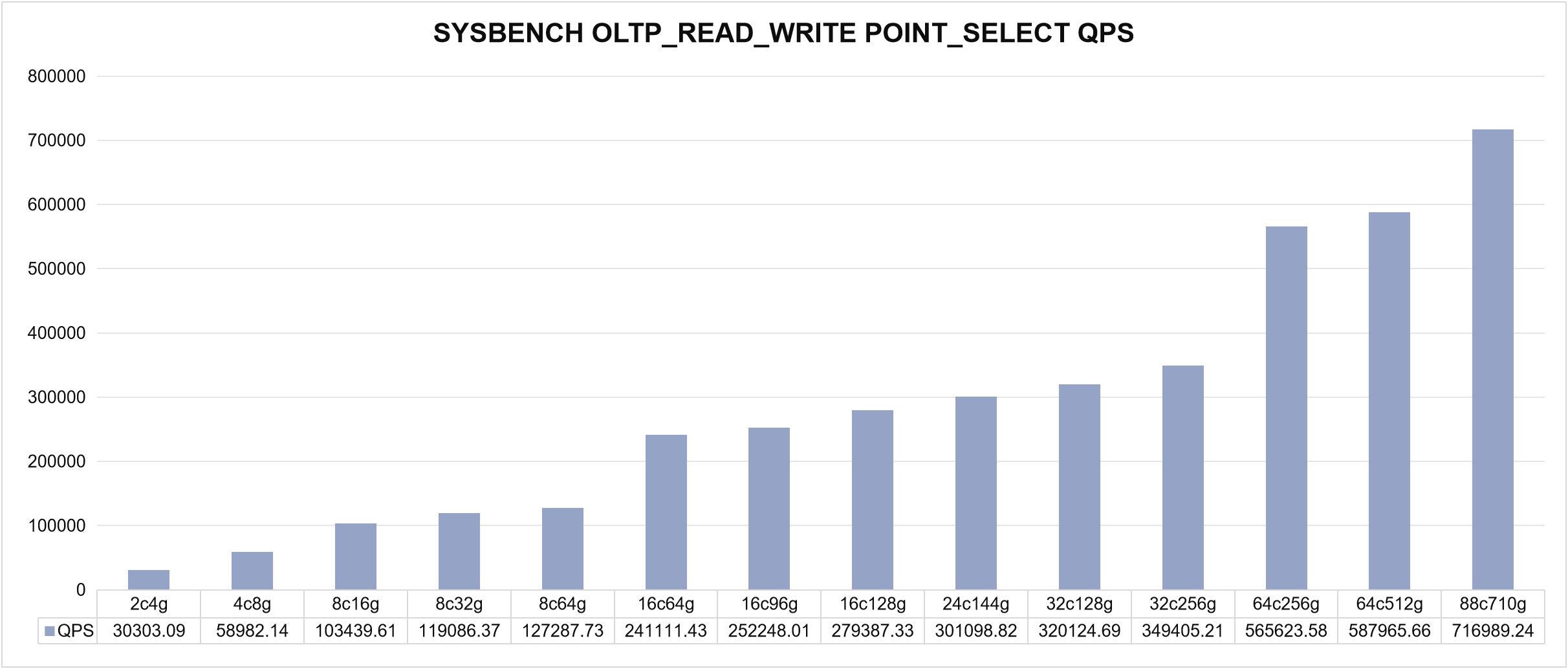
Scenario 4: Mixed Read-Write (point select)


Specifications
Concurrency
Data Volume of a Single Table (table_size)
Total Number of Tables (tables)
QPS
2 cores and 4 GB
64
800000
100
30303.09
4 cores and 8 GB
128
800000
100
58982.14
8 cores and 16 GB
256
800000
300
103439.61
8 cores and 32 GB
256
800000
300
119086.37
8 cores and 64 GB
128
800000
450
127287.73
16 cores and 64 GB
256
800000
450
241111.43
16 cores and 96 GB
256
800000
600
252248.01
16 cores and 128 GB
256
800000
600
279387.33
24 cores and 144 GB
256
5000000
300
301098.82
32 cores and 128 GB
256
5000000
300
320124.69
32 cores and 256 GB
256
5000000
400
349405.21
64 cores and 256 GB
512
5000000
400
565623.58
64 cores and 512 GB
512
6000000
450
587965.66
88 cores and 710 GB
64
7000000
450
716989.24

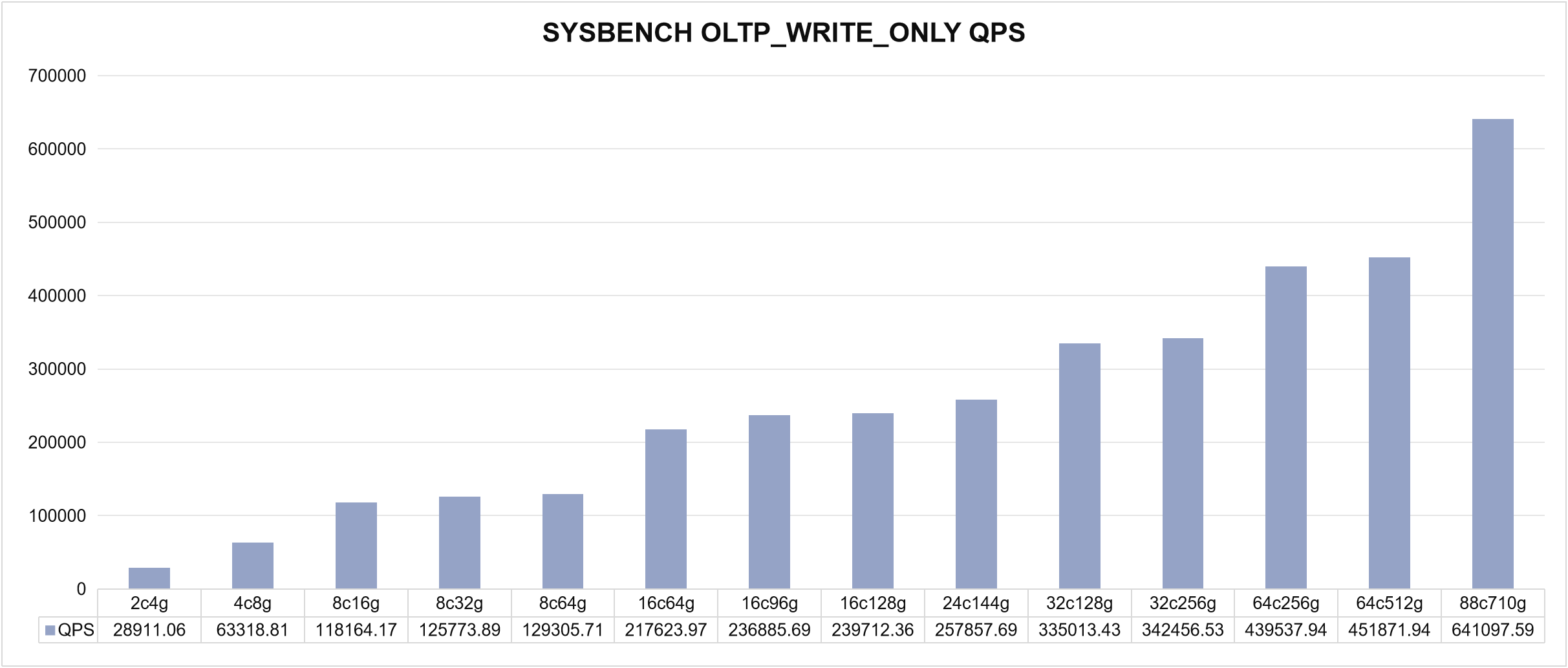
Scenario 5: Write-Only


Specifications
Concurrency
Data Volume of a Single Table (table_size)
Total Number of Tables (tables)
QPS
2 cores and 4 GB
128
800000
100
28911.06
4 cores and 8 GB
128
800000
100
63318.81
8 cores and 16 GB
128
800000
300
118164.17
8 cores and 32 GB
128
800000
300
125773.89
8 cores and 64 GB
256
800000
450
129305.71
16 cores and 64 GB
1024
800000
450
217623.97
16 cores and 96 GB
128
800000
600
236885.69
16 cores and 128 GB
1024
800000
600
239712.36
24 cores and 144 GB
1024
5000000
300
257857.69
32 cores and 128 GB
1024
5000000
300
335013.43
32 cores and 256 GB
1024
5000000
400
342456.53
64 cores and 256 GB
1024
5000000
400
439537.94
64 cores and 512 GB
1024
6000000
450
451871.94
88 cores and 710 GB
1500
7000000
450
641097.59

Help and Support

Was this page helpful?

Help us improve! Rate your documentation experience in 5 mins.

Feedback