tencent cloud

Data Lake Compute

Release Notes
Product Introduction
Overview
Strengths
Use Cases
Purchase Guide
Billing Overview
Refund
Payment Overdue
Configuration Adjustment Fees
Getting Started
Complete Process for New User Activation
DLC Data Import Guide
Quick Start with Data Analytics in Data Lake Compute
Quick Start with Permission Management in Data Lake Compute
Quick Start with Partition Table
Enabling Data Optimization
Cross-Source Analysis of EMR Hive Data
Standard Engine Configuration Guide
Configuring Data Access Policy
Operation Guide
Console Operation Introduction
Development Guide
Runtime Environment
SparkJar Job Development Guide
PySpark Job Development Guide
Query Performance Optimization Guide
UDF Function Development Guide
System Restraints
Client Access
JDBC Access
TDLC Command Line Interface Tool Access
Third-party Software Linkage
Python Access
Practical Tutorial
Accessing DLC Data with Power BI
Table Creation Practice
Using Apache Airflow to Schedule DLC Engine to Submit Tasks
Direct Query of DLC Internal Storage with StarRocks
Spark cost optimization practice
DATA + AI
Using DLC to Analyze CLS Logs
Using Role SSO to Access DLC
Resource-Level Authentication Guide
Implementing Tencent Cloud TCHouse-D Read and Write Operations in DLC
DLC Native Table
SQL Statement
SuperSQL Statement
Overview of Standard Spark Statement
Overview of Standard Presto Statement
Reserved Words
API Documentation
History
Introduction
API Category
Making API Requests
Data Table APIs
Task APIs
Metadata APIs
Service Configuration APIs
Permission Management APIs
Database APIs
Data Source Connection APIs
Data Optimization APIs
Data Engine APIs
Resource Group for the Standard Engine APIs
Data Types
Error Codes
General Reference
Error Codes
Quotas and limits
Operation Guide on Connecting Third-Party Software to DLC
FAQs
FAQs on Permissions
FAQs on Engines
FAQs on Features
FAQs on Spark Jobs
DLC Policy
Privacy Policy
Data Privacy And Security Agreement
Service Level Agreement
Contact Us

Overview

PDF
Focus Mode
Font Size
Last updated: 2025-12-19 16:05:44
Data Lake Compute (DLC) offers agile and efficient data lake analytics and computation services. With its serverless architecture, it is ready to use out of the box. By utilizing standard SQL syntax, it can accomplish data processing and multi-source data joint computation, effectively reducing the cost of setting up and using data analysis services, and enhancing the agility of enterprise data.


Users are not required to perform traditional data layer modeling, significantly reducing the preparation time for massive data analysis. Furthermore, it can be combined with Tencent's big data ecosystem products such as WeData and DataInLong to swiftly construct an enterprise-level, cloud-native, real-time lake computation platform.
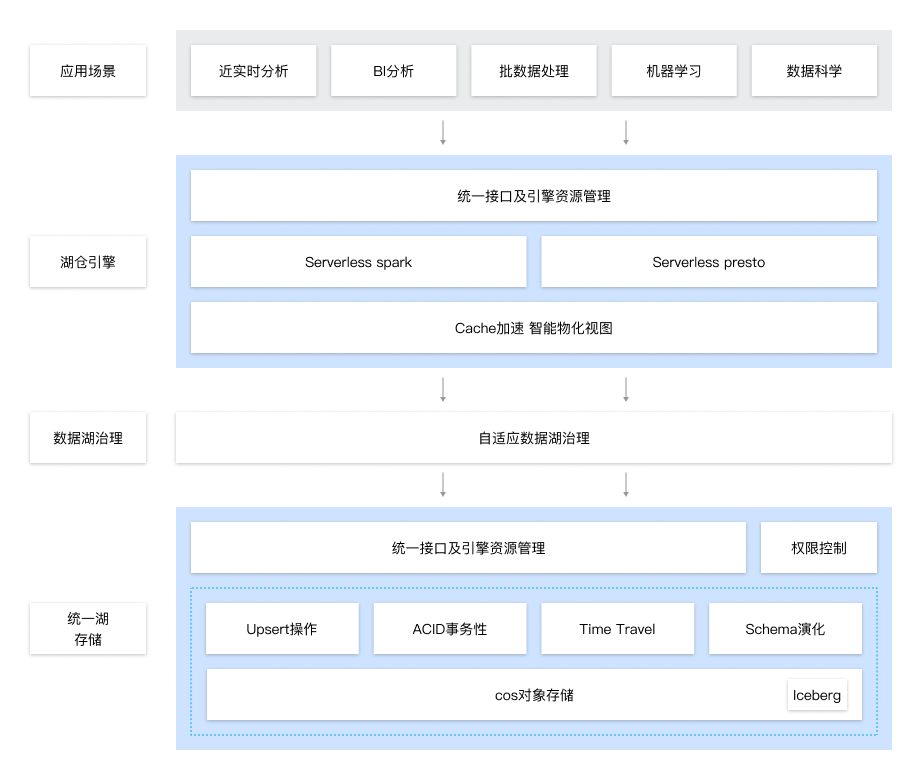
Unified Data Development: Integration with Tencent Cloud's WeData platform for unified integration, development, governance, and application of data lakes.
High-Performance Lakehouse Analysis Engine: Supports both Spark and Presto engines, unifies multi-engine SQL syntax, and accelerates query caching, thereby completing data query analysis more swiftly and efficiently.
Unified Metadata Service: Offers unified metadata management and a comprehensive permission system to meet multi-tenant usage scenarios.
Adaptive Data Governance: Equipped with intelligent lake format governance capabilities, efficiently handling small file merging under stream writing and deletion of expired snapshots from historical versions.
Unified Lake Storage: Data storage enhanced by COS and Iceberg, ensuring ACID transactionality of data and supporting a materialized view cache acceleration layer.

Main Features

Data Exploration: Ready-to-use SaaS-based data lake analysis.

Standard SQL can be used to easily query data lakes, compatible with SparkSQL, eliminating the need to understand the data structure of different data facilities, and assisting customers in seamlessly upgrading from database scenarios to big data scenarios. It also supports joint query analysis of heterogeneous data from multiple sources, including MySQL, EMR Hive(COS), EMR Hive(HDFS), and more.

Data Job: Ultimate elasticity and cost-effective Spark batch processing.

Aimed at big data + AI scenarios, it leverages the batch processing and stream computing capabilities of native Spark to support users in performing complex data processing and ETL operations through data tasks. It supports the management of commonly used dependency packages in machine learning and AI scenarios, swiftly constructing a big data foundation for AI scenarios. Additionally, it possesses a comprehensive data access policy management function, supporting the configuration of data access policies to ensure data security.

Data Management: User-friendly and comprehensive capabilities for holistic governance of data lakes.

Provides a unified metadata management view for data lakes, enabling the creation and editing of the overall data directory of the data lake, as well as the creation, querying, and deletion of database tables and data views, thereby eliminating data silos. It also supports intelligent data governance for backup lake formats. Users need not concern themselves with complex data lake format governance and optimization. DLC will intelligently handle a large number of small files and orphan snapshots generated by frequent fragmented writing, thereby comprehensively enhancing the performance of data lake queries.

Data Engine: Massive scale computation expansion, elastic cost reduction and efficiency enhancement.

Offers flexible and efficient elastic management of Spark and Presto cloud-native computing engines, supports various scaling rules configurations, significantly reduces the comprehensive cost of data lake query analysis, and closely aligns with the actual business usage curve. As a low-cost, highly elastic cloud-native data lake solution, Data Lake Compute empowers businesses to establish unified data assets, maximize performance advantages, and enable agile innovation in business applications.

Help and Support

Was this page helpful?

Help us improve! Rate your documentation experience in 5 mins.

Feedback