tencent cloud

Data Lake Compute

Release Notes
Product Introduction
Overview
Strengths
Use Cases
Purchase Guide
Billing Overview
Refund
Payment Overdue
Configuration Adjustment Fees
Getting Started
Complete Process for New User Activation
DLC Data Import Guide
Quick Start with Data Analytics in Data Lake Compute
Quick Start with Permission Management in Data Lake Compute
Quick Start with Partition Table
Enabling Data Optimization
Cross-Source Analysis of EMR Hive Data
Standard Engine Configuration Guide
Configuring Data Access Policy
Operation Guide
Console Operation Introduction
Development Guide
Runtime Environment
SparkJar Job Development Guide
PySpark Job Development Guide
Query Performance Optimization Guide
UDF Function Development Guide
System Restraints
Client Access
JDBC Access
TDLC Command Line Interface Tool Access
Third-party Software Linkage
Python Access
Practical Tutorial
Accessing DLC Data with Power BI
Table Creation Practice
Using Apache Airflow to Schedule DLC Engine to Submit Tasks
Direct Query of DLC Internal Storage with StarRocks
Spark cost optimization practice
DATA + AI
Using DLC to Analyze CLS Logs
Using Role SSO to Access DLC
Resource-Level Authentication Guide
Implementing Tencent Cloud TCHouse-D Read and Write Operations in DLC
DLC Native Table
SQL Statement
SuperSQL Statement
Overview of Standard Spark Statement
Overview of Standard Presto Statement
Reserved Words
API Documentation
History
Introduction
API Category
Making API Requests
Data Table APIs
Task APIs
Metadata APIs
Service Configuration APIs
Permission Management APIs
Database APIs
Data Source Connection APIs
Data Optimization APIs
Data Engine APIs
Resource Group for the Standard Engine APIs
Data Types
Error Codes
General Reference
Error Codes
Quotas and limits
Operation Guide on Connecting Third-Party Software to DLC
FAQs
FAQs on Permissions
FAQs on Engines
FAQs on Features
FAQs on Spark Jobs
DLC Policy
Privacy Policy
Data Privacy And Security Agreement
Service Level Agreement
Contact Us

Strengths

PDF
Focus Mode
Font Size
Last updated: 2024-09-18 18:01:03

Agility and ease of use

DLC offers a SaaS-based experience that is ready to use without the need for additional selection, installation, or optimization.
Users can easily start data analysis using standard SQL syntax without worrying about complex underlying Ops or performance tuning of data lake.

Cost efficiency

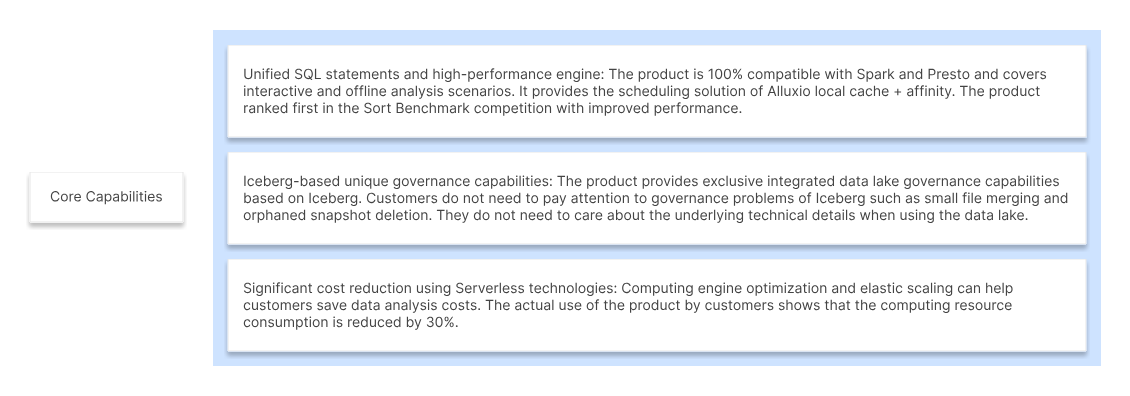
DLC leverages a storage-compute separation architecture for massive big data analysis. Its containerized big data components enable rapid and flexible deployment, while cloud-native COS allows for unlimited scalability and auto scaling.
DLC supports pay-as-you-go billing, reducing the cost of query and analysis. Additionally, using data partitioning or columnar compression formats can further optimize cost savings.

Unified lakehouse architecture

DLC enables unified SQL analysis and batch processing of jobs for cross-lakehouse architecture, fully supporting enterprise-grade BI, machine learning, and data science scenes within a single data lake architecture.
It allows for the flexible construction of EB-level lakehouse storage, supporting large-scale machine learning and near-real-time data warehouse analysis.

Superior performance

Data Lake Compute is serverless, so you don't need to worry about the underlying Ops. The system terminates compute resources after use and scales instantly and dynamically as computing power requirements change.
It comes with high-performance data engines and efficient models to boost the query efficiency. As a cache acceleration solution with zero costs and superior performance, it covers interactive query, batch query, smart analysis, and much more use cases.

Security enhancement

Data Lake Compute adopts Tencent Cloud's mature VPC network isolation technology to ensure that tenants are isolated at the network level.
It further achieves high data reliability and security thanks to Tencent Cloud's superior security enhancement.
It enables fine-grained permission control to make operations more secure.

Data portfolio

Data Lake Compute quickly supports a wide variety of machine learning capabilities to accommodate use cases of one-stop smart data analysis.
It offers visualization capabilities to help you gain data insights through predictive analysis.

Ecosystem integration

Data Lake Compute is seamlessly integrated into Tencent Cloud's data ecosystem for direct access to data stored in COS.
It is compatible with numerous platforms and supports a diversity of upper-layer data applications.


Help and Support

Was this page helpful?

Help us improve! Rate your documentation experience in 5 mins.

Feedback