FAQs
Download
Focus Mode
Font Size
The following are common issues encountered when Big Data Intelligent Agent Workbench DataBuddy is used. If your issue is not covered, see Contact Us to obtain further support.
What Is DataBuddy and Who Is It For?
Big Data Intelligent Agent Workbench DataBuddy is a fully managed, Agent-Native Data + AI integrated data intelligence platform launched by Tencent Cloud. Through its built-in three Agents (engineering / governance / analytics), unified metadata, and unified semantic layer, it evolves big data platforms from "humans operating tools" to "AI doing the work while humans provide oversight."
Core roles that DataBuddy is designed for:
Data Engineers: Build data ingestion, ETL, and workflows
Data Scientists: Train and deploy machine learning models
Data Analysts / Business Users: Query data using natural language and generate analysis reports and dashboards.
Data Administrators: Data governance, quality monitoring, and compliance
Business Owners: Drive the business value of AI initiatives
What Are the Differences Between DataBuddy and Traditional Data Platforms?
Dimension | Traditional data platform | DataBuddy |
Consumer | People | Humans + Agents |
Interaction method | Manual GUI operations and handwritten SQL | Conversation is delivery, and agents complete tasks end to end. |
Data consumption | Scheduled data retrieval and manual report generation | Intelligent data query, AI one-click report and proactive push |
Ops | Manually check logs for troubleshooting | AI intelligent diagnosis (60%+ of issues self-healed by AI) |
Governance | Manually write rules and perform regular inspections | AI autonomous protection (24/7 proactive scanning + remediation) |
How Is DataBuddy Billed?
DataBuddy adopts a license-free + dual billing model. The main billing dimensions include:
Compute resources: measured in CUs (1 vCPU + 4 GB) as the unified billing unit, with support for pay-as-you-go (starting from CNY 0.35/CU/hour) and yearly/monthly subscription (starting from CNY 150/CU/month)
AI Capabilities (Agent): A DataBuddy Agent subscription costs CNY 198/user/month. Additional five-tier credit packs can be purchased for elastic scaling.
Storage and Requests: Lakehouse storage is billed by GB/month plus the number of read/write requests.
Data Governance / Applications: Data catalog, lineage, quality, and security permissions are included in the edition at no additional cost.
Is There a Free Trial? What Are the Trial Limitations?
DataBuddy provides a free trial quota. For details on the trial scope, resource quota, duration, and common restrictions, see Buddy Trial Limitations.
Will My Data Be Deleted After Overdue Payment?
Overdue payments do not immediately delete data. DataBuddy follows Tencent Cloud's standard isolation-to-termination policy. After an account falls into arrears, resources enter an isolated state and retain data. Only when the payment remains overdue beyond the specified period are resources reclaimed. For details, see Overdue Payment Description.
What Data Sources Does DataBuddy Support?
DataBuddy currently supports 47+ data sources across six categories:
Relational Databases: MySQL, PostgreSQL, Oracle, SQL Server, DB2, TDSQL, Doris, and more.
Data Warehouse / Lakehouse: Hive, Iceberg, Hudi, Delta Lake, StarRocks, ClickHouse, TCHouse, and more.
NoSQL / KV: MongoDB, Redis, Elasticsearch, HBase, Cassandra, DynamoDB, and more.
Message Queues / Streaming: Kafka, Pulsar, RocketMQ, MQTT, RabbitMQ, Flink CDC, and more.
File / Object Storage: HDFS, COS, S3, GCS, Azure Blob, FTP, SFTP
API / Multimodal: REST API, images, videos, PDFs, and more.
It also supports five ingestion solutions: offline synchronization, real-time synchronization, file-to-Table, file-to-Volume, and batch-to-Volume.
Do We Need to Migrate Data to Use DataBuddy if Our Enterprise Already Has a Data Warehouse/OLAP Engine?
No, it is not required. DataBuddy supports three ingestion solutions:
1. Full-Stack Data Lake: Build a new data platform with data ingested into lakehouse storage + DataBuddy compute + three Agents.
2. Federated Analysis: Unified management of full-stack data lake + customer data sources, enabling federated analysis without data movement.
3. Direct Analysis: Connect directly to existing customer OLAP engines through a semantic layer, introducing only the Agent intelligent analysis capability.
For a comparison of the applicable scenarios and capabilities of the three solutions, see Application Scenarios.
Can DataBuddy Agent Misoperate Data? How Is Security Ensured?
DataBuddy Agent has built-in multi-layered security protection, covering all risks in the OWASP LLM Top 10:
Prompt Injection Detection: Detects and blocks attack chains in real time to prevent conversations from hijacking Agent behavior.
Strong OBO Permission Binding: The Agent uses the real user identity and reuses the underlying data platform permissions, preventing privilege escalation.
High-Risk SQL Interception + Intent Validation: Performs high-risk assessment and intent alignment before execution.
"Three-Element" Precise Interception: Triggers human confirmation when "untrusted input + state change + sensitive data" are simultaneously present.
Automatic Sensitive Data Masking: AI-powered automatic identification and dynamic masking, with full-chain auditing of Token consumption and access.
How Is Permission Isolation Implemented for Different Roles (Analysts/Engineers/Administrators)?
DataBuddy adopts a two-layer permission model:
Role Permission Points (Project-Level): Preset roles (Admin / Run / View / None) + custom permission points.
Object ACL (Object-Level): Three-level cascading across files, workflows, data sources, and Catalog / Schema / Table.
Authorization for users and user groups is supported. Assets without permissions are grayed out but visible and requestable in the UI. For details, see Member and Permission Management.
What Is the Service Availability SLA for DataBuddy? What Should I Do if It Is Not Met?
DataBuddy commits to service availability of no less than 99.5%. If a service fails to meet the monthly target (except for cases under the exemption clauses), you can submit a ticket to apply for voucher compensation, which is divided into three tiers:
Service availability Av | Compensation voucher |
99.5% > Av ≥ 98% | 10% of the monthly service fee |
98% > Av ≥ 95% | 25% of the monthly service fee |
Av < 95% | 100% of the monthly service fee |
Compensation requests must be submitted through the ticket system within 60 calendar days after the end of the month in which the service failed to meet the target. For complete terms and application material requirements, see Service Level Agreement.
How to Quickly Troubleshoot Task Failures?
DataBuddy provides a four-layer operational monitoring view + AI-powered intelligent diagnosis:
Four-Layer Monitoring: Workflow run list → run records → run details (DAG / list / Gantt chart) → task run details (results / logs / task insights / Spark UI)
AI-Powered Intelligent Diagnosis: Automatically outputs four-dimensional information → instance information → root cause analysis → impact scope → repair suggestions.
Multi-Channel Alarms: Email / Webhook / WeCom / Teams / Slack
One-Click Rerun: If an upstream task fails, the root cause task can be automatically identified and rerun with one click.
For data ingestion issues, DataBuddy Agent also provides AI-powered root cause analysis with an average time of 1.2 seconds, and 60%+ of issues can be self-healed by AI.
How to Resolve the Issue Where a Sub-Account Cannot Activate DataBuddy?
When a sub-account attempts to activate DataBuddy, it may encounter the following no-permission situations:
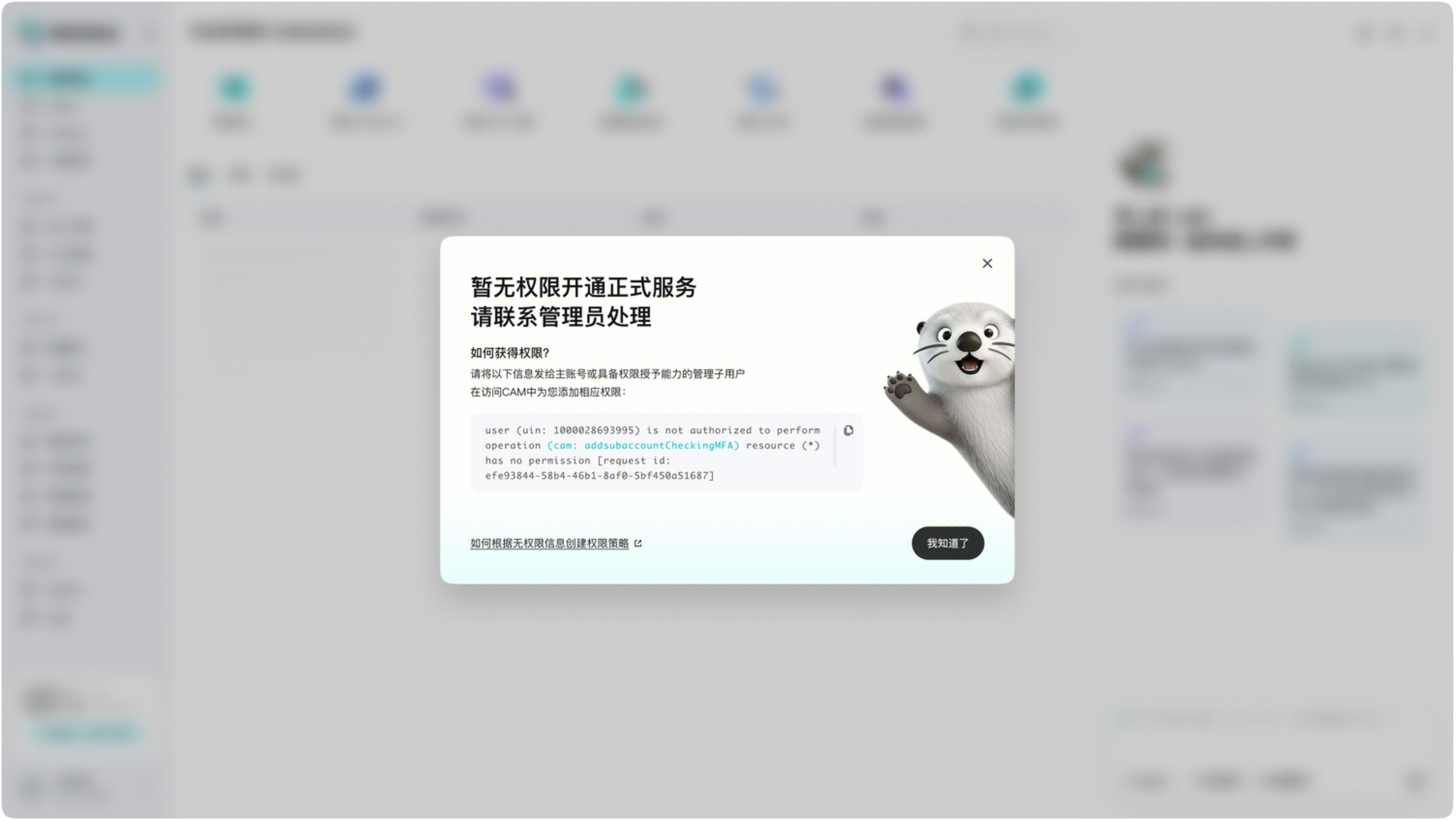
This is because activating DataBuddy requires creating a service role to access other original products (such as various engines and data sources).
A sub-account does not have the permission to submit execution tasks to DLC clusters. The root account or a sub-account with higher administrative permissions should follow the steps below to grant the preset policy QcloudCamSubaccountsAuthorizeRoleFullAccess to the sub-account:
Step | Operation Content |
1. Select a sub-account. | 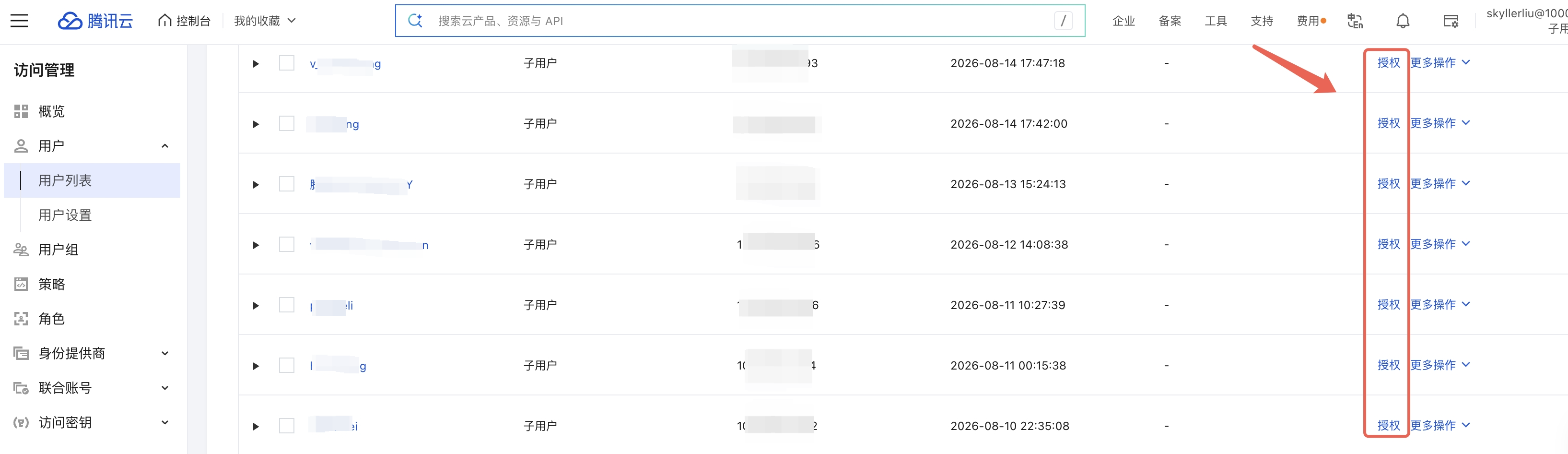 |
2. Authorize the preset policy. | Search for the preset policy name "QcloudCamSubaccountsAuthorizeRoleFullAccess" to complete authorization. Note: Note: This policy contains all permissions required for a sub-account to authorize service roles. Grant it with caution. 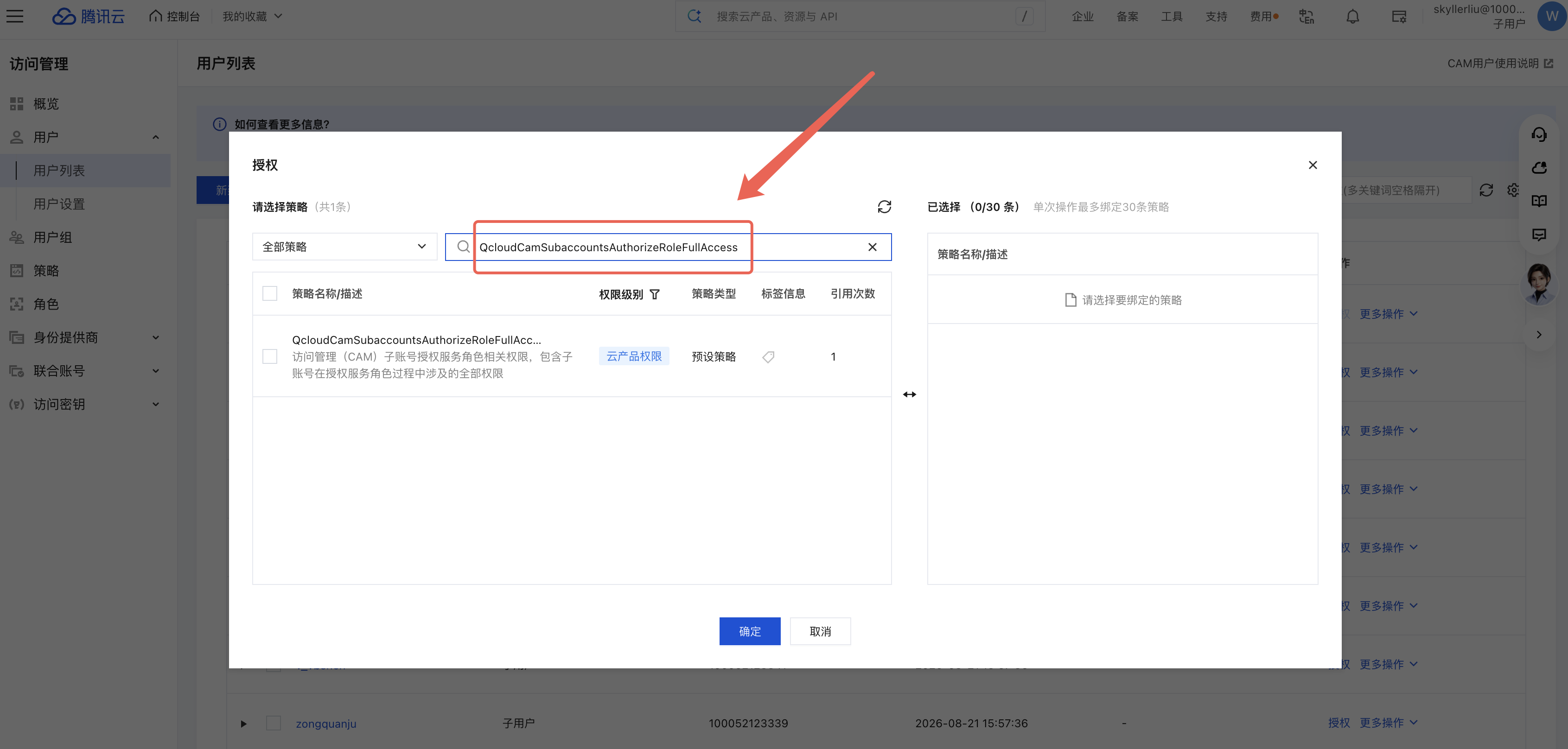 Notify the sub-account to try the operation again after authorization. |
How to Resolve the Issue Where a Sub-Account Cannot Execute Data Lake Compute (DLC) Tasks?
When a sub-account submits tasks through Data Lake Compute (DLC) resource groups, such as job clusters or interactive clusters, the following permission issues may occur:
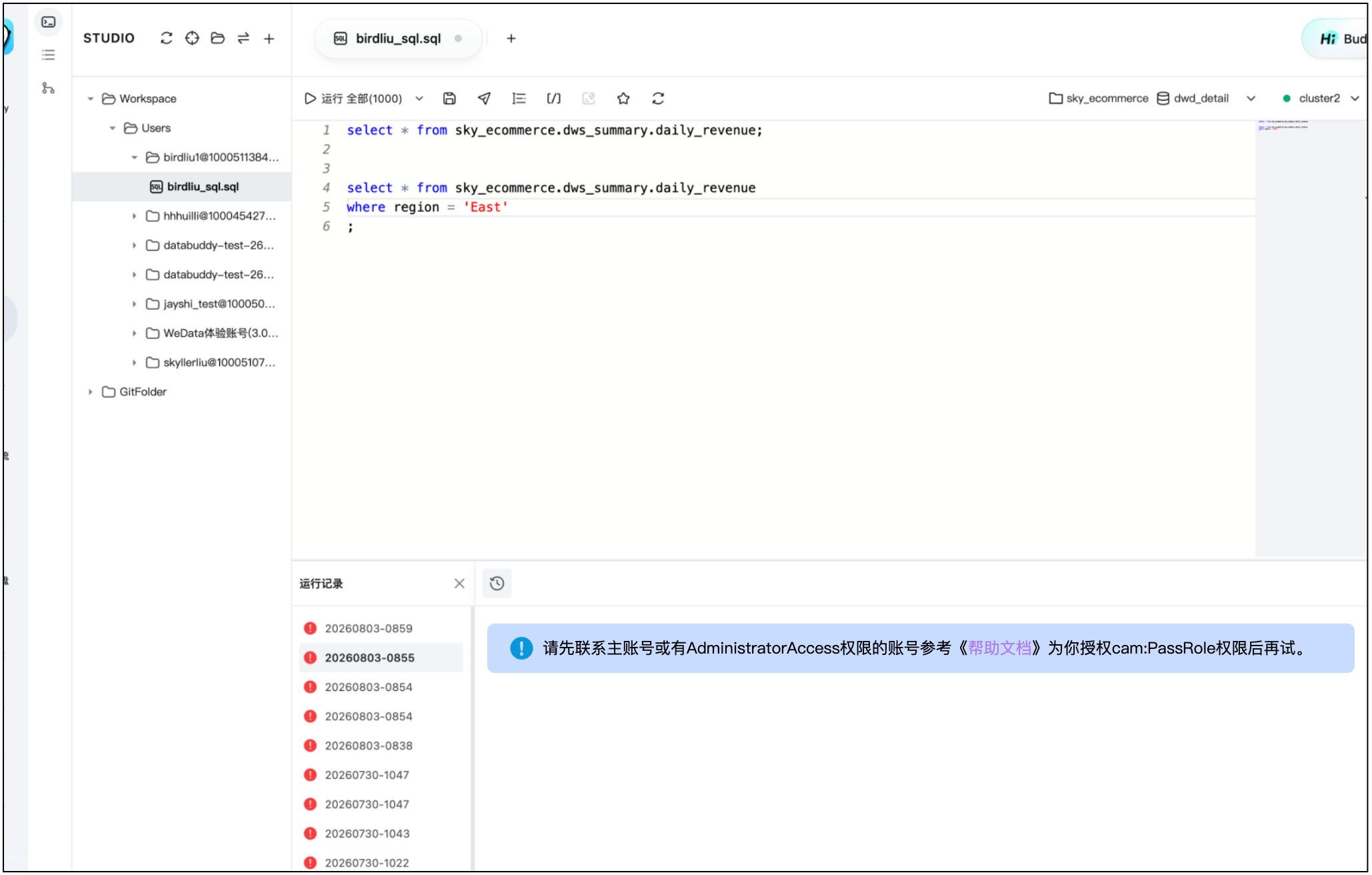
This occurs because the sub-account lacks the permission to submit tasks to DLC clusters through DataBuddy. The root account or a sub-account with higher permissions must grant the pass role permission to it. Follow the steps below:
Step | Operation Content |
1. Create a custom policy. | 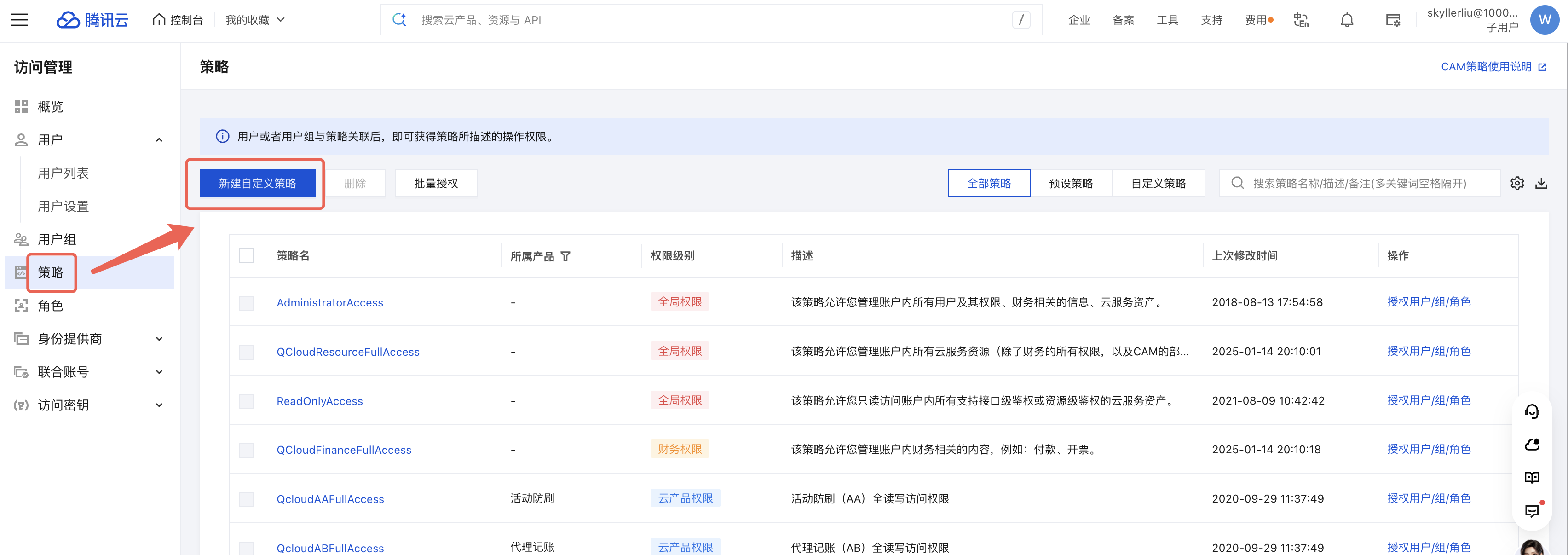 Fill in the following JSON in the policy content:
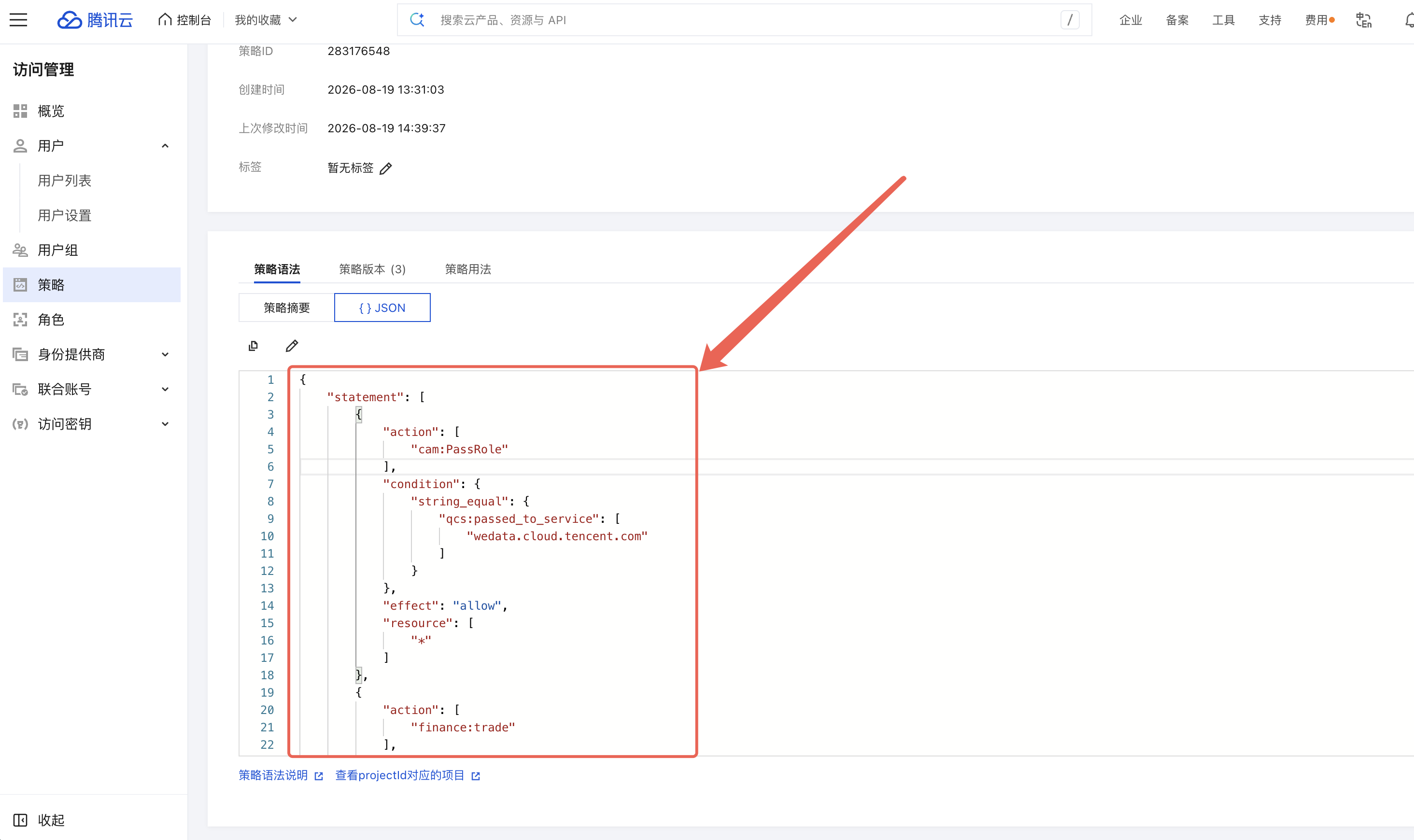 Then name the custom policy: 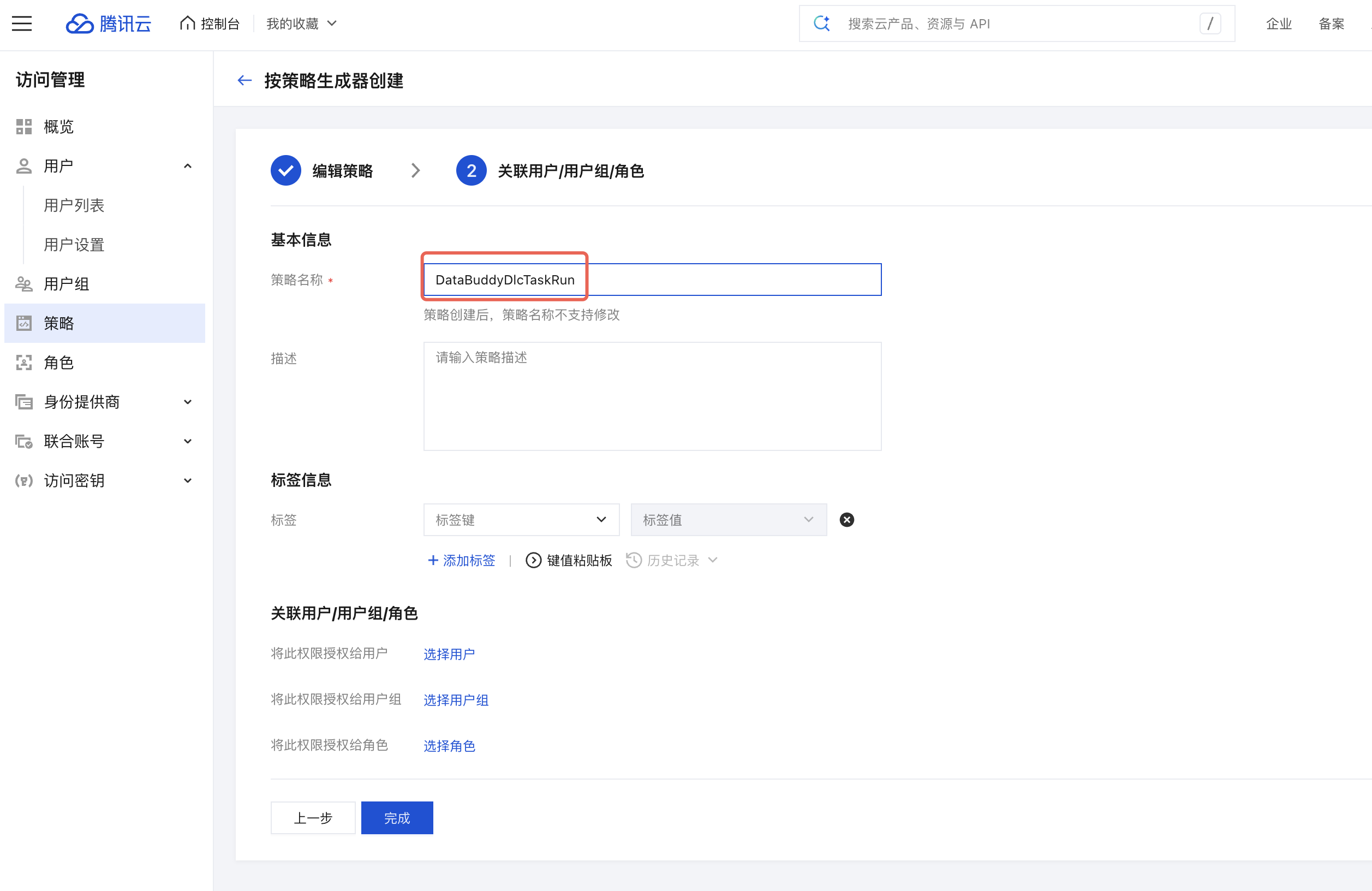 You can also authorize directly on this page (optional): 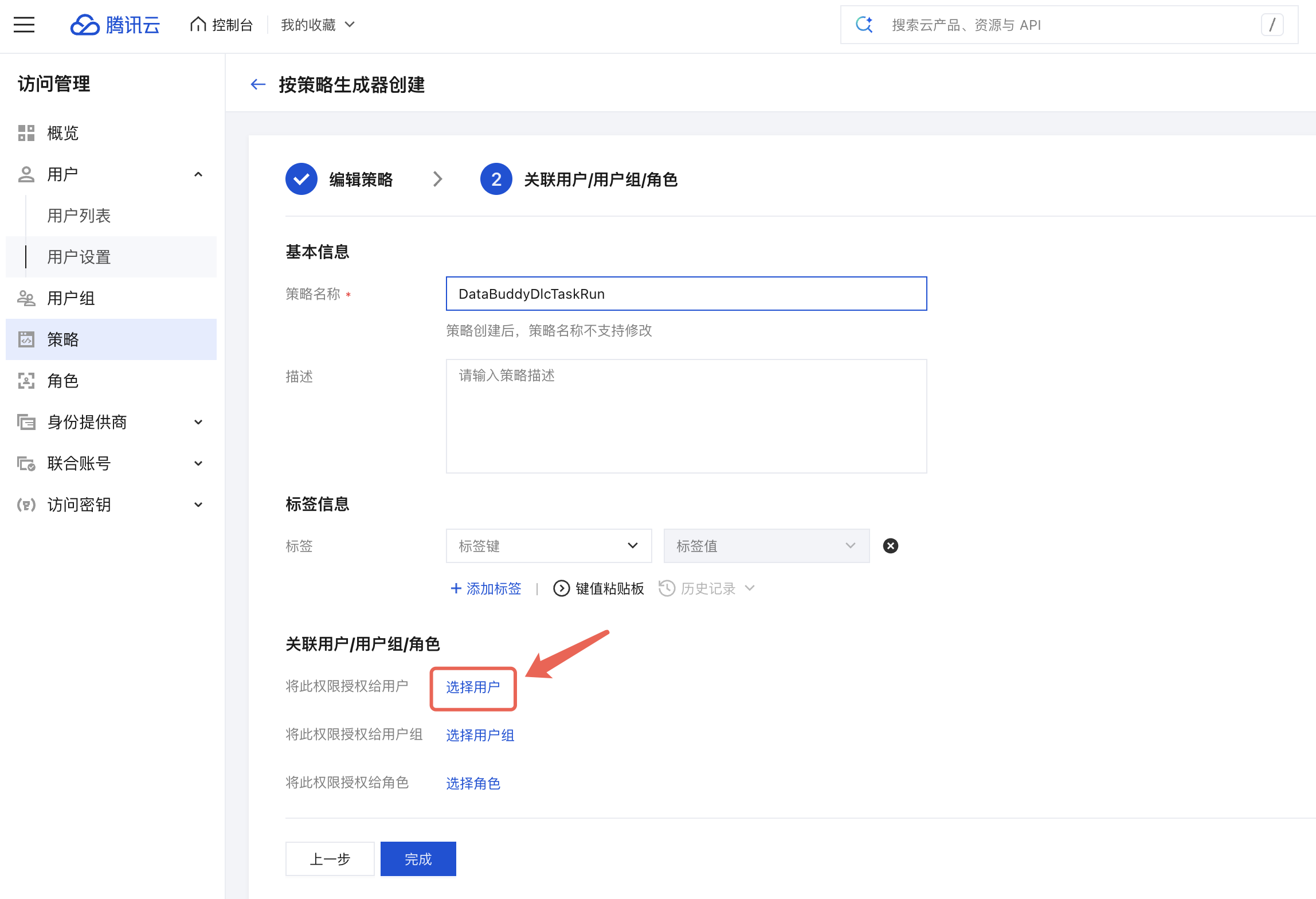 |
2. Select a sub-account. | Go to the user list page, find the sub-account to authorize, and click Authorize. 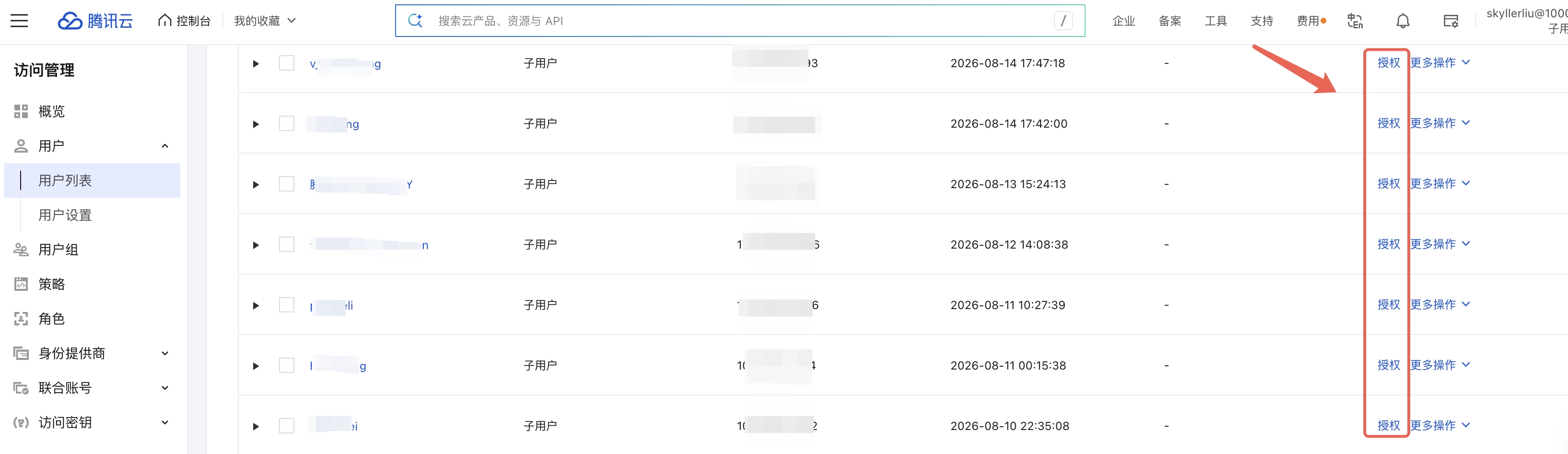 |
3. Authorize the preset policy. | Search for the custom policy name to complete authorization: 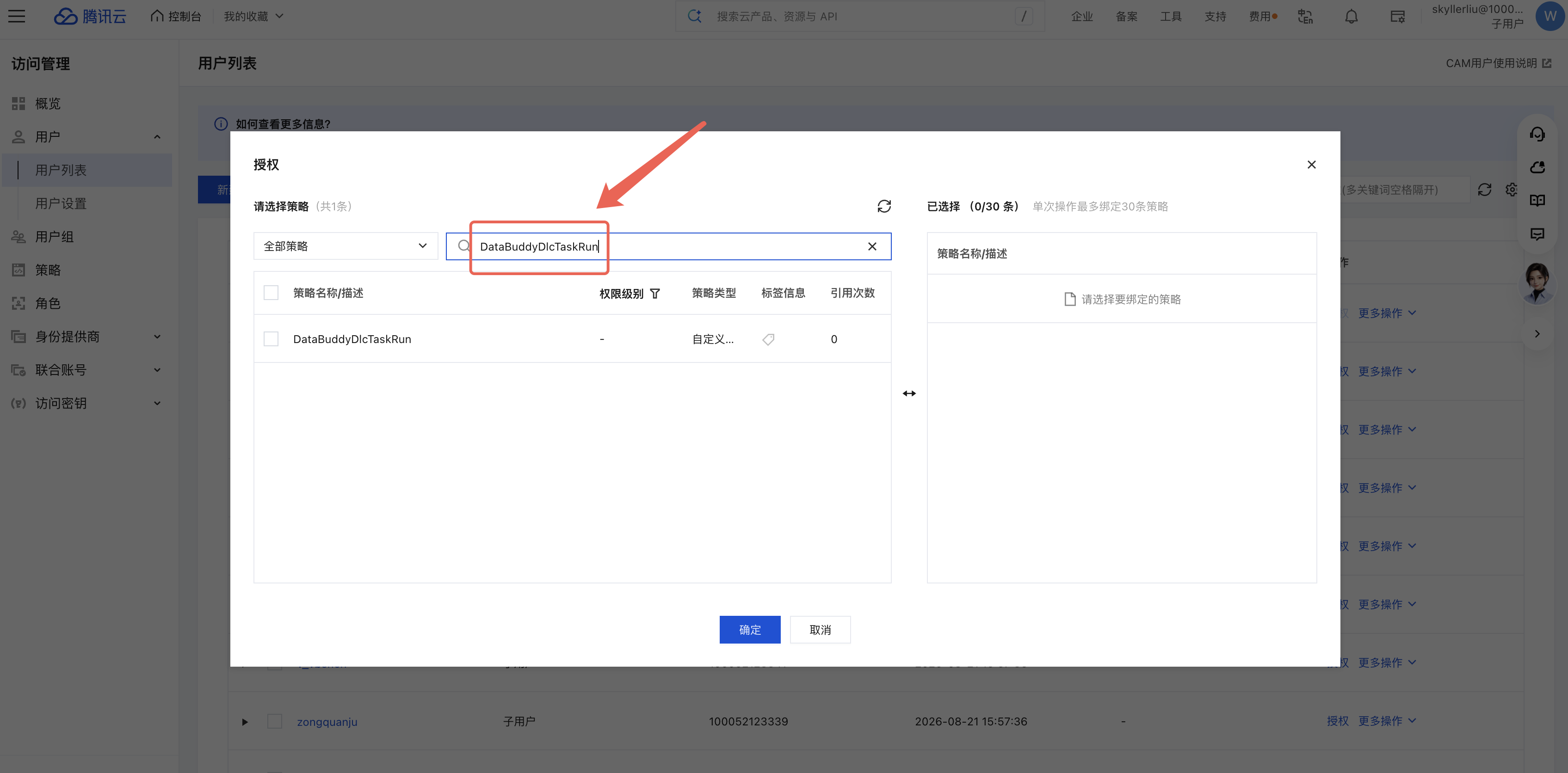 After authorization is completed, notify the sub-account to try the operation again. |
Help and Support
Was this page helpful?
You can also Contact sales or Submit a Ticket for help.
Help us improve! Rate your documentation experience in 5 mins.
Feedback