tencent cloud

Content Delivery Network

Updates and Announcements
Release Notes
Announcements
User Tutorial
Product Introduction
Product Overview
Strengths
Use Cases
Term
Use Limits
CDN Performance Descriptions (Spot-check)
Purchase Guide
CDN Purchase Guide
ECDN Purchase Guide
Getting Started
Configuring CDN from Scratch
Adding Domain Names
CNAME Configuration
Domain Name Ownership Verification
FAQs about Domain Name Connection
Configuration Guide
Domain Management
Domain Name Configurations
Statistical Analysis
Purge and Prefetch
Log Management
EdgeOne
Service Query
Offline Cache
Permission Management
Permission Configuration
Console Permissions
Activate Real-time Logging as Sub-account/Collaborator
Use Cases
Accelerating Resources on COS with CDN
Practical Tutorial
Guide to Using the EdgeOne Tool for Migrating Content Delivery Network (CDN) Related Services
CDN - CVM
CDN - COS
Configuring CNAME via DNSPod
Regularly Storing CDN Logs
API Documentation
History
Introduction
API Category
Content Management APIs
Real-time Log APIs
Service Query APIs
Data Query APIs
Making API Requests
Log Query APIs
StopCdnDomain
Configuration Management APIs
Obsoleted APIs
Other APIs
Data Types
Error Codes
FAQ
Features
Billing
FAQs about Domain Name Connection
Cache Configuration FAQs
Purge and Prefetch
Statistical Analysis
FAQs about HTTPS
Connection
Errors
Troubleshooting Methods
Status Codes and Solutions
Node Cache Inconsistency
Slow Access Speed After CDN Activation
Low Traffic Hit Rate
404 Status Code
Page Display - CORS error
Resource Cache Failure
Service Level Agreement
Glossary

HTTPS Configuration

PDF
Focus Mode
Font Size
Last updated: 2024-12-30 21:39:37
If you need to configure an existing certificate for your domain name, please see below. If the certificate you configure is from Tencent Cloud SSL Certificates Service, you can skip this step.

Uploading Certificate

Generally, CAs provide the following types of certificates, and Nginx is used by CDN. Enter the Nginx folder, use a text editor to open ".crt" (certificate) and ".key" (private key) files, and view the content of the certificate and private key in PEM format.

Certificate

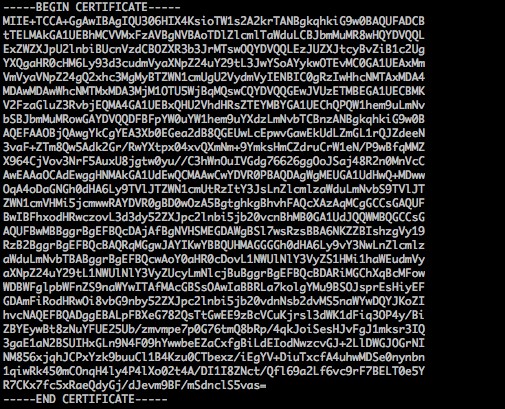
Common certificate extensions include ".pem", ".crt", and ".cer". Open the certificate file in a text editor and you can see content similar to the one shown below. A ".pem" certificate begins with "-----BEGIN CERTIFICATE-----" and ends with "-----END CERTIFICATE-----". Every line in between contains 64 characters, while the last line may have less than 64 characters:
img

If your certificate is issued by an intermediate CA, your certificate file will consist of multiple certificates. In this case, you need to manually splice the server certificates and intermediate certificates for upload by putting the server certificate content before the intermediate certificate content without any blank lines in between. Please refer to the rules or instructions that came with the certificate.
There should be no blank lines between the certificates
All certificates are in PEM format
A certificate chain from an intermediate CA comes in this format:
-----BEGIN CERTIFICATE-----
-----END CERTIFICATE-----
-----BEGIN CERTIFICATE-----
-----END CERTIFICATE-----
-----BEGIN CERTIFICATE-----
-----END CERTIFICATE-----

Private key

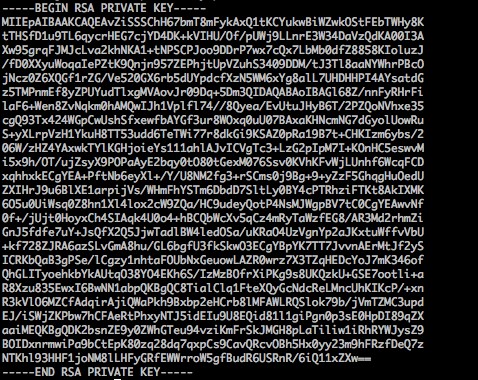
Common private key extensions include ".pem" and ".key". Open the private key file in a text editor and you will see content similar to the one shown below. A ".pem" private key begins with "-----BEGIN RSA PRIVATE KEY-----" and ends with "-----END RSA PRIVATE KEY-----". Every line in between contains 64 characters, while the last line may have less than 64 characters.
img

If your private key begins with "-----BEGIN PRIVATE KEY-----" and ends with "-----END PRIVATE KEY-----", we recommend you convert the format using OpenSSL with the following command:
openssl rsa -in old_server_key.pem -out new_server_key.pem

Converting other formats to PEM

Currently, CDN only supports certificates in PEM format. Certificates in other formats need to be converted to PEM format. We recommend you use OpenSSL. The following shows how to convert some common formats to PEM.

DER to PEM

DER format is generally used on Java platforms. Certificate conversion:
openssl x509 -inform der -in certificate.cer -out certificate.pem
Private key conversion:
openssl rsa -inform DER -outform PEM -in privatekey.der -out privatekey.pem

P7B to PEM

P7B format is generally used on Windows Server and Tomcat. Certificate conversion:
openssl pkcs7 -print_certs -in incertificat.p7b -out outcertificate.cer
Open outcertificat.cer with a text editor to view the content of the PEM certificate. Private key conversion: private keys can generally be exported on IIS servers.

PFX to PEM

PFX format is generally used on Windows Server. Certificate conversion:
openssl pkcs12 -in certname.pfx -nokeys -out cert.pem
Private key conversion:
openssl pkcs12 -in certname.pfx -nocerts -out key.pem -nodes

Completing certificate chain

When configuring a private certificate, you may encounter an issue that the certificate chain cannot be completed, as shown below.
In this case, you can paste the certificate content (in PEM format) issued by the CA after the domain name certificate (in PEM format) to complete the certificate chain. You can also submit a ticket for assistance.

Hosted Certificate

Tencent Cloud provides a certificate hosting service: SSL Certificates Service. You can upload existing certificates to SSL Certificates Service Console for unified hosting and deployment on other Tencent Cloud products. It also allows you to purchase and apply for certificates.
SSL Certificates Service provides you with 20 DV SSL certificates issued by TrustAsia free of charge.

Help and Support

Was this page helpful?

Help us improve! Rate your documentation experience in 5 mins.

Feedback