Managing disaster recovery instances
Download
Focus Mode
Font Size
Scenarios
For scenarios that require strong business continuity, data reliability, or regulatory compliance, TencentDB for MySQL provides cross-region disaster recovery instances to help users improve business continuity at a lower cost while enhancing data reliability.
Note:
The fees for a disaster recovery instance are the same as those for the primary instance. For more information, see Product Pricing.
Feature Characteristics
A dedicated database connection address is provided. The disaster recovery instance can provide read access for scenarios such as nearby access and data analysis, with low device redundancy costs.
The primary/secondary high availability architecture is used to eliminate the single point of failure risk for the database.
Data is synchronized to the disaster recovery instance over a private network dedicated line, providing lower synchronization latency and higher stability. The synchronization link quality is far superior to that of the public network.
Currently, the direct connection traffic is free during the promotion period, and the time for commercial charges will be announced separately.
How It Works
When TencentDB is used as a disaster recovery database, the disaster recovery instance serves as a replicated backup of the primary instance database.
When the primary instance changes, the log information that records the modifications is replicated to the disaster recovery instance. Data synchronization is then achieved through log replay.
If the primary instance fails, the disaster recovery instance can be activated within seconds to restore full read/write functionality.
Feature Limits
Creating disaster recovery instances is not supported for single-node instances.
A primary instance supports the creation of up to 4 disaster recovery instances.
Disaster recovery instances can only be purchased for primary instances that meet the following requirements: 1 GB memory or above, 50 GB disk or above, MySQL 5.6 or later (for MySQL 5.6, you need to submit a ticket to apply for this feature), the InnoDB engine, and the two-node, three-node, four-node, or cloud disk architecture. If your primary instance does not meet these requirements, upgrade it first.
The minimum specifications for a disaster recovery instance are 1 GB memory and 50 GB disk, and the storage capacity must be at least 1.1 times the used storage of the primary instance.
The following features are not currently supported for disaster recovery instances: project transfer, rollback, SQL operations, character set change, account management, port change, data import, rollback logs, and read-only instances.
Creating a Disaster Recovery Instance
1. Log in to the MySQL console. In the instance list, click Instance ID or Manage in the Operation column to go to the details page.
2. In the instance architecture diagram on the instance details page, click Add Disaster Recovery Instance to go to the page for purchasing a disaster recovery instance.
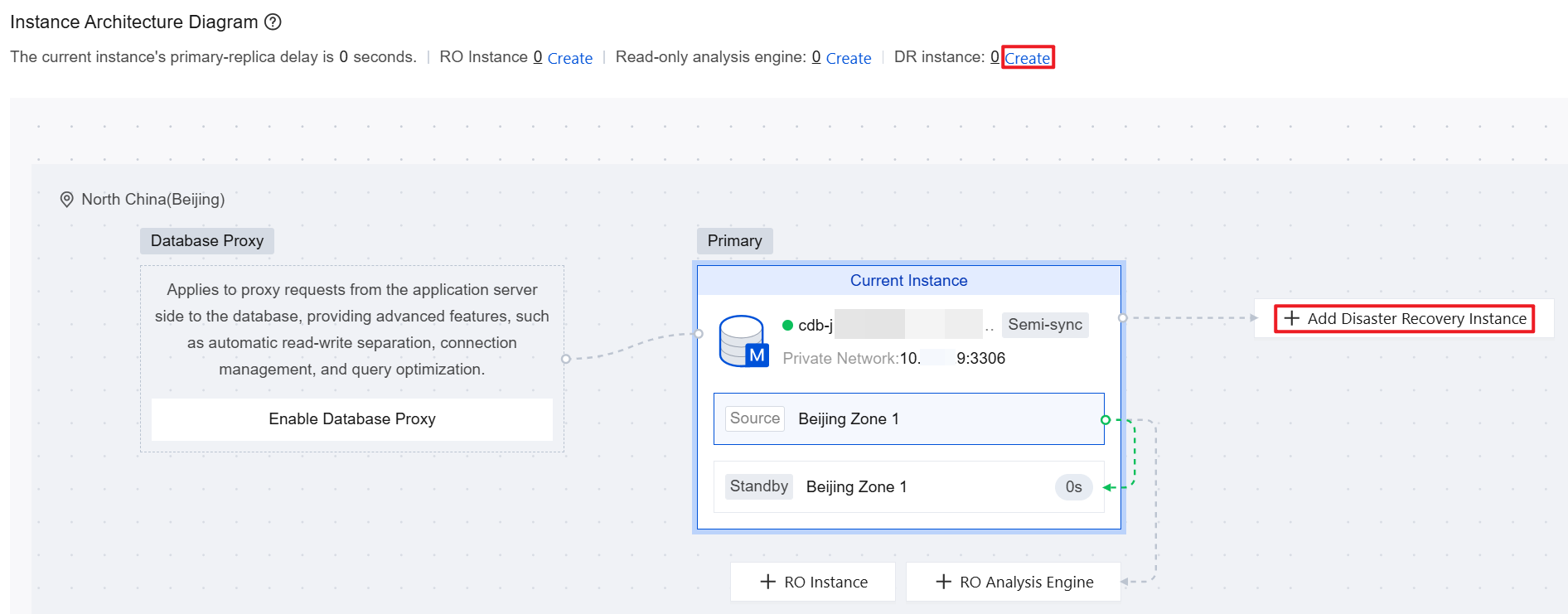
3. On the purchase page, configure the basic information of the disaster recovery instance, such as Billing Mode and Region.
Note:
The creation duration is affected by the data volume. During this period, the console operations on the primary instance will be locked. You need to plan accordingly.
The synchronization policy is immediate synchronization, which means data is synchronized immediately after the disaster recovery instance is created.
Currently, only data synchronization for the entire instance is supported. Ensure that you have sufficient disk space.
Ensure that the primary instance is in the Running state and that no instance-related change tasks, such as specification adjustment or restart, are in progress. Otherwise, the synchronization task may fail.
4. After confirming that the information is correct, click Buy Now and wait for the disaster recovery instance to be delivered.
5. Return to the instance list. After the instance status changes to Running, you can proceed with subsequent operations.
Managing disaster recovery instances
View a disaster recovery instance
Disaster recovery instances can be viewed in the region where they reside. You can filter out all disaster recovery instances in that region from the instance list.
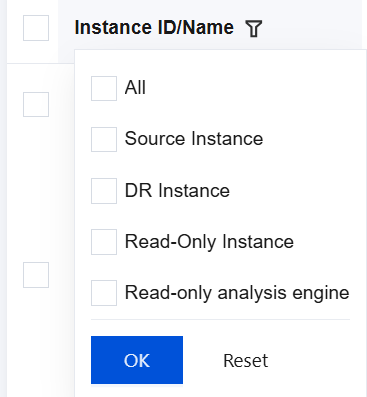
View the relationship
Click the icon to the right of each disaster recovery instance or primary instance to view the subordination.
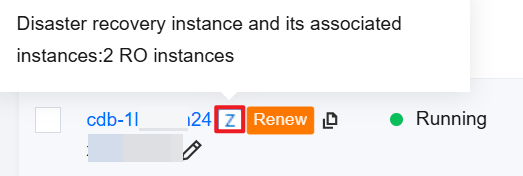
View sync delay
You can view the synchronization delay between the primary instance and the disaster recovery instance in the Instance Architecture Diagram section on the Instance Details page.

Disaster recovery instance features
The disaster recovery instance provides the following features: instance details, instance monitoring, parameter settings, database management, security groups, backup and recovery, log center, data security, and connection check.
Promoting a Disaster Recovery Instance to Primary Instance
When you need to switch the disaster recovery instance to the primary instance, you can proactively perform the switch in the console.
Attention:
After a disaster recovery instance is promoted to the primary instance, it takes over as the new primary instance. The access address of the new primary instance changes, so you need to configure the new access address on the application side. The original primary instance no longer handles existing workloads.
After a disaster recovery instance is switched to the primary instance, the synchronization connection with the original primary instance will be disconnected. Once disconnected, the synchronization connection cannot be re-established. Proceed with caution.
1. In the instance list, select the disaster recovery instance that you want to promote to the primary instance, and click its Instance ID to go to the instance management page.
2. On the instance management page, click Promote to Source Instance in the upper-right corner to promote the disaster recovery instance to the primary instance. After the switch, the synchronization connection with the original primary instance will be disconnected, and the instance will regain database data write capabilities and full MySQL features.

Help and Support
Was this page helpful?
You can also Contact sales or Submit a Ticket for help.
Help us improve! Rate your documentation experience in 5 mins.
Feedback