Template deployment - quick deployment of Egg project
1. Log in to the SCF console and click Function Service on the left sidebar.
2. Select the region where to create a function at the top of the page and click Create to enter the function creation process.
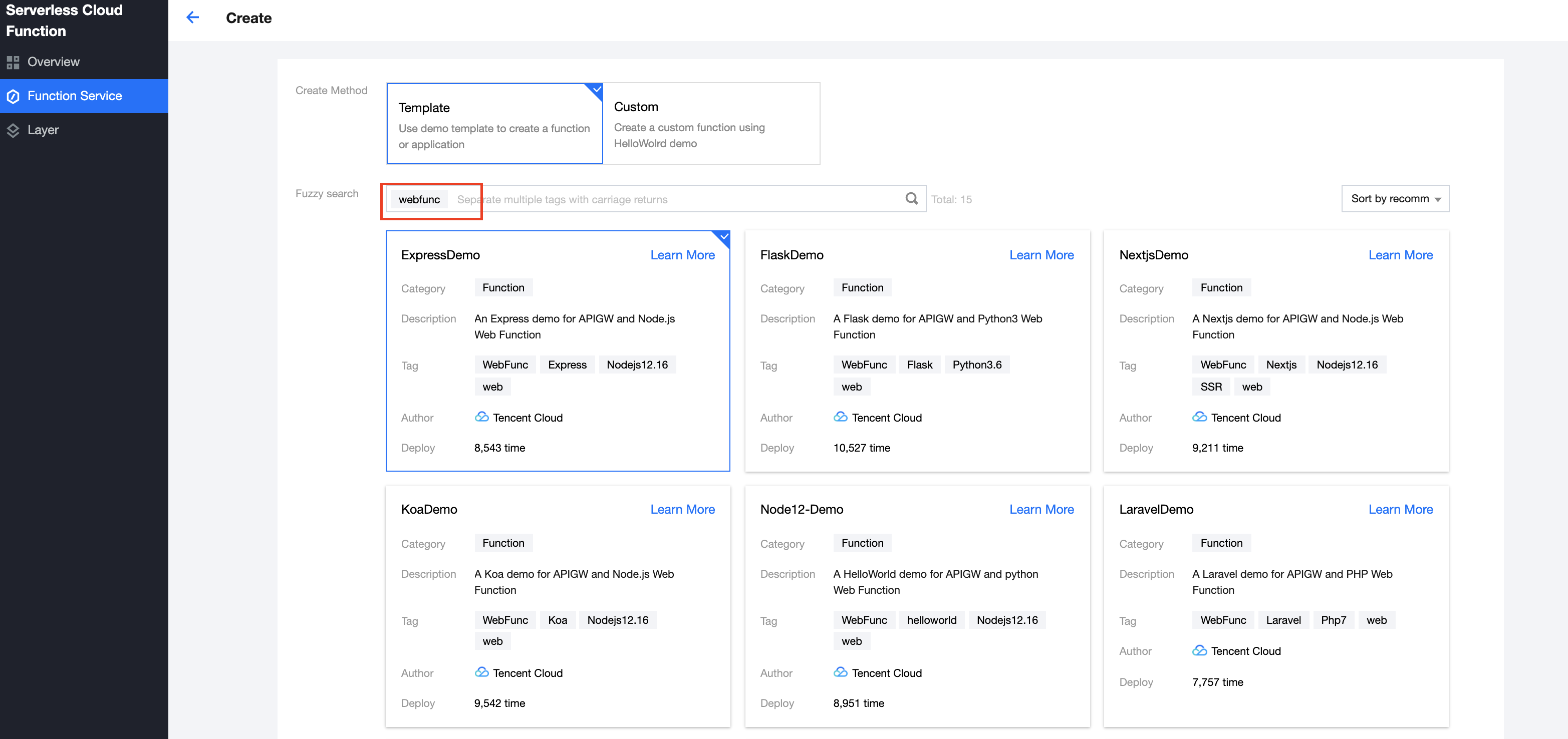
3. Select Template for Creation Method, enter Egg in the search box to filter function templates, select Egg Framework Template, and click Next as shown below:
4. On the Configuration page, you can view and modify the specific configuration information of the template project.
5. Click Complete. After creating the web function, you can view its basic information on the Function Management page.
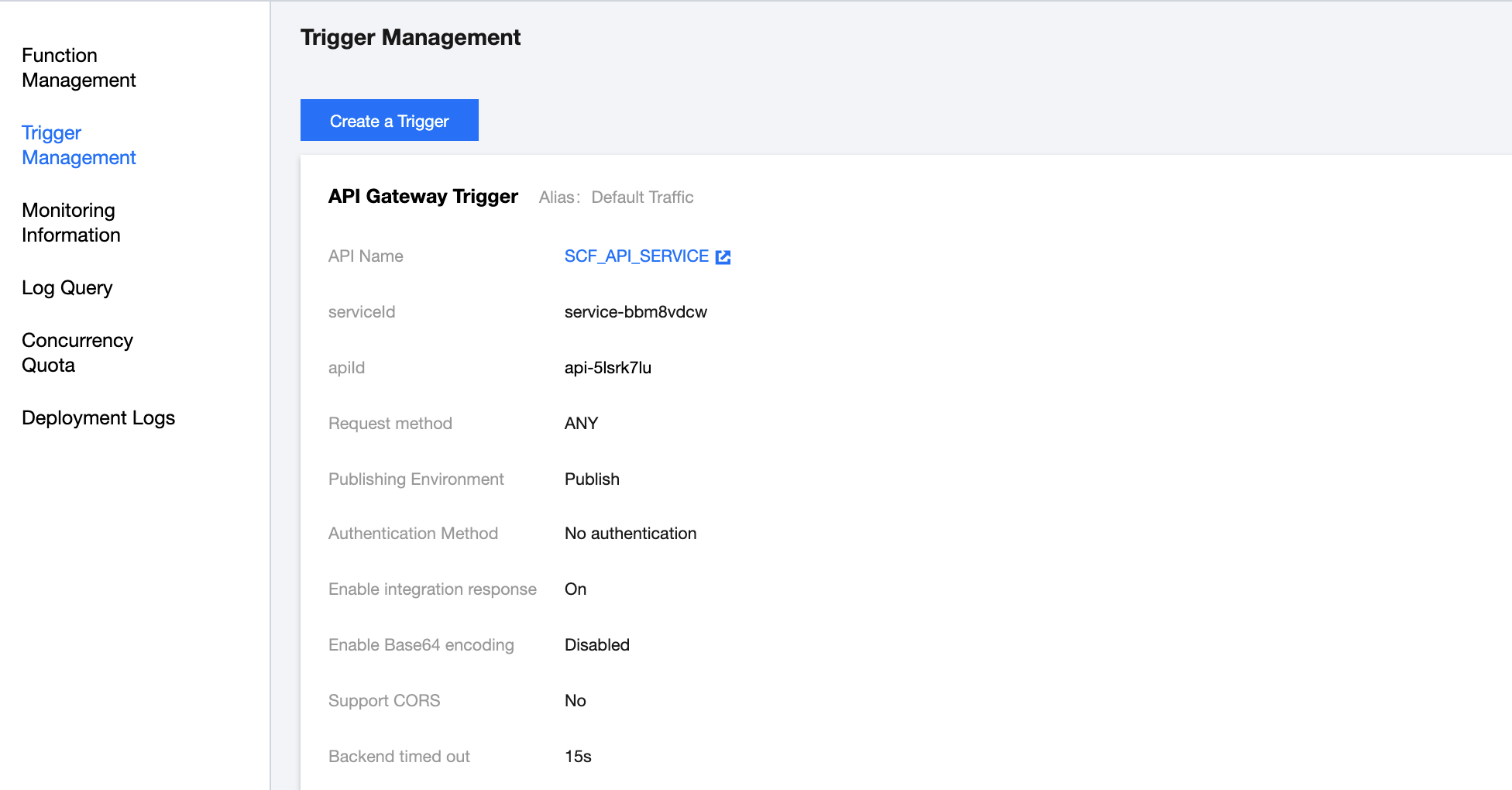
6. You can access the deployed Egg project at the access path URL generated by API Gateway. Click Trigger Management on the left to view the access path as shown below:
7. Click the access path URL to access the Egg project.
Custom deployment - quick migration of local project to cloud
Prerequisites
The Node.js runtime environment has been installed locally.
Local development
1. Refer to Quick Start to quickly initialize the sample project as follows:
mkdir egg-example &&cd egg-example
npm init egg --type=simple
npm i
2. In the root directory, run the following command to directly start the service locally.
npm run dev
open http://localhost:7001
3. Visit http://localhost:7001 in a browser, and you can access the sample Egg project locally.
Cloud deployment
Next, perform the following steps to make simple modifications to the initialized project, so that it can be quickly deployed through a web function. The project transformation here is usually divided into the following three steps:
Change the listening address and port to 0.0.0.0:9000.
Modify the write path. Only the /tmp directory is readable/writable in the SCF environment.
Add the scf_bootstrap bootstrap file.
The specific steps are as follows:
1. Create the scf_bootstrap bootstrap file in the project root directory and add the following content to it (which is used to configure environment variables and start services. Here is only a sample. Please adjust the specific operations according to your actual business scenario):
#!/var/lang/node12/bin/node
'use strict';
/**
* Node path in docker: /var/lang/node12/bin/node
* As only `/tmp` is readable/writable in SCF, two environment variables need to be modified at startup
* `NODE_LOG_DIR` changes the default node write path of `egg-scripts` (~/logs) to `/tmp`
* `EGG_APP_CONFIG` changes the default directory of the Egg application to `/tmp`
console.log('Server start on http://0.0.0.0:9000');
});
2. After the creation is completed, you need to run the following command to modify the executable permission of the file. By default, the permission 777 or 755 is required for it to start normally. Below is the sample code:
chmod777 scf_bootstrap
3. Log in to the SCF console and click Function Service on the left sidebar.
4. Select the region where to create a function at the top of the page and click Create to enter the function creation process.
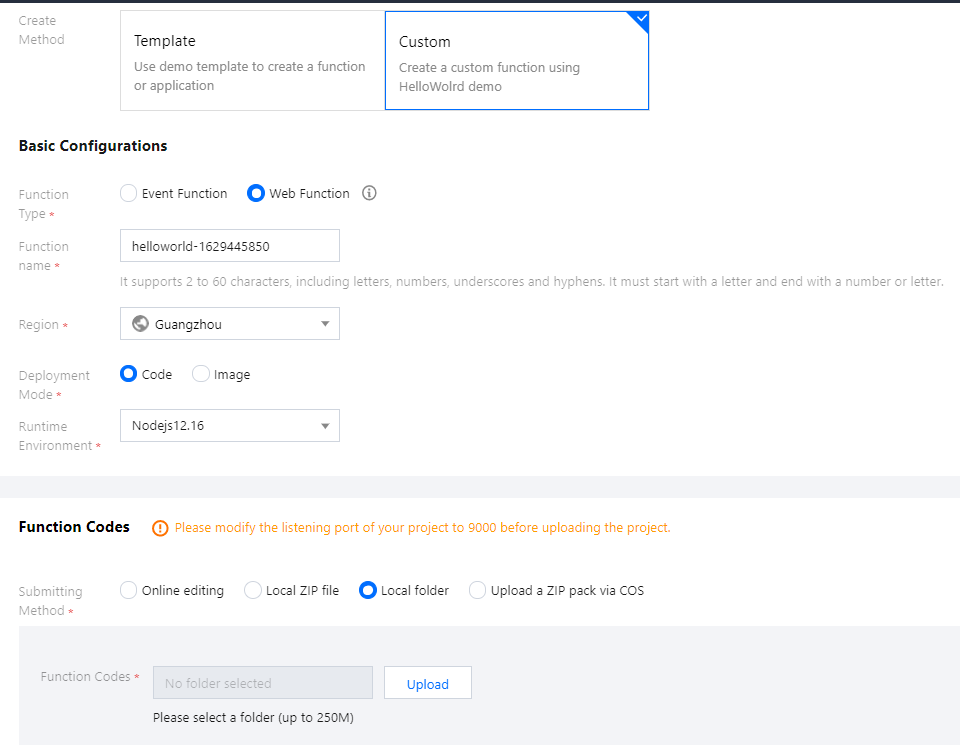
5. Select Custom Creation for Creation Method and configure the options as prompted as shown below:
Function Type: select Web function.
Function Name: enter the name of your function.
Region: enter your function deployment region, which is Guangzhou by default.
Runtime Environment: select Nodejs 12.16.
Deployment Method: select Code deployment and upload your local project.
Submitting Method: select Local folder.
Function Code: select the specific local folder where the function code is.
6. Click Complete.
Development management
After the deployment is completed, you can quickly access and test your web service in the SCF console and try out various features of SCF, such as layer binding and log management. In this way, you can enjoy the advantages of low cost and flexible scaling brought by the serverless architecture.