Release Notes
Broker Release Notes
Announcement
Serverful and Serverless) to meet user needs in different scenarios. When you purchase a CKafka cluster, it is recommended that you select products based on a combination of factors such as business application scenarios, product capabilities, and usage costs.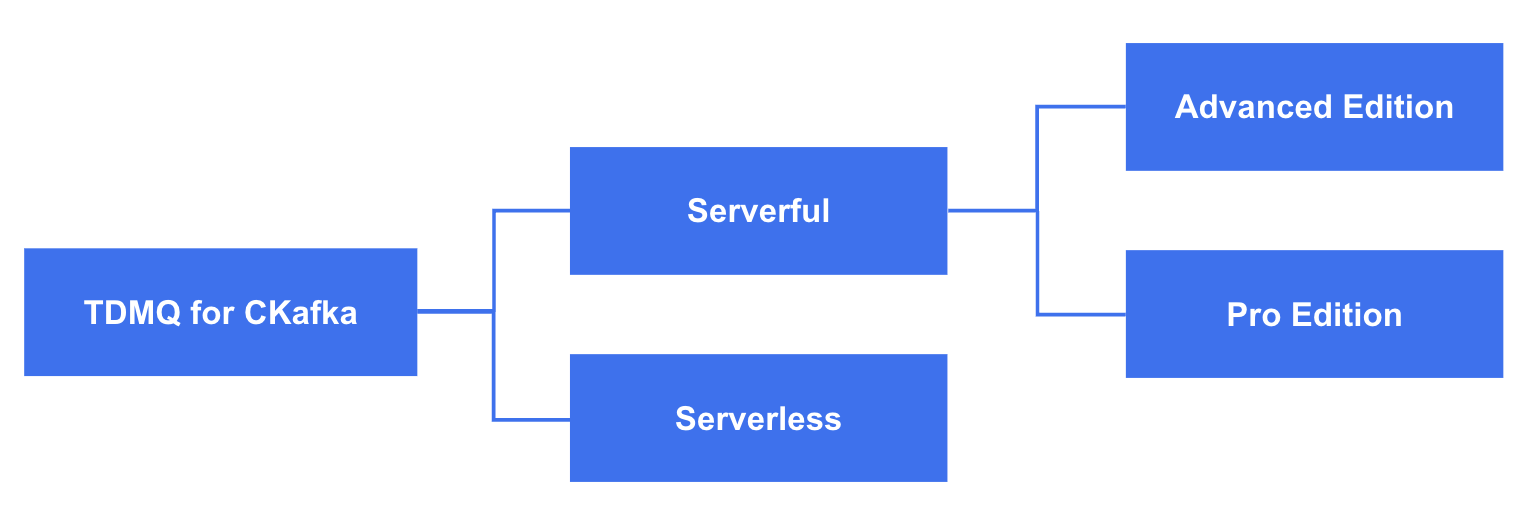
Item | Item Description | Pro Edition | Advanced Edition | Standard Edition (No Longer Available for New Purchases) |
Architecture | Deployment architecture | Dedicated instances. | Shared physical node resources. | Shared physical node resources. |
Stability | SLA guarantee | Service availability: 99.995%. Storage availability: See CBS SLA Description. | Service availability: 99.95%. Storage availability: See CBS SLA Description. | Service availability: 99.95%. Storage availability: See CBS SLA Description. |
Specifications | Bandwidth specification range | 40MB/s, 100MB/s, 150MB/s | ||
| Storage | Supports fixed storage and elastic storage. For elastic storage, the storage space is theoretically unlimited and billed on a pay-as-you-go basis. | Fixed storage only. | Fixed storage only. |
| High flexibility, allowing individual scale-out of bandwidth and topic/partition limits, as well as disk capacity expansion. | High flexibility, allowing individual scale-out of bandwidth and topic/partition limits, as well as disk capacity expansion. | Low flexibility, allowing individual expansion of disk capacity. | |
Isolation | ✓ | × | × | |
Security management | ✓ | × | × | |
Intelligent Ops | Dynamic message retention policy; automatic disk capacity expansion. | Dynamic message retention policy. | | |
| ✓ | × | × | |
| ✓ | × | × | |
| ✓ | × | × | |
Monitoring and alarms | ✓ | × | × | |
| Metric sorting | ✓ | × | × |
| ✓ | × | × | |
| ✓ | × | × | |
High availability | ✓ | ✓ | × | |
| ✓ | × | × | |
Upgrade | ✓ | × | × | |
| Broker repair and upgrade | Fast upgrade. | Shared cluster with a longer maintenance cycle. | Shared cluster with a longer maintenance cycle. |
Advanced service | Technical service | Provides parameter optimization consulting services, allowing you to customize parameter configurations for special business scenarios. You can submit a ticket for application. | Supports basic troubleshooting and issue resolution. | Supports basic troubleshooting and issue resolution. |
Item | Item Description | Serverless Edition |
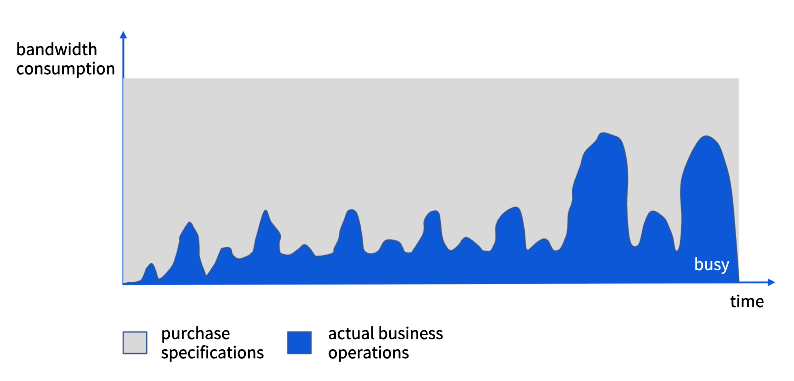
Specifications | Reserved bandwidth range | Production reserved bandwidth: 90 ~ 1020 MB/s, with a step size of 30 MB/s Consumption reserved bandwidth: 30-1020 MB/s, with a step size of 10 MB/s The upper limit for the ratio of consumption reserved bandwidth to production reserved bandwidth is 3:1. |
| Elastic capacity limit | Supports up to 2x elasticity, that is: Production elastic capacity limit = 2 * Production reserved bandwidth. Consumption elastic capacity limit = 2 * Consumption reserved bandwidth. |
| Amount of storage space | Storage space is theoretically unlimited and billed on a pay-as-you-go basis. |
| Partition Specs | Current upper limit: 3000 partitions (including replicas) Future plans: As larger production reserved bandwidth specifications are introduced, the upper limit for the number of partitions will be increased accordingly. |
| Topic Specs | To ensure data reliability, Serverless instances only support creating Topics with 3 replicas. The Topic specification is Partition Specs/3. |
| Message retention period | 1 day ~ 365 days |
| Adjust Configuration | Production reserved bandwidth and consumption reserved bandwidth can be upgraded or downgraded independently. |
| Public Network Bandwidth | Public network access is not currently supported. |
Stability | Cross-AZ high-availability deployment | ✓ |
| High Data Reliability | 3-replica Topic configuration |
Isolation | Topic traffic throttling | ✓ |
Security management | SSL authentication | ✓ |
Message query | / | ✓ |
Intelligent Ops | One-click diagnosis | ✓ |
Was this page helpful?
You can also Contact sales or Submit a Ticket for help.
Help us improve! Rate your documentation experience in 5 mins.
Feedback