tencent cloud

Cloud Access Management

Product Introduction
CAM Overview
Features
Scenarios
Basic Concepts
Use Limits
User Types
Purchase Guide
Getting Started
Creating Admin User
Creating and Authorizing Sub-account
Logging In to Console with Sub-account
User Guide
Overview
Users
Access Key
User Groups
Role
Identity Provider
Policies
Permissions Boundary
Troubleshooting
Downloading Security Analysis Report
CAM-Enabled Role
Overview
Compute
Container
Microservice
Essential Storage Service
Data Process and Analysis
Data Migration
Relational Database
Enterprise Distributed DBMS
NoSQL Database
Database SaaS Tool
Database SaaS Service
Networking
CDN and Acceleration
Network Security
Data Security
Application Security
Domains & Websites
Big Data
Middleware
Interactive Video Services
Real-Time Interaction
Media On-Demand
Media Process Services
Media Process
Cloud Real-time Rendering
Game Services
Cloud Resource Management
Management and Audit Tools
Developer Tools
Monitor and Operation
More
CAM-Enabled API
Overview
Compute
Edge Computing
Container
Distributed cloud
Microservice
Serverless
Essential Storage Service
Data Process and Analysis
Data Migration
Relational Database
Enterprise Distributed DBMS
NoSQL Database
Database SaaS Tool
Networking
CDN and Acceleration
Network Security
Endpoint Security
Data Security
Business Security
Application Security
Domains & Websites
Office Collaboration
Big Data
Voice Technology
Image Creation
Tencent Big Model
AI Platform Service
Natural Language Processing
Optical Character Recognition
Middleware
Communication
Interactive Video Services
Real-Time Interaction
Stream Services
Media On-Demand
Media Process Services
Media Process
Cloud Real-time Rendering
Game Services
Education Sevices
Medical Services
Cloud Resource Management
Management and Audit Tools
Developer Tools
Monitor and Operation
More
Use Cases
Security Practical Tutorial
Multi-Identity Personnel Permission Management
Authorizing Certain Operations by Tag
Supporting Isolated Resource Access for Employees
Enterprise Multi-Account Permissions Management
Reviewing Employee Operation Records on Tencent Cloud
Implementing Attribute-Based Access Control for Employee Resource Permissions Management
During tag-based authentication, only tag key matching is supported
Business Use Cases
TencentDB for MySQL
CLB
CMQ
COS
CVM
VPC
VOD
Others
API Documentation
History
Introduction
API Category
Making API Requests
User APIs
Policy APIs
Role APIs
Identity Provider APIs
Data Types
Error Codes
FAQs
Role
Key
Others
CAM Users and Permissions
Glossary

Sub-Account Access Key Management

PDF
Focus Mode
Font Size
Last updated: 2025-04-29 10:29:09
Note:
To reduce the risk of key exposure, as of November 30, 2023, the function to query SecretKey for all root accounts and sub-accounts will be closed, which can only be kept at the time of creation. Please keep your SecretKey in time.

Operation Scenarios

Access keys, also known as API keys, are the security certificates required for user identity verification when accessing Tencent Cloud APIs. They are composed of both a SecretId and a SecretKey. If a user does not possess an API key, it is necessary to create one within the API key management system, otherwise, they will be unable to invoke the cloud API interface.
This document describes how to create, enable/disable and delete API keys as well as view API key information for sub-users and collaborators.
Note:
SecretId: Used to identify an API caller, similar to a username. A SecretId has a uniform prefix "IKID".
SecretKey: Used to verify the identity of an API caller, similar to a password.

Prerequisites

Log in to the CAM Console and go to User List. Find the sub-user or collaborator that needs to be configured and click Username to enter the user details page.

Directions

Creating an API Key for a Sub-Account

You can create an API key for a sub-user/collaborator. After the API key is created, the sub-user/collaborator can use APIs, SDKs, or other development tools to manage the resources under the root account within the scope of the configured permissions.
1. On the user details page, click API Keys to enter the API key management page.
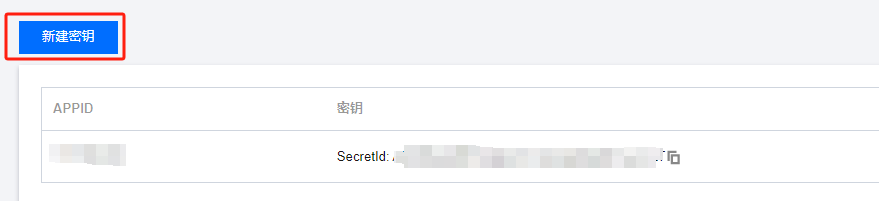
2. On the API key management page, click Create Key.

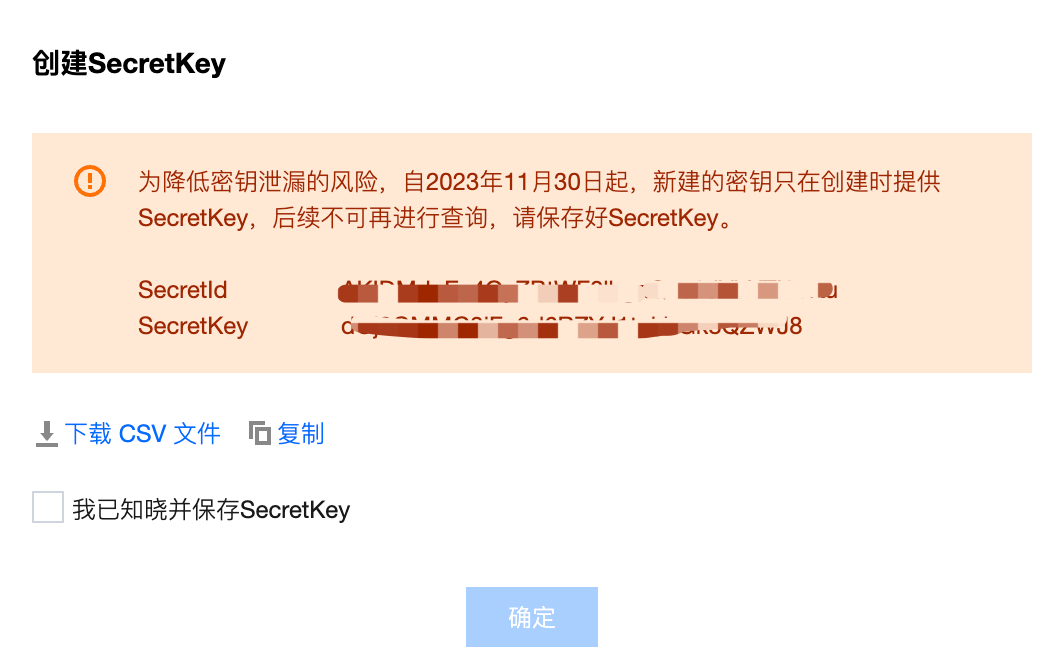
3. In the pop-up window of Create SecretKey, the key you've created will be displayed. Please keep your SecretId and SecretKey well. As of November 30, 2023, the created keys will only provide the SecretKey when created, and can not be queried afterward.

Note:
Each sub-user/collaborator can have at most two API keys.
An API key is an important credential for creating TencentCloud API requests. For the security of your assets and services, please keep the keys private, change them regularly, and delete old keys promptly after creating new ones.

Viewing a Sub-Account API Key

You can view and copy the SecretId of a sub-user's/collaborator's API key. The sub-user/collaborator can use APIs, SDKs, or other development tools through SecretId and SecretKey within their permissions to manage resources under the root account.
1. On the user details page, click API Keys to enter the API key management page.
2. On the API key management page, perform the following operations to view and copy the SecretId of the API key. An API key is an important credential for creating Tencent Cloud API requests. For the security of your assets and services, please keep the keys private, change them regularly, and delete old keys promptly after creating new ones.
Note:
SecretId: this can be directly viewed in the Key column. Click

to copy and save it.
SecretKey: click Show in the Key column. You will be able to view it after being authenticated. Click

to copy and save it. (To reduce the risk of key exposure, as of November 30, 2023, the function to query SecretKey for all root accounts and sub-accounts will be closed, which can only be kept at the time of creation. Please keep your SecretKey in time.)

Disabling/Enabling a Sub-Account API Key

You can disable an API key of a sub-user/collaborator. Please do so with caution as Tencent Cloud will block all requests that use the API key after it is disabled.
1. On the user details page, click API Key to enter the API key management page.
2. On the API key management page, click Disable in the Operation column.
3. In the confirmation window that pops up, click Confirm to disable the access key.
Note:
You can click Enable in the Operation column to enable the key. After the key is enabled, the sub-account/collaborator can use APIs, SDKs, or other development tools to manage the resources under the root account within the scope of the configured permissions.

Deleting a Sub-Account API Key

1. On the user details page, click API Key to enter the API key management page.
2. On the API key management page, click Disable in the "Operation" column. If the API key that you want to delete has already been disabled, proceed to step 4.
3. In the confirmation window that pops up, click Confirm.
4. On the API key management page, click Delete in the "Operation" column to delete the API key.
Note:
Please note that an API key cannot be recovered once deleted.

API Key Access Record Description

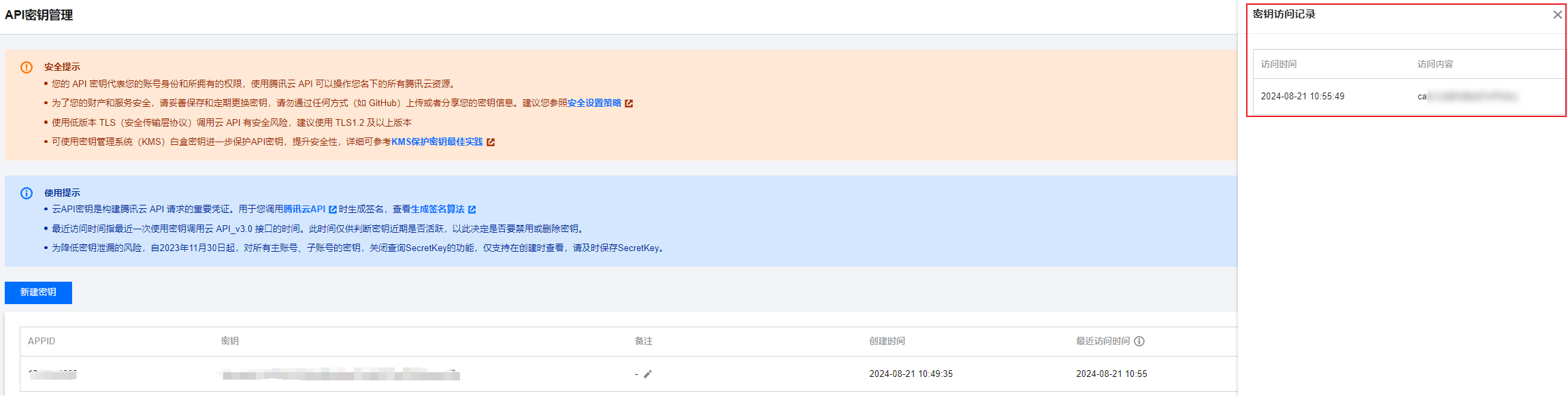
1. 1. On the API Key Management page, click More Access Records in the operation column, as shown in the following figure:
Note:
More Access Records: displays the latest 20 access records from the past 3 months, including both successful and failed calls. Due to the large volume of data, there may be a delay of about 1 hour.
Access records only log requests to the server. Regardless of whether a call is successful or has the necessary permissions, all attempts are recorded.

2. On the Key Access Records page on the right, view the details of key access records.

Last Access Time: displays the last time the key was used.
For more information on how to query sub-account information through the SecretId of an access key, please see Searching for Sub-users with Search Box and Searching for Collaborators with Search Box.

Help and Support

Was this page helpful?

Help us improve! Rate your documentation experience in 5 mins.

Feedback