Product Architecture 2.0
Unduh
Mode fokus
Ukuran font
TDSQL-C for MySQL Storage Architecture 2.0 is a next-generation storage architecture newly built based on cloud-native design principles, comprehensively upgraded around the three core themes of stability, disaster recovery, and cost reduction. Building on the advantage of separating compute from storage, the new architecture provides enterprise-grade businesses with higher-reliability database services through technological innovations such as log storage separation, three-AZ deployment, and storage compression. This document introduces the product architecture 2.0 version of TDSQL-C for MySQL.
Interpretation of Terms
In this product, the terms Product Series 2.0 and Product Architecture 2.0 both refer to TDSQL-C for MySQL Storage Architecture 2.0.
Supported Versions
Database Version | Product Architecture 1.0 | Product Architecture 2.0 |
MySQL 5.7 | Supported | Not supported. |
MySQL 8.0 | Supported | Supported |
Billing Overview
Product Architecture 2.0 has exited the open beta. Commercial billing for it officially begins at 00:00:00 on July 27, 2026. For pricing details, see Product Pricing.
Supported Instance Modes
Product Architecture 2.0 only supports clusters whose instance mode is provisioned resources, and does not currently support clusters whose instance mode is Serverless.
Comparison Between Architecture 1.0 and 2.0
Feature Dimension | Product Architecture 1.0 | Product Architecture 2.0 |
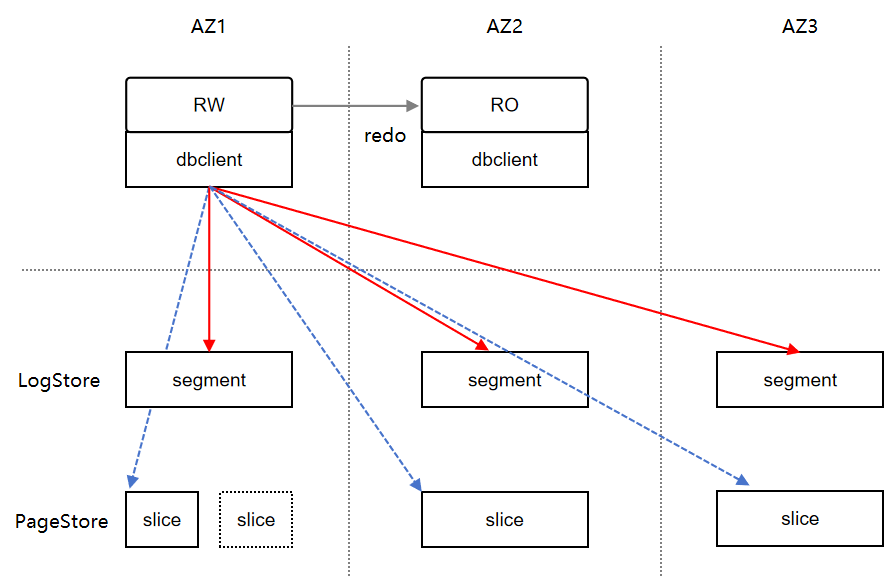
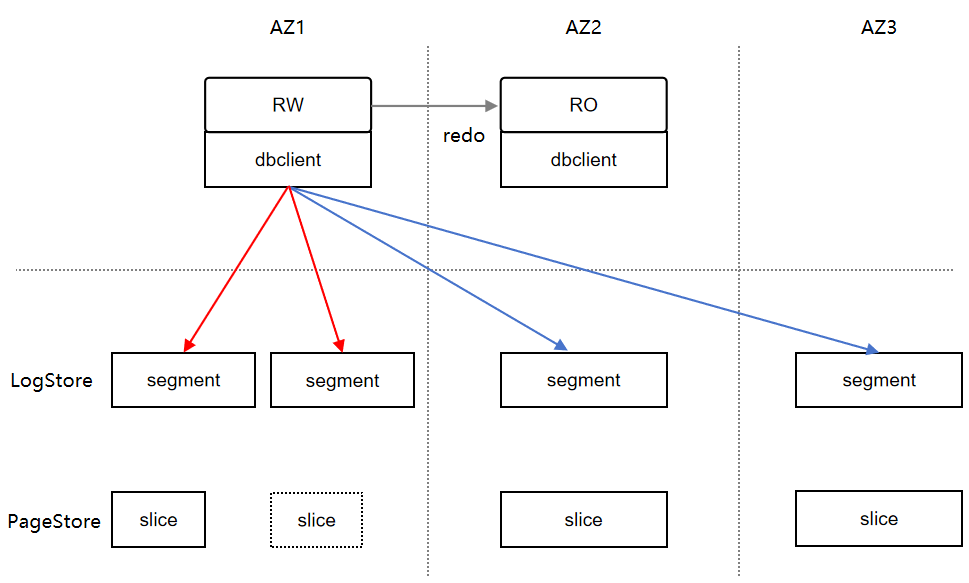
Log Storage Method | Logs and data are co-located in the same Tablet. | Logs and data are stored separately (LogStore + PageStore). |
AZ Deployment | Single AZ / Multi-AZ deployment (2AZ) | Single AZ / Multi-AZ deployment (3AZ) Note: Only single AZ deployment is supported during the open beta. A 3-AZ deployment requires at least one RO node that spans multiple AZs. |
Data Replicas | Three replicas | Strongly synchronous 3AZ: 3 log replicas, 3 or 4 data replicas. Asynchronous 3AZ: 3 - 4 replicas |
Storage Compression | Not supported. | Supports instance / database / table level + two-level compression |
Data Tiering | Not supported. | Supports intelligent tiering at the database/table level |
Product Architecture 2.0 Diagram
Advantages of Product Architecture 2.0
TDSQL-C for MySQL combines the characteristics of commercial databases—stability, reliability, high-performance, and scalability—with the advantages of open-source cloud databases, which are simplicity, openness, and efficient iteration. The 2.0 architecture further strengthens the core capabilities of enterprise-grade databases:
Higher Stability: It reduces the impact on business operations during three major scenarios—storage component releases, failed disk replacements, and network jitter (transient impact may still occur in extreme scenarios)—and eliminates the risks of slow queries and write unavailability caused by monthly changes.
Higher Disaster Recovery Capability: It uses a 3-AZ deployment by default, with no additional charge for cross-AZ storage replicas.
Lower Cost Reduction: It supports instance/database/table-level + two-level compression, combined with intelligent cold data tiering from the database/table level to the data level (featuring automatic heatmap recommendations and support for common DDL operations such as ALTER TABLE and CREATE INDEX), resulting in reduced storage costs.
Typical Application Scenarios for Product Architecture 2.0
The 2.0 architecture is primarily designed for three types of business scenarios:
High Disaster Recovery Scenarios: Businesses such as financial transactions, ride-hailing, and cross-border payments impose stringent requirements on SLA, RPO, and RTO.
Cost-Sensitive Scenarios: For businesses with large-volume data storage, tiered compression is required to significantly reduce per-GB storage costs and improve resource utilization.
Hot/Cold Data Tiering Scenarios: For businesses with distinct hot and cold data distribution, where some databases or tables need to be archived but still require online querying and DDL operations, intelligent cold data tiering ensures performance and availability while reducing costs.
FAQs
Q1: Does Product Architecture 2.0 Support Downgrading to 1.0?
A: Downgrade rollback is not currently supported. Architecture 2.0 is a brand-new storage architecture and does not support online downgrade. We recommend that you first validate it on non-core business, and migrate core business only after its stability is confirmed.
Q2: Can MySQL 5.7 Use Architecture 2.0?
A: No. Product Architecture 2.0 only supports MySQL 8.0. To use the features of the 2.0 architecture, we recommend using MySQL 8.0.
Q3: How to Select the Architecture Version During Purchase?
A: On the purchase page, select "2.0" from the "Product Series" options. Note: The product series does not currently support online switching after purchase.
Q4: Does Cold Data Support DDL Operations?
A: Yes. Product Architecture 2.0 implements DDL compatibility for cold tables, including operations such as ALTER TABLE and CREATE INDEX.
References
Bantuan dan Dukungan
Apakah halaman ini membantu?
Anda juga dapat Menghubungi Penjualan atau Mengirimkan Tiket untuk meminta bantuan.
masukan