
WMA Agents run within cloud sandboxes, providing uninterrupted 24/7 service and operation. This makes them particularly suitable for scenarios such as long-running tasks, online customer service, and automatically triggered tasks. They also support automatic hibernation and millisecond-level recovery capabilities, significantly reducing usage costs.
WMA Agents run within cloud sandboxes, providing uninterrupted 24/7 service and operation. This makes them particularly suitable for scenarios such as long-running tasks, online customer service, and automatically triggered tasks. They also support automatic hibernation and millisecond-level recovery capabilities, significantly reducing usage costs.

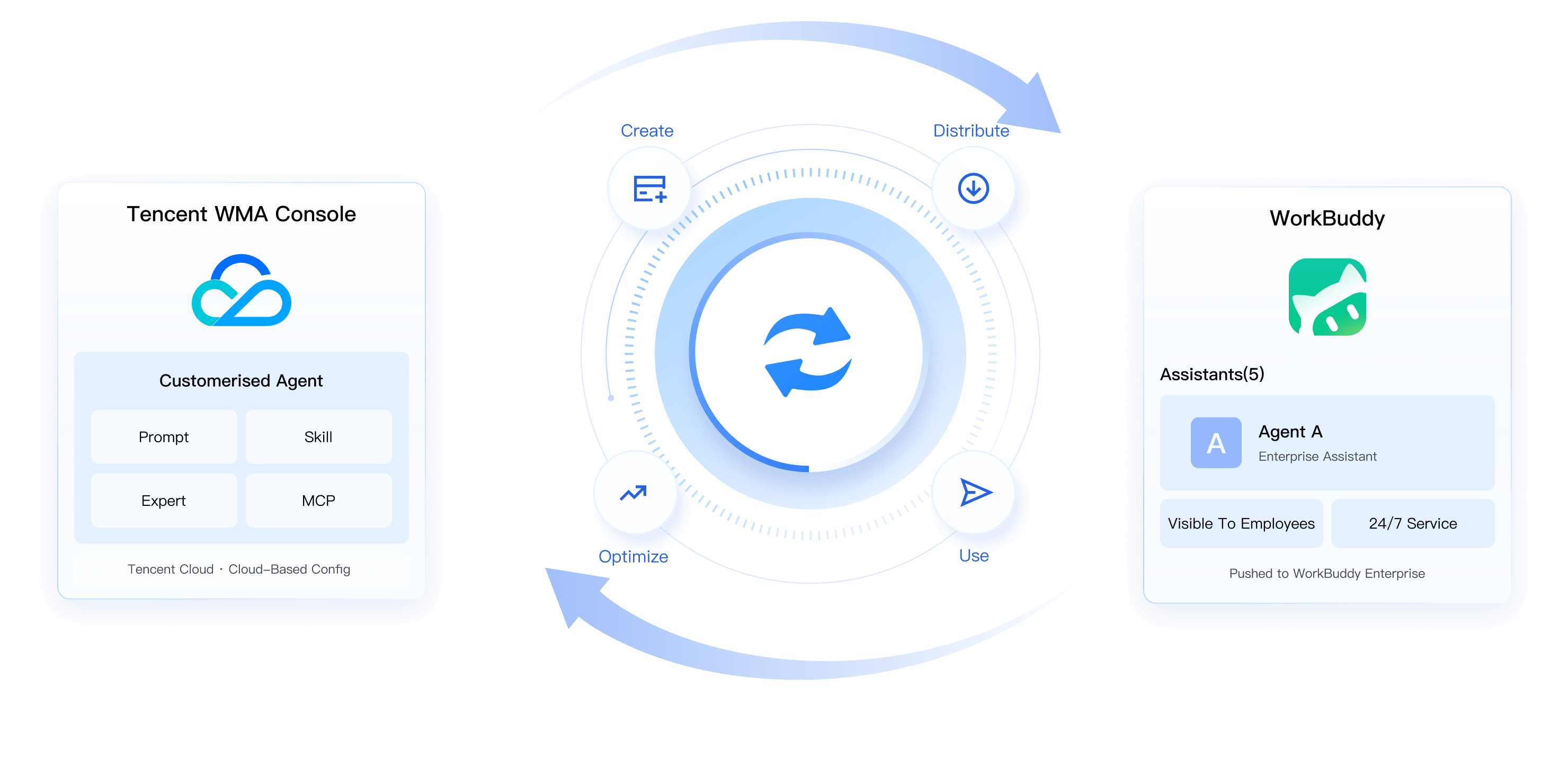
Agents created in the WMA console can be deployed with one click to the WorkBuddy-side enterprise agent list bound to the current account, seamlessly connecting the agent from creation to usage. The system supports multiple permission management options, allowing users to flexibly manage an agent's visibility scope and manageable permissions.
Agents created in the WMA console can be deployed with one click to the WorkBuddy-side enterprise agent list bound to the current account, seamlessly connecting the agent from creation to usage. The system supports multiple permission management options, allowing users to flexibly manage an agent's visibility scope and manageable permissions.

WMA executes all operations, from configuration to runtime, in the cloud. It enables secure Agent access to various business systems based on a unified identity. All sensitive data, including Skill configurations and MCP invocation results, as well as sensitive outputs, are retained exclusively in the cloud and never stored locally. This fundamentally eliminates the risk of enterprise asset and data exfiltration.
WMA executes all operations, from configuration to runtime, in the cloud. It enables secure Agent access to various business systems based on a unified identity. All sensitive data, including Skill configurations and MCP invocation results, as well as sensitive outputs, are retained exclusively in the cloud and never stored locally. This fundamentally eliminates the risk of enterprise asset and data exfiltration.

Built on the WorkBuddy Harness core, it incorporates a four-layer architecture for Agent orchestration, memory, action, and governance. This unlocks the full potential of large models in long-running task scenarios, delivering faster execution, more precise reasoning, and more reliable task guidance.
Built on the WorkBuddy Harness core, it incorporates a four-layer architecture for Agent orchestration, memory, action, and governance. This unlocks the full potential of large models in long-running task scenarios, delivering faster execution, more precise reasoning, and more reliable task guidance.

It provides end-to-end governance for agents, spanning from deployment to operation. This governance encompasses unified identity, isolated runtime environments, full-link traceability, performance evaluation, and continuous optimization. For each Agent, it establishes deterministic operational boundaries and quantifiable quality baselines.
It provides end-to-end governance for agents, spanning from deployment to operation. This governance encompasses unified identity, isolated runtime environments, full-link traceability, performance evaluation, and continuous optimization. For each Agent, it establishes deterministic operational boundaries and quantifiable quality baselines.

The industry-leading, complete sandbox environment for Agent-native Runtime provides capabilities such as data persistence, cross-node recovery, second-level CoW Fork, port forwarding, and integrated delivery with a warm-up pool. It directly connects to the Tencent Cloud full-stack foundation and elastic computing resources, enabling smooth scaling to clusters of tens of thousands of nodes.
The industry-leading, complete sandbox environment for Agent-native Runtime provides capabilities such as data persistence, cross-node recovery, second-level CoW Fork, port forwarding, and integrated delivery with a warm-up pool. It directly connects to the Tencent Cloud full-stack foundation and elastic computing resources, enabling smooth scaling to clusters of tens of thousands of nodes.
WMA Agents run within cloud sandboxes, providing uninterrupted 24/7 service and operation. This makes them particularly suitable for scenarios such as long-running tasks, online customer service, and automatically triggered tasks. They also support automatic hibernation and millisecond-level recovery capabilities, significantly reducing usage costs.
Agents created in the WMA console can be deployed with one click to the WorkBuddy-side enterprise agent list bound to the current account, seamlessly connecting the agent from creation to usage. The system supports multiple permission management options, allowing users to flexibly manage an agent's visibility scope and manageable permissions.
WMA executes all operations, from configuration to runtime, in the cloud. It enables secure Agent access to various business systems based on a unified identity. All sensitive data, including Skill configurations and MCP invocation results, as well as sensitive outputs, are retained exclusively in the cloud and never stored locally. This fundamentally eliminates the risk of enterprise asset and data exfiltration.
Built on the WorkBuddy Harness core, it incorporates a four-layer architecture for Agent orchestration, memory, action, and governance. This unlocks the full potential of large models in long-running task scenarios, delivering faster execution, more precise reasoning, and more reliable task guidance.
It provides end-to-end governance for agents, spanning from deployment to operation. This governance encompasses unified identity, isolated runtime environments, full-link traceability, performance evaluation, and continuous optimization. For each Agent, it establishes deterministic operational boundaries and quantifiable quality baselines.
The industry-leading, complete sandbox environment for Agent-native Runtime provides capabilities such as data persistence, cross-node recovery, second-level CoW Fork, port forwarding, and integrated delivery with a warm-up pool. It directly connects to the Tencent Cloud full-stack foundation and elastic computing resources, enabling smooth scaling to clusters of tens of thousands of nodes.
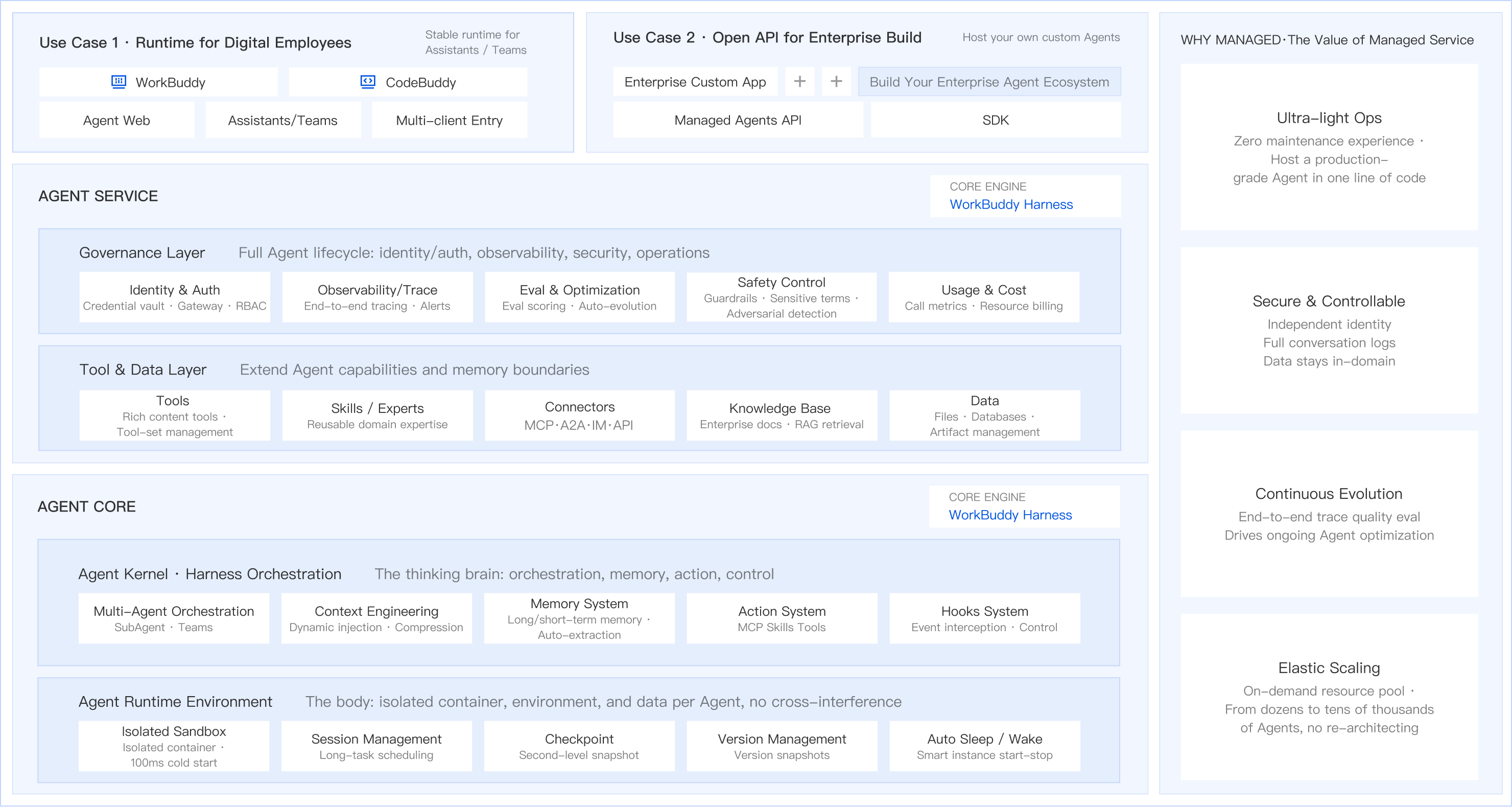
It is a managed platform designed for enterprise-level Agent scenarios. Built on the mature WorkBuddy Harness core, each layer—from identity and runtime environment to connectivity, tracing, and evaluation—is natively designed for Agent workload characteristics. Enterprises can access it via APIs / SDKs to stably run, manage, and continuously iterate each Agent in the cloud.
Scenario 1: As the runtime foundation for digital employees, it supports the stable operation of WorkBuddy Assistants / Teams. When users access corresponding features, the system automatically manages the hosted Agents, requiring no user intervention.
Scenario 2: Enterprises can create custom Agents. By leveraging open APIs and SDKs, enterprises can fully customize their intelligent agents. These agents come with the mature WorkBuddy Harness core and a complete toolchain infrastructure—including out-of-the-box connectors like MCP / OAuth / A2A—and support Skill encapsulation and expert templates. This eliminates the need to build foundational capabilities such as Agent runtime, session management, and memory storage from scratch. Enterprises can focus solely on business logic and Prompt orchestration. Using a visual management console, they can complete Agent creation, testing, version management, and one-click deployment. Subsequently, the custom Agents can be embedded into office systems like WeCom / OA, or published to their own business scenarios via APIs / the Web.
The underlying layer is built on a three-tier stack of NBD + Btrfs + OverlayFS. It delivers a P95 latency of ≤ 300ms for new sandbox creation, a creation throughput of ≥ 10,000 times per second, and supports hundreds of thousands of concurrent online sandboxes. When paused, a sandbox retains only remote disk data and consumes no compute resources. The platform supports long-term asynchronous operations, second-level CoW Fork, artifact version management, and automatic sleep / wake cycles. It also provides end-to-end observability, including operation overviews, invocation traces, and effectiveness evaluation.
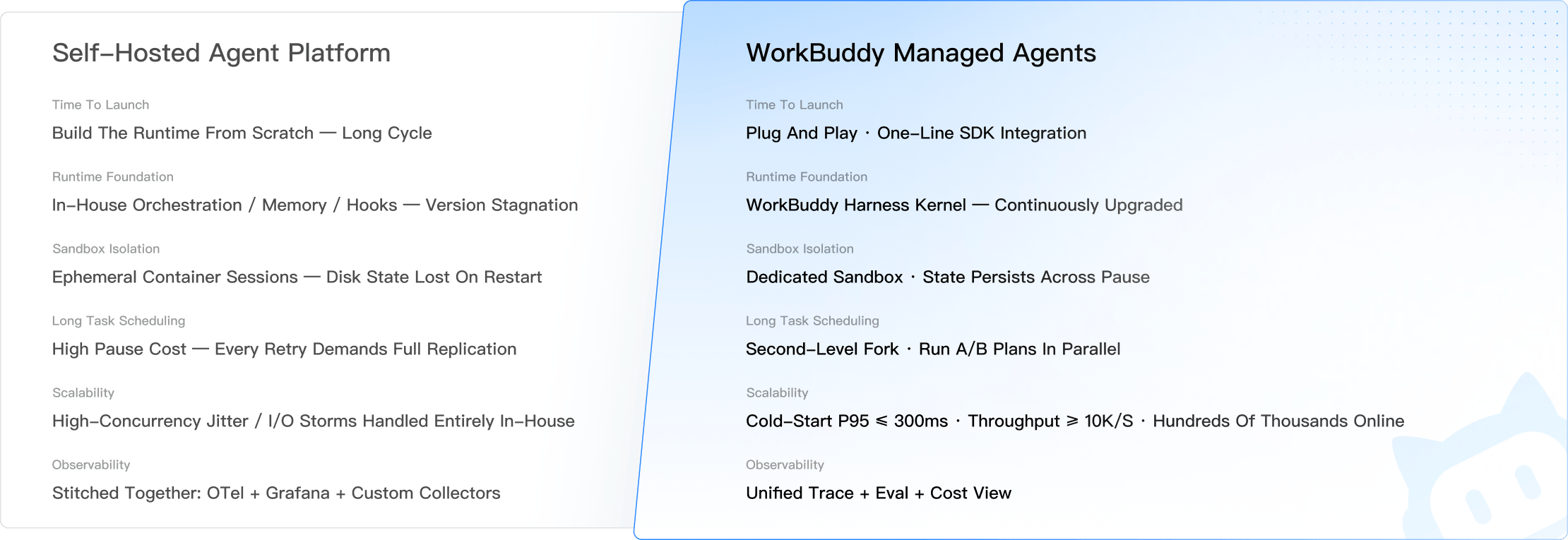
Building an Agent platform in-house requires constructing foundational infrastructure from scratch, including orchestration frameworks, memory systems, action invocation, Hooks management, isolated runtime environments, observability. This results in high R&D and Ops costs. In contrast, WorkBuddy Managed Agents delivers the Harness core + cloud runtime as an integrated solution. Developers simply need to call APIs/SDKs to integrate business logic, enabling one-click hosting of production-grade Agents. This significantly reduces the overall TCO.
All three belong to the WorkBuddy Enterprise product matrix. Tencent CodeBuddy is an AI coding copilot for R&D scenarios, Tencent WorkBuddy is a general-purpose office assistant for all employees, and Tencent WorkBuddy Managed Agents is an underlying managed runtime service for developers and enterprises. It not only supports the aforementioned two applications but can also host enterprise-customized intelligent agents.
1. The cloud account must be connected to the WorkBuddy-side account, and the WorkBuddy-side account type must be an enterprise account.
2. Log in to the Tencent Cloud WMA product console or use the TencentCloud API to create an Agent, then configure and debug it.
3. Log in to the WorkBuddy-side Admin management platform. You can view the Agent list created in Step 2, then use the Agent deployment feature on the Admin platform.
4. Go to WorkBuddy side - Assistant - Enterprise Agents to view the Agent deployed in Step 3.
It is a managed platform designed for enterprise-level Agent scenarios. Built on the mature WorkBuddy Harness core, each layer—from identity and runtime environment to connectivity, tracing, and evaluation—is natively designed for Agent workload characteristics. Enterprises can access it via APIs / SDKs to stably run, manage, and continuously iterate each Agent in the cloud.
Scenario 1: As the runtime foundation for digital employees, it supports the stable operation of WorkBuddy Assistants / Teams. When users access corresponding features, the system automatically manages the hosted Agents, requiring no user intervention.
Scenario 2: Enterprises can create custom Agents. By leveraging open APIs and SDKs, enterprises can fully customize their intelligent agents. These agents come with the mature WorkBuddy Harness core and a complete toolchain infrastructure—including out-of-the-box connectors like MCP / OAuth / A2A—and support Skill encapsulation and expert templates. This eliminates the need to build foundational capabilities such as Agent runtime, session management, and memory storage from scratch. Enterprises can focus solely on business logic and Prompt orchestration. Using a visual management console, they can complete Agent creation, testing, version management, and one-click deployment. Subsequently, the custom Agents can be embedded into office systems like WeCom / OA, or published to their own business scenarios via APIs / the Web.
The underlying layer is built on a three-tier stack of NBD + Btrfs + OverlayFS. It delivers a P95 latency of ≤ 300ms for new sandbox creation, a creation throughput of ≥ 10,000 times per second, and supports hundreds of thousands of concurrent online sandboxes. When paused, a sandbox retains only remote disk data and consumes no compute resources. The platform supports long-term asynchronous operations, second-level CoW Fork, artifact version management, and automatic sleep / wake cycles. It also provides end-to-end observability, including operation overviews, invocation traces, and effectiveness evaluation.
Building an Agent platform in-house requires constructing foundational infrastructure from scratch, including orchestration frameworks, memory systems, action invocation, Hooks management, isolated runtime environments, observability. This results in high R&D and Ops costs. In contrast, WorkBuddy Managed Agents delivers the Harness core + cloud runtime as an integrated solution. Developers simply need to call APIs/SDKs to integrate business logic, enabling one-click hosting of production-grade Agents. This significantly reduces the overall TCO.
All three belong to the WorkBuddy Enterprise product matrix. Tencent CodeBuddy is an AI coding copilot for R&D scenarios, Tencent WorkBuddy is a general-purpose office assistant for all employees, and Tencent WorkBuddy Managed Agents is an underlying managed runtime service for developers and enterprises. It not only supports the aforementioned two applications but can also host enterprise-customized intelligent agents.
1. The cloud account must be connected to the WorkBuddy-side account, and the WorkBuddy-side account type must be an enterprise account.
2. Log in to the Tencent Cloud WMA product console or use the TencentCloud API to create an Agent, then configure and debug it.
3. Log in to the WorkBuddy-side Admin management platform. You can view the Agent list created in Step 2, then use the Agent deployment feature on the Admin platform.
4. Go to WorkBuddy side - Assistant - Enterprise Agents to view the Agent deployed in Step 3.