Introduction to Cloud Recording Backfill
Baixar
Modo Foco
Tamanho da Fonte
During the upload of device video data to the cloud, recording gaps may occur due to network instability, device failures, and other causes, resulting in incomplete cloud recordings. The cloud recording backfill feature can automatically pull device local recordings and fill in the missing cloud recordings after detecting a video stream interruption. Common types of recording gaps are as follows.
Scattered small gaps appear in the recording timeline:

An entire segment is missing for a continuous period:

Recording Backfill Principles
During data upload to the cloud, the platform monitors the upload status of video streams in real time. After detecting a video stream interruption, the platform marks the channel information and interruption time, and automatically triggers recording backfill within 48 hours from the interruption. The recording backfill process is as follows:
1. Video Stream Monitoring: Monitor the upload status of video streams in real time. After detecting a video stream interruption, mark the channel information and interruption time.
2. Recording Backfill Trigger: Based on the interruption time, the platform interacts with the device to pull the device local recording for the missing period and upload it to the cloud. If a segment fails to be backfilled, it will be queued for continuous retries. Segments that remain unsuccessful for more than 48 hours will no longer be backfilled.
3. Cloud Recording Completion: The platform merges the received device local recording with the existing cloud recording to complete the cloud recording.
Use Limits
Only video channels of devices using the GB28181 protocol are supported, and this applies only to real-time recording upload to cloud plans.
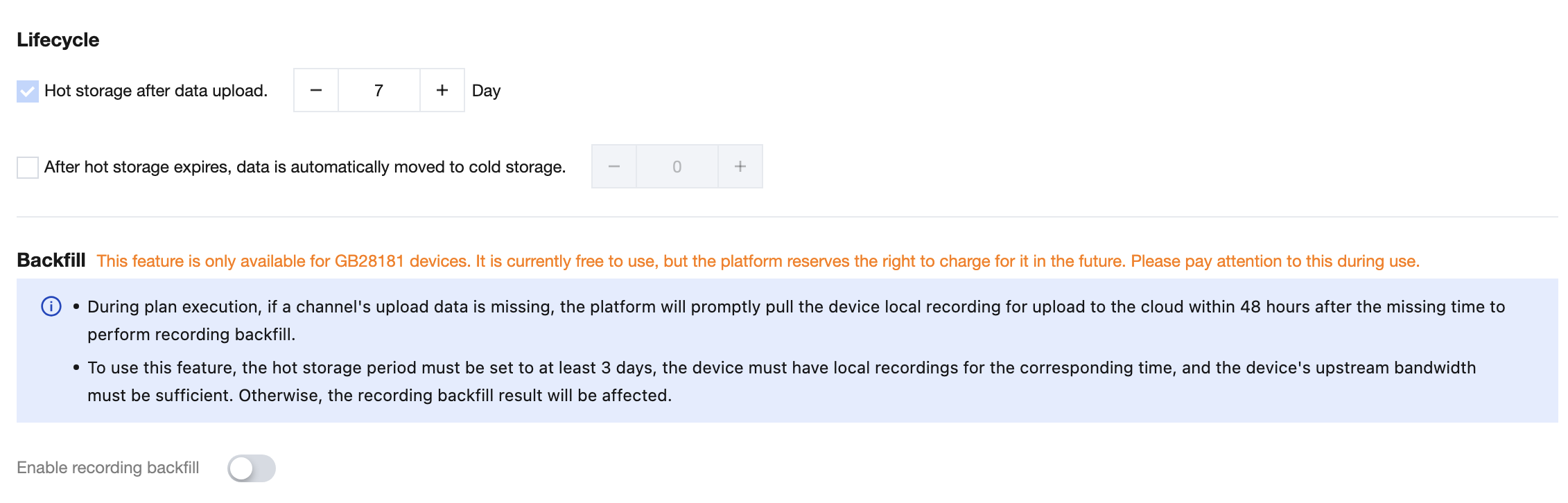
In the lifecycle rules of a recording plan, the hot storage duration must be set to at least 3 days after data upload.
The duration of a single missing segment must be greater than 2 seconds and less than 1 hour. Missing segments with a duration less than or equal to 2 seconds or greater than or equal to 1 hour do not support recording backfill.
At the time of the gap, the device must have the corresponding local recording. Otherwise, recording backfill cannot be performed.
The device and video channel must be online. Recording backfill cannot be performed when the device is offline.
The pulled device local recording must have the same bitstream as the existing cloud recording. Otherwise, the backfilled data may not be playable.
The device-side uplink bandwidth must be sufficient. Otherwise, the recording backfill performance will be affected.
Usage
1. When creating or editing a real-time recording upload to cloud plan, enable the recording backfill switch and click OK. After it is enabled, the platform automatically performs recording backfill for each video channel of devices using the GB28181 protocol under the plan.
2. View or download the daily recording backfill report for each video channel on the plan details page. The report includes information such as daily recording integrity, total backfill duration, backfill details, and the duration still missing after backfill.
3. The platform updates the previous day's recording details at 8:00 every day. The final accurate recording backfill data will be available on day T+3. For example, if recording backfill starts on January 1, it ends no later than January 3, and the final backfill data can be viewed after 8:00 on January 4.
Billing Overview
This feature is currently in open beta and is free to use during the beta period. After the beta ends, the platform may adjust the billing policy, and any adjustments will be announced in advance.
Warning:
During the beta period, SLA service availability for this feature is not guaranteed due to factors such as device and network conditions.
This feature is free to use, but the concurrent recording backfill process increases uplink network bandwidth consumption, and the traffic generated is billed normally.
Ajuda e Suporte
Esta página foi útil?
Você também pode entrar em contato com a Equipe de vendas ou Enviar um tíquete em caso de ajuda.
comentários