tencent cloud

Tencent Cloud Observability Platform

Release Notes and Announcements
Release Notes
Product Introduction
Overview
Strengths
Basic Features
Basic Concepts
Use Cases
Use Limits
Purchase Guide
Tencent Cloud Product Monitoring
Application Performance Management
Mobile App Performance Monitoring
Real User Monitoring
Cloud Automated Testing
Prometheus Monitoring
Grafana
EventBridge
PTS
Quick Start
Monitoring Overview
Instance Group
Tencent Cloud Product Monitoring
Application Performance Management
Real User Monitoring
Cloud Automated Testing
Performance Testing Service
Prometheus Getting Started
Grafana
Dashboard Creation
EventBridge
Alarm Service
Cloud Product Monitoring
Tencent Cloud Service Metrics
Operation Guide
CVM Agents
Cloud Product Monitoring Integration with Grafana
Troubleshooting
Practical Tutorial
Application Performance Management
Product Introduction
Access Guide
Operation Guide
Practical Tutorial
Parameter Information
FAQs
Mobile App Performance Monitoring
Overview
Operation Guide
Access Guide
Practical Tutorial
Tencent Cloud Real User Monitoring
Product Introduction
Operation Guide
Connection Guide
FAQs
Cloud Automated Testing
Product Introduction
Operation Guide
FAQs
Performance Testing Service
Overview
Operation Guide
Practice Tutorial
JavaScript API List
FAQs
Prometheus Monitoring
Product Introduction
Access Guide
Operation Guide
Practical Tutorial
Terraform
FAQs
Grafana
Product Introduction
Operation Guide
Guide on Grafana Common Features
FAQs
Dashboard
Overview
Operation Guide
Alarm Management
Console Operation Guide
Troubleshooting
FAQs
EventBridge
Product Introduction
Operation Guide
Practical Tutorial
FAQs
Report Management
FAQs
General
Alarm Service
Concepts
Monitoring Charts
CVM Agents
Dynamic Alarm Threshold
CM Connection to Grafana
Documentation Guide
Related Agreements
Application Performance Management Service Level Agreement
APM Privacy Policy
APM Data Processing And Security Agreement
RUM Service Level Agreement
Mobile Performance Monitoring Service Level Agreement
Cloud Automated Testing Service Level Agreement
Prometheus Service Level Agreement
TCMG Service Level Agreements
PTS Service Level Agreement
PTS Use Limits
Cloud Monitor Service Level Agreement
API Documentation
History
Introduction
API Category
Making API Requests
Monitoring Data Query APIs
Alarm APIs
Legacy Alert APIs
Notification Template APIs
TMP APIs
Grafana Service APIs
Event Center APIs
TencentCloud Managed Service for Prometheus APIs
Monitoring APIs
Data Types
Error Codes
Glossary

Receiving Alarm Notifications through a WeCom Group

PDF
Modo Foco
Tamanho da Fonte
Última atualização: 2024-01-27 17:35:59
This document describes how to receive alarm notifications through a WeCom group.

Use Limits

Regarding sending WeCom group messages, the number of messages sent by each bot cannot exceed 20 per minute. If you have many alarm policies, we recommend that you create multiple bots and associate alarm policies with different bots. Otherwise, multiple alarm policies may trigger alarms simultaneously, and you may fail to receive some alarm notifications as a result.
Note:
After you successfully create WeCom bots and configure the callback address, Tencent Cloud Observability Platform will automatically push the alarm messages to the WeCom bots. This way, you can receive alarm notifications through a WeCom group.

Step 1: Add a Bot on WeCom

WeCom for PC

1. On WeCom for PC, find the target WeCom group for receiving alarm notifications.
2. Right-click the WeCom group. In the window that appears, click Add Group Bot.
3. In the window that appears, click Create a Bot.
4. In the window that appears, enter a custom bot name and click Add.
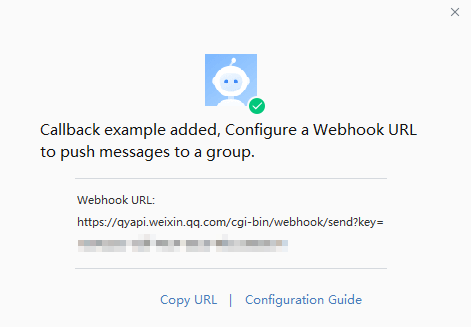
5. Copy the webhook address and configure the API callback by following Step 2.


WeCom for Web

1. On WebCom for Web, open the target WeCom group for receiving alarm notifications.
2. Click the group settings icon in the upper-right corner.
3. On the group settings page, choose Group Bots > Add a Bot.
4. On the management page for adding bots, enter a custom name for the new bot.
5. Click Add, copy the webhook address, and configure the API callback by following Step 2.

Step 2: Configure the Alarm API Callback

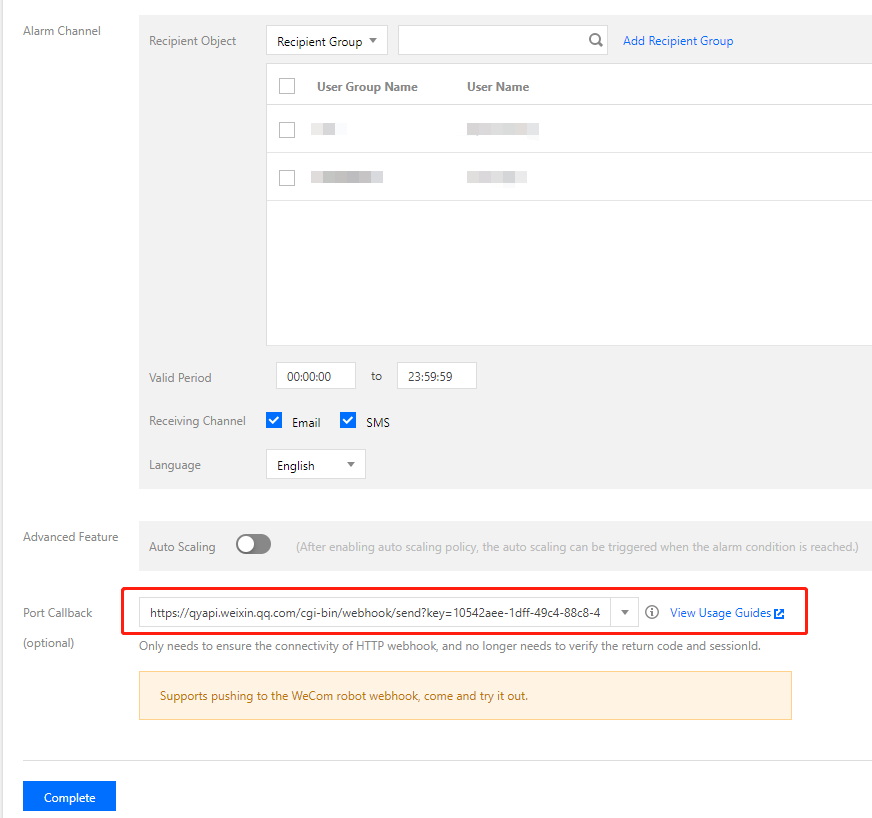
Go to Tencent Cloud Observability Platform Console - Create Alarm Policy, enter the webhook address, and click Complete.


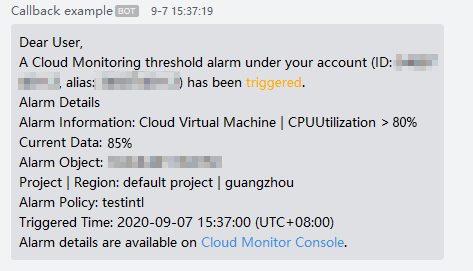
After the configuration is completed successfully, when an alarm policy is triggered or the alarm is resolved, you will receive alarm notifications sent by group bots through the WeCom group, as shown in the following figure:

Ajuda e Suporte

Esta página foi útil?

comentários