tencent cloud

Cloud Log Service

Release Notes and Announcements
Release Notes
Announcements
User Guide
Product Introduction
Overview
Features
Available Regions
Limits
Concepts
Service Regions and Service Providers
Purchase Guide
Billing Overview
Product Pricing
Pay-as-You-Go
Billing
Cleaning up CLS resources
Cost Optimization
FAQs
Getting Started
Getting Started in 1 Minute
Getting Started Guide
Quickly Trying out CLS with Demo
Operation Guide
Resource Management
Permission Management
Log Collection
Metric Collection
Log Storage
Metric Storage
Search and Analysis (Log Topic)
Search and Analysis (Metric Topic)
Dashboard
Data Processing documents
Shipping and Consumption
Monitoring Alarm
Cloud Insight
Independent DataSight console
Historical Documentation
Practical Tutorial
Log Collection
Search and Analysis
Dashboard
Monitoring Alarm
Shipping and Consumption
Cost Optimization
Developer Guide
Embedding CLS Console
CLS Connection to Grafana
API Documentation
History
Introduction
API Category
Making API Requests
Topic Management APIs
Log Set Management APIs
Index APIs
Topic Partition APIs
Machine Group APIs
Collection Configuration APIs
Log APIs
Metric APIs
Alarm Policy APIs
Data Processing APIs
Kafka Protocol Consumption APIs
CKafka Shipping Task APIs
Kafka Data Subscription APIs
COS Shipping Task APIs
SCF Delivery Task APIs
Scheduled SQL Analysis APIs
COS Data Import Task APIs
Data Types
Error Codes
FAQs
Health Check
Collection
Log Search
Others
CLS Service Level Agreement
CLS Policy
Privacy Policy
Data Processing And Security Agreement
Contact Us
Glossary

Global Accelerator Log Upload

PDF
Focus Mode
Font Size
Last updated: 2025-12-03 11:22:42

Use Cases

Tencent Cloud Log Service (CLS) Global Accelerator solution is designed to address the challenge of ensuring stable log uploads in poor network environments. This solution accelerates log upload to CLS via any network. For multinational corporations and mobile Internet enterprises, this solution provides a secure and reliable way to quickly connect websites, mobile applications, and application services, enabling global proximity access and cross-region deployment of network services.

Business Pain Points

High network latency and severe packet loss during log uploads across regions over the public network.
Poor support for mobile application customers, leading to inefficient log upload services.

Global Accelerator Solution

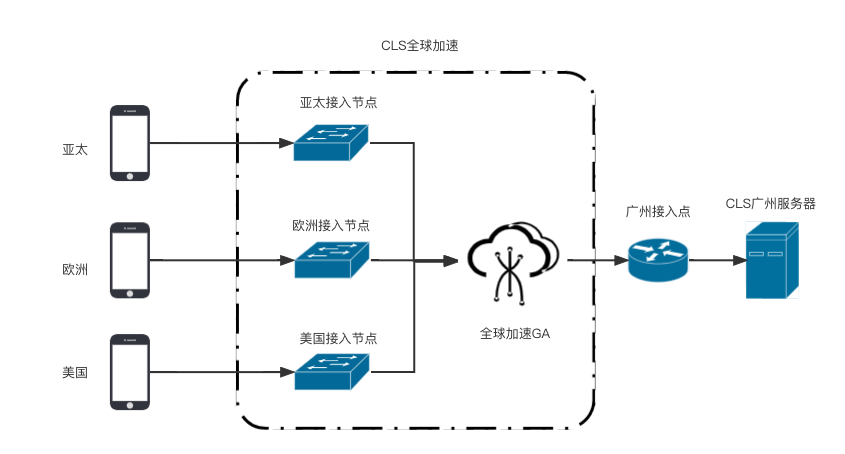
The global cross-region access solution is as shown in the following figure (outside the Chinese mainland -> Guangzhou).


How it works: Proximity access -> Tencent Cloud private network -> Access node in the destination region - CLS server in the destination region.

Solution Highlights

Provides acceleration for latency-sensitive customers.
Provides enterprise-level stable network access.
Provides a secure network environment.
Easy to access and maintain.

Access Method

The feature may involve cross-border data transfer. You need to submit a ticket to apply for using the feature. In the ticket, describe the following information:
Log source region
Log destination region
Estimated maximum required bandwidth
Account information (AppID)
Once the ticket is approved, we will provide a dedicated log upload acceleration domain name for your account. Using this domain name, you can accelerate cross-region log uploads through the following method.

Collecting Logs with LogListener for Upload Acceleration

First-Time Installation of LogListener
See LogListener Installation Guide to download and install LogListener. For the LogListener initialization steps, take the installation path /usr/local/ as an example. In the /usr/local/loglistener/tools path, run the LogListener initialization command with root permissions. The initialization command is as follows:
./loglistener.sh init -secretid AKID******************************** -secretkey whHwQfjdLnzzCE1jIf09xxxxxxxxxxxx -domain asccelerate-xxxxx-ap-xxxxx -IP xxx.xxx.xxx.xxx
Note:
In the initialization command, -secretid, -secretkey, and -domain are required parameters. For more parameters, see the Parameter Description section below.

Parameter Description

Parameter Name
Required
Type Description
secretid
Yes
Part of the cloud API key. SecretId is used to identify the API caller's identity.
secretkey
Yes
Part of the cloud API key. SecretKey is the key used to encrypt the signature string and verify the signature string on the server side.
domain
Yes
Specify the domain name for log upload acceleration.
IP
No
IP address of the machine. If this parameter is not specified, LogListener will automatically obtain the IP address of the local machine.
label
No
Machine label. If this parameter is specified, the machine will be associated with a group of machines that share the same label. Separate multiple labels with commas. If a machine label is configured, the machine will only be associated with a machine group through the label, not through its IP address. If this parameter is not configured, the machine group can only be associated with the machine through its IP address.
Enabling Global Accelerator for Existing LogListener
1. Log in to your machine.
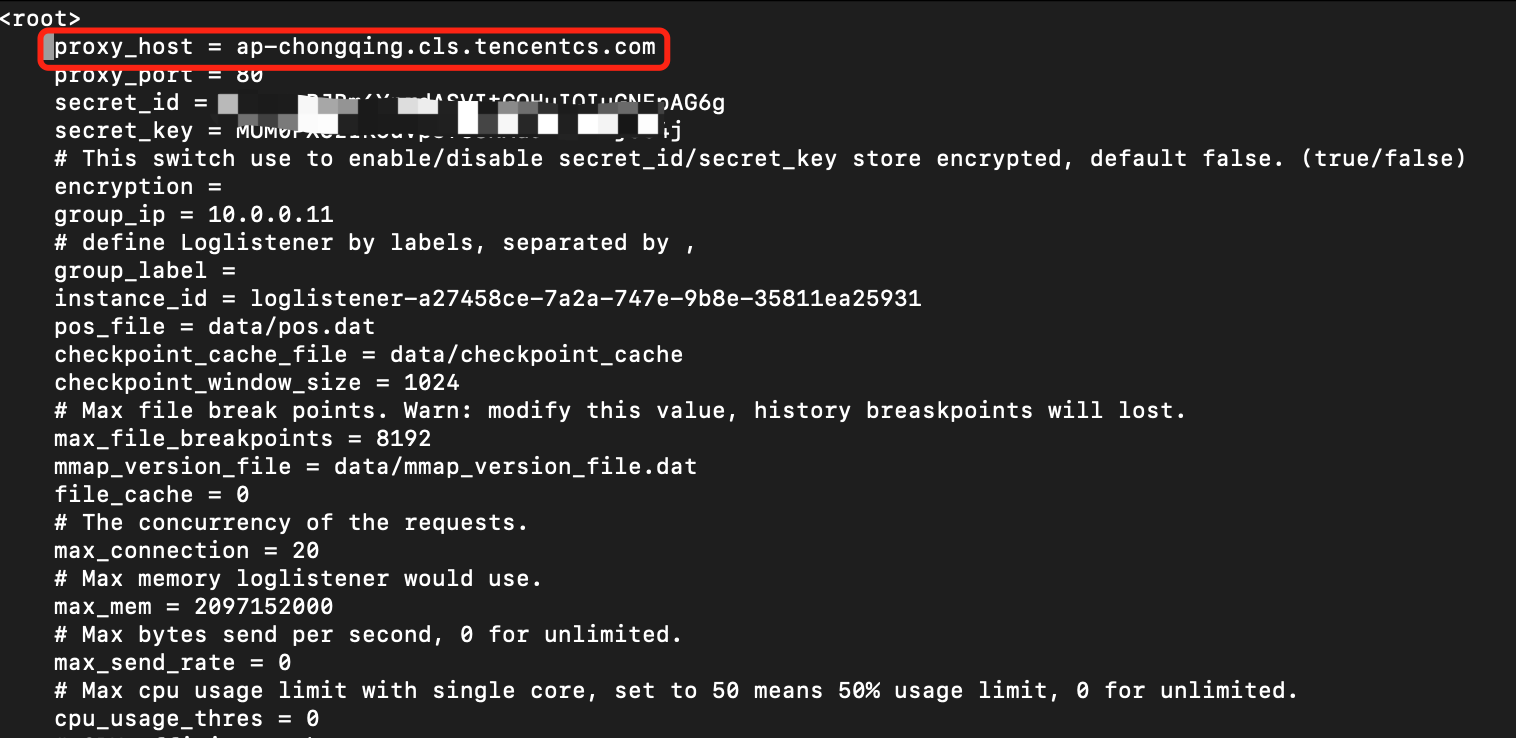
2. Take the LogListener installation path /usr/local/ as an example. In the /usr/local/loglistener/etc path, run the following command to open the LogListener configuration file loglistener.conf.
vim loglistener.conf
3. Locate the proxy-host configuration item and change its value to your Global Accelerator domain name.


4. Run the following command to restart LogListener.
systemctl restart loglistenerd

Upload Acceleration via the API/SDK

Simply replace the host input parameter in the API/SDK with your acceleration domain name to achieve accelerated upload via the API/SDK.

Billing Rule

When using Global Accelerator to upload logs, you are charged based on the write traffic generated after log compression. For billing details, see Product Pricing.
Note:
Using the Global Accelerator feature generates this traffic, while regular public network access does not.
When the Global Accelerator feature is used, log write traffic is not generated repeatedly.


Help and Support

Was this page helpful?

Help us improve! Rate your documentation experience in 5 mins.

Feedback