tencent cloud

Elastic MapReduce

  • Release Notes and Announcements
  • Product Introduction
  • Purchase Guide
    • EMR on CVM Billing Instructions
    • EMR on TKE Billing Instructions
    • EMR Serverless HBase Billing Instructions
    • EMR Serverless TCBase Billing Overview
  • Getting Started
  • EMR on CVM Operation Guide
    • Planning Cluster
    • Administrative rights
    • Configuring Cluster
    • Managing Cluster
    • Managing Service
    • Monitoring and Alarms
    • TCInsight
  • EMR on TKE Operation Guide
  • EMR Serverless HBase Operation Guide
  • EMR Serverless TCBase Operation Guide
  • EMR Development Guide
    • Hadoop Development Guide
    • Spark Development Guide
    • Hbase Development Guide
    • Phoenix on Hbase Development Guide
    • Hive Development Guide
    • Presto Development Guide
    • Sqoop Development Guide
    • Hue Development Guide
    • Oozie Development Guide
    • Flume Development Guide
    • Kerberos Development Guide
    • Knox Development Guide
    • Alluxio Development Guide
    • Kylin Development Guide
    • Livy Development Guide
    • Kyuubi Development Guide
    • Zeppelin Development Guide
    • Hudi Development Guide
    • Superset Development Guide
    • Impala Development Guide
    • Druid Development Guide
    • TensorFlow Development Guide
    • Kudu Development Guide
    • Ranger Development Guide
    • Kafka Development Guide
    • StarRocks Development Guide
    • Flink Development Guide
    • JupyterLab Development Guide
    • MLflow Development Guide
  • Practical Tutorial
    • Practice of EMR on CVM Ops
    • Data Migration
    • Practical Tutorial on Custom Scaling
  • API Documentation
    • History
    • Introduction
    • API Category
    • Making API Requests
    • Cluster Resource Management APIs
    • Cluster Services APIs
    • User Management APIs
    • Information Query APIs
    • Scaling APIs
    • Configuration APIs
    • Other APIs
    • Cluster Lifecycle APIs
    • Serverless HBase APIs
    • YARN Resource Scheduling APIs
    • Data Types
    • Error Codes
  • FAQs
    • EMR on CVM
  • Service Level Agreement
  • Contact Us

Setting Tags

Download
Mode fokus
Ukuran font
Terakhir diperbarui: 2023-12-27 10:01:45

Overview

Tags are key-value pairs provided by Tencent Cloud EMR to identify cluster types or node resources.
You can manage clusters or node resources in a categorized manner by using tags in various dimensions such as business, purpose, and responsible person, or use tags to easily identify them. Tag key-value pairs have no semantic meaning for EMR and are parsed and matched strictly based on strings.

Limits

A tag is a key-value pair. You can set tags for EMR clusters or node resources to manage them in a categorized manner. Then, you can easily view and identify clusters and node resources under the corresponding tags. You can edit tags in the EMR console.
There are several limits on tags:
Quantity limit: Each cluster or node can have up to 50 tags. (Up to five tags can be added at a time.)
Tag key limits:
You cannot use "qcloud", "tencent", or "project" at the beginning of a tag key because they are reserved by the system.
A tag key can contain up to 255 characters. Only digits, letters, and the + = . @ - symbols are supported.
Tag value limit: A tag value can contain up to 127 characters. Only digits, letters, symbols + = . @ -, and a null string are supported.

Directions

Editing cluster tags

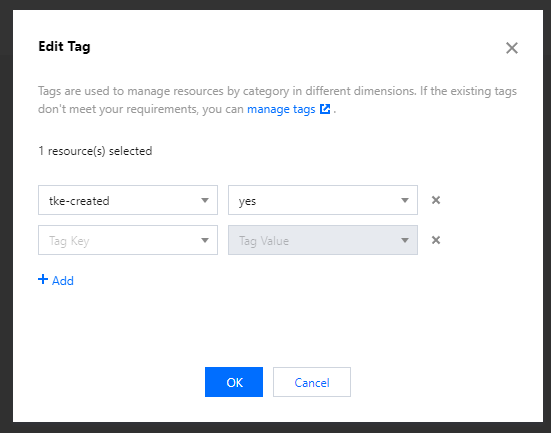
1. Log in to the EMR console, select the target cluster on the Cluster list page and click More > Edit tag.

2. Add, modify or delete tags as needed in the pop-up dialog box.
Note
You can edit tags for up to 20 clusters at a time.

Editing node tags

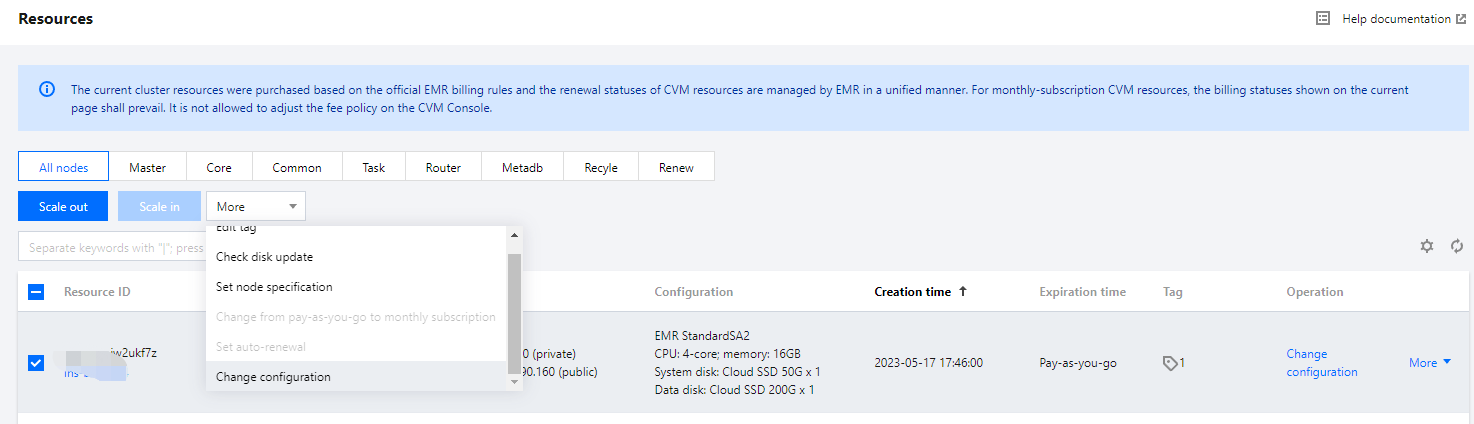
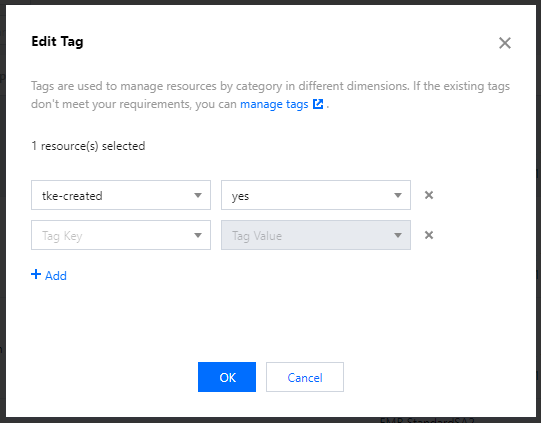
1. Log in to the EMR console and click a cluster ID/name to go to the cluster details page. Select Cluster resources > Resources, select the target node, and click More > Edit tag.

2. Add, modify or delete tags as needed in the pop-up dialog box.
Note
You can edit tags for up to 20 clusters at a time.

Bantuan dan Dukungan

Apakah halaman ini membantu?

masukan