tencent cloud

Elasticsearch Service

User Guide
Release Notes and Announcements
Release Notes
Product Announcements
Security Announcement
Product Introduction
Overview
Elasticsearch Version Support Notes
Features
Elastic Stack (X-Pack)
Strengths
Scenarios
Capabilities and Restrictions
Related Concepts
Purchase Guide
Billing Overview
Pricing
Elasticsearch Service Serverless Pricing
Notes on Arrears
ES Kernel Enhancement
Kernel Release Notes
Targeted Routing Optimization
Compression Algorithm Optimization
FST Off-Heap Memory Optimization
Getting Started
Evaluation of Cluster Specification and Capacity Configuration
Creating Clusters
Accessing Clusters
ES Serverless Guide
Service Overview
Basic Concepts
5-Minute Quick Experience
Quick Start
Access Control
Writing Data
Data Query
Index Management
Alarm Management
ES API References
Related Issues
Data Application Guide
Data Application Overview
Data Management
Elasticsearch Guide
Managing Clusters
Access Control
Multi-AZ Cluster Deployment
Cluster Scaling
Cluster Configuration
Plugin Configuration
Monitoring and Alarming
Log Query
Data Backup
Upgrade
Practical Tutorial
Data Migration and Sync
Use Case Construction
Index Configuration
SQL Support
Receiving Watcher Alerts via WeCom Bot
API Documentation
History
Introduction
API Category
Instance APIs
Making API Requests
Data Types
Error Codes
FAQs
Product
ES Cluster
Service Level Agreement
Glossary
New Version Introduction
Elasticsearch Service July 2020 Release
Elasticsearch Service February 2020 Release
Elasticsearch Service December 2019 Release

Login User Verification

PDF
Mode fokus
Ukuran font
Terakhir diperbarui: 2021-10-29 15:08:07
Before learning how to access an ES cluster, you need to understand user authentication in ES clusters first.

ES Cluster User Authentication

This feature is used to improve the data access security of ES clusters (for more information, please see Protect your data in the Elastic Stack). You must pass the authentication based on username and password before you can access an ES cluster through Kibana, clients, or APIs. For more information, please see Accessing Cluster from API, Accessing Cluster from Client, and Accessing Cluster from Kibana.
Note:
You are required to set the username and password when creating an ES cluster.
For clusters with this feature not enabled, the username and password will be used only for Kibana login.
For clusters with this feature enabled, the username and password can be used for authentication for ES cluster login in any method.

Elasticsearch Editions Supporting ES Cluster User Authentication

Not all Elasticsearch editions support this feature. The support conditions of all editions are as follows:
Open Source Edition: it does not support this feature.
Basic Edition: only v6.8 or above allows you to enable or disable this feature, while legacy versions do not support this feature.
Platinum Edition: this feature is enabled by default and cannot be disabled.

Notes on Enabling ES Cluster User Authentication

If you did not enable user authentication for an ES cluster previously and now want to enable it by upgrading the cluster or toggling the configuration switch, you need to complete the following steps first:
Modify your business code in advance, so that the username and password can be passed in when relevant APIs are called to normally access the cluster after this feature is enabled.
According to Elasticsearch's official design requirements, you need to fully restart the cluster after enabling this feature. During the restart, the cluster will be unavailable; therefore, please do so at an appropriate time.

Enabling/Disabling ES Cluster User Authentication on Basic Edition v6.8 or Above

When creating a cluster, you can choose whether to enable or disable ES cluster user authentication.
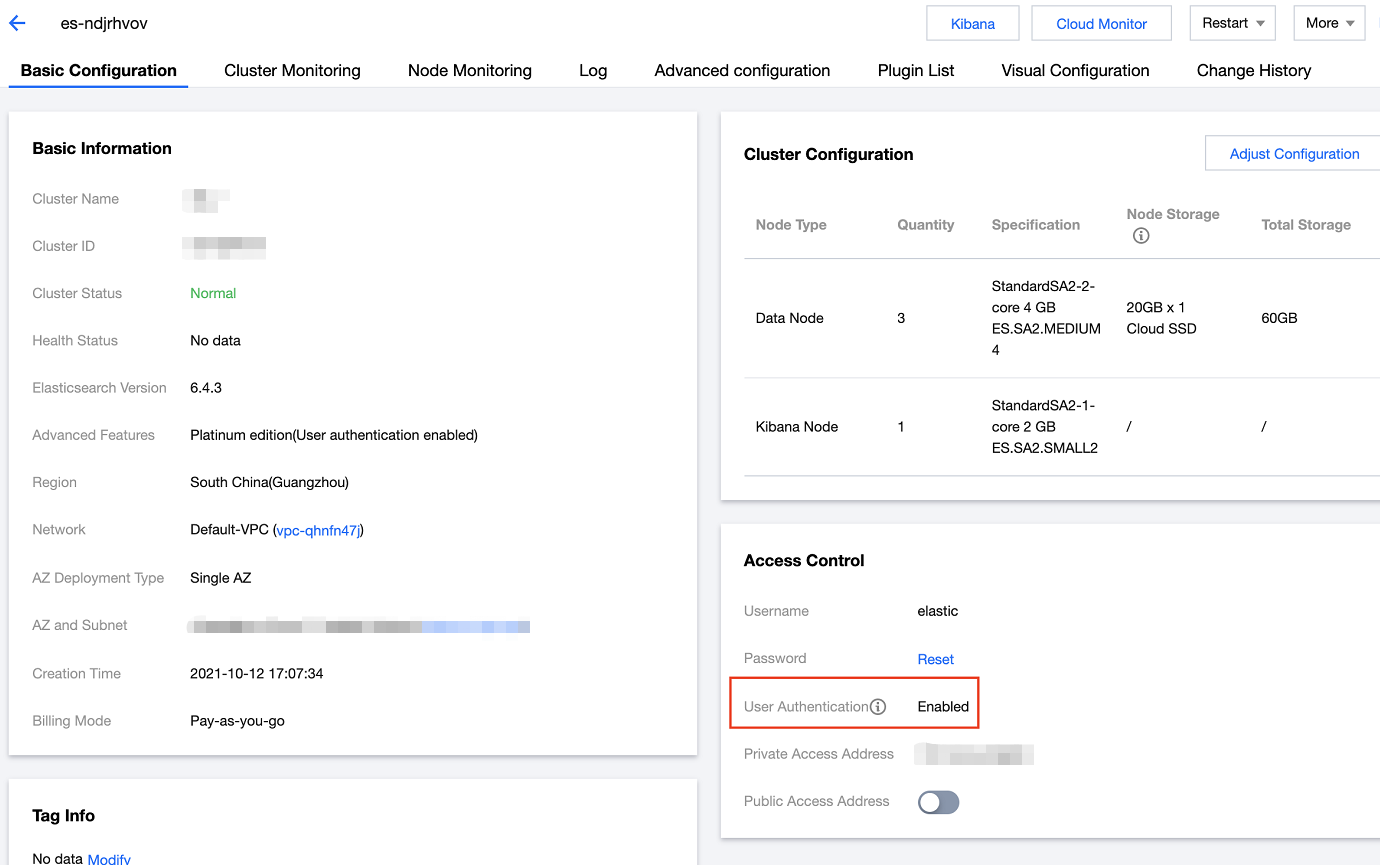
After a cluster is created, if you need to change the feature status, you can enter the cluster details page for configuration.

Bantuan dan Dukungan

Apakah halaman ini membantu?

masukan