tencent cloud

TDMQ for CKafka

Release Notes and Announcements
Release Notes
Broker Release Notes
Announcement
Product Introduction
Introduction and Selection of the TDMQ Product Series
What Is TDMQ for CKafka
Strengths
Scenarios
Technology Architecture
Product Series Introduction
Apache Kafka Version Support Description
Comparison with Apache Kafka
High Availability
Use Limits
Regions and AZs
Related Cloud Services
Billing
Billing Overview
Pricing
Billing Example
Changing from Postpaid by Hour to Monthly Subscription
Renewal
Viewing Consumption Details
Overdue Payments
Refund
Getting Started
Guide for Getting Started
Preparations
VPC Network Access
Public Domain Name Access
User Guide
Usage Process Guide
Configuring Account Permission
Creating Instance
Configuring Topic
Connecting Instance
Managing Messages
Managing Consumer Group
Managing Instance
Changing Instance Specification
Configuring Traffic Throttling
Configuring Elastic Scaling Policy
Configuring Advanced Features
Viewing Monitoring Data and Configuring Alarm Rules
Synchronizing Data Using CKafka Connector
Use Cases
Cluster Resource Assessment
Client Practical Tutorial
Log Integration
Open-Source Ecosystem Integration
Replacing Supporting Route (Old)
Migration Guide
Migration Solution Overview
Migrating Cluster Using Open-Source Tool
Troubleshooting
Topics
Clients
Messages
​​API Reference
History
Introduction
API Category
Making API Requests
Other APIs
ACL APIs
Instance APIs
Routing APIs
DataHub APIs
Topic APIs
Data Types
Error Codes
SDK Reference
SDK Overview
Java SDK
Python SDK
Go SDK
PHP SDK
C++ SDK
Node.js SDK
SDK for Connector
Security and Compliance
Permission Management
Network Security
Deletion Protection
Event Record
CloudAudit
FAQs
Instances
Topics
Consumer Groups
Client-Related
Network-Related
Monitoring
Messages
Agreements
CKafka Service Level Agreements
Contact Us
Glossary
ドキュメントTDMQ for CKafkaUser GuideManaging InstanceConfiguring Instance Termination Protection

Configuring Instance Termination Protection

PDF
フォーカスモード
フォントサイズ
最終更新日: 2026-01-20 17:02:39
After instance deletion protection is enabled, the instance cannot be deleted through the console or an API. To delete the instance, you need to manually disable the deletion protection feature first. It is recommended to keep this feature enabled for key businesses.

Constraints and Limitations

Instance deletion protection does not apply to system-level deletion. For example, postpaid by hour instances are isolated and subsequently released due to overdue payment, and yearly/monthly subscription instances are isolated and released after expiration.

Enabling Instance Deletion Protection

There are three entries to enable instance deletion protection.
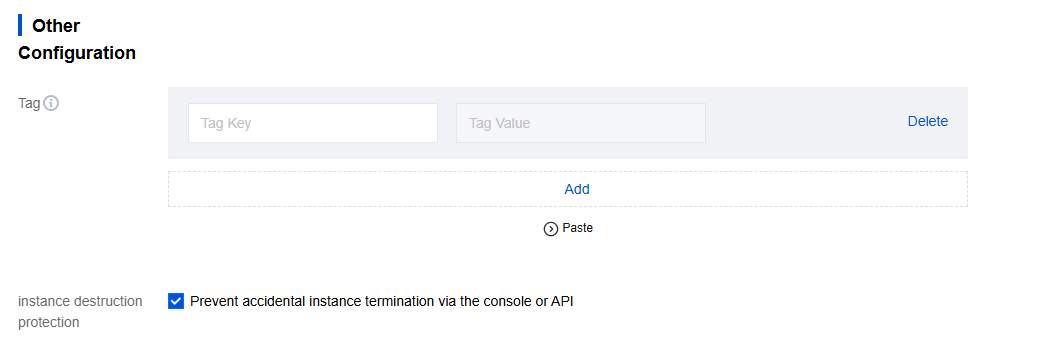
Entry 1: Log in to the TDMQ for CKafka console, click Create in Instance List, and enable instance deletion protection on the purchase page.
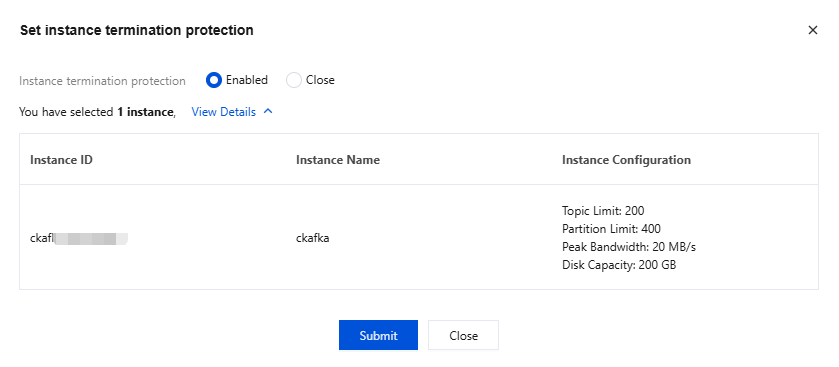
Entry 2: Log in to the CKafka console, choose More > Set Instance Termination Protection in the Operation column of the target instance in Instance List, and enable instance deletion protection.
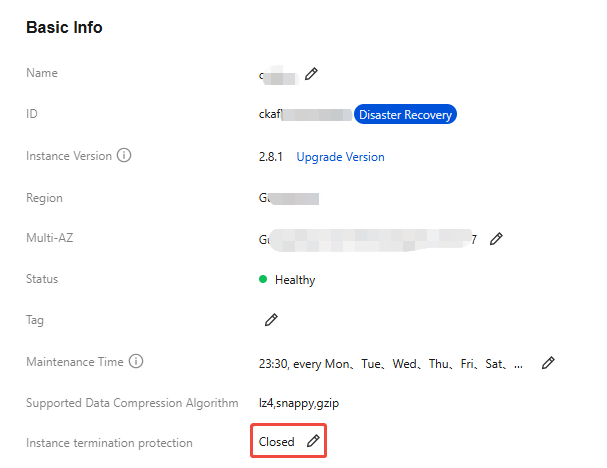
Entry 3: Log in to the CKafka console, click the ID of the target instance in Instance List to go to the basic instance information page, and enable Instance Termination Protection in the Basic Info module.

Disabling Instance Deletion Protection

There are two entries to disable instance deletion protection.
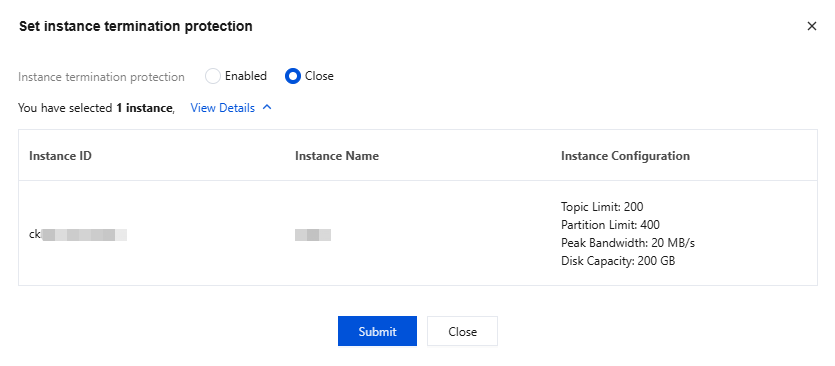
Entry 1: Log in to the CKafka console, choose More > Set Instance Termination Protection in the Operation column of the target instance in Instance List, and disable instance deletion protection.
Entry 2: Log in to the CKafka console, click the ID of the target instance in Instance List to go to the basic instance information page, and disable Instance Termination Protection in the Basic Information module.

ヘルプとサポート

この記事はお役に立ちましたか?

フィードバック