tencent cloud

Tencent Real-Time Communication

Integration Overview (Android)

Download
Mode fokus
Ukuran font
Terakhir diperbarui: 2026-06-15 15:14:30
Build participant, role, and device-control capabilities for AtomicXCore-powered rooms in minutes. This guide walks developers through integrating AtomicXCore’s core features for large-scale webinars, company-wide meetings, and online education. The UI is fully customizable, so you can focus on business logic and refining the end-to-end user experience.
What’s the difference between a standard conference and a webinar?
Standard Conference: Ideal for small to medium collaborative environments. All participants have equal audio/video privileges, with interactive features such as screen sharing and member management.
Webinar: Designed for large-scale live presentations, supports unlimited concurrent audience entry. Audience members can use the "Raise Hand" feature to request guest access and participate in discussions. The system is optimized for high-concurrency chat, supporting tens of thousands of participants and professional presentation needs.

Feature Overview

Host
Guest
Audience
Host can start high-definition audio/video streaming, share screens, and manage participants.
Guest can enable their microphone for real-time voice discussions and sharing.
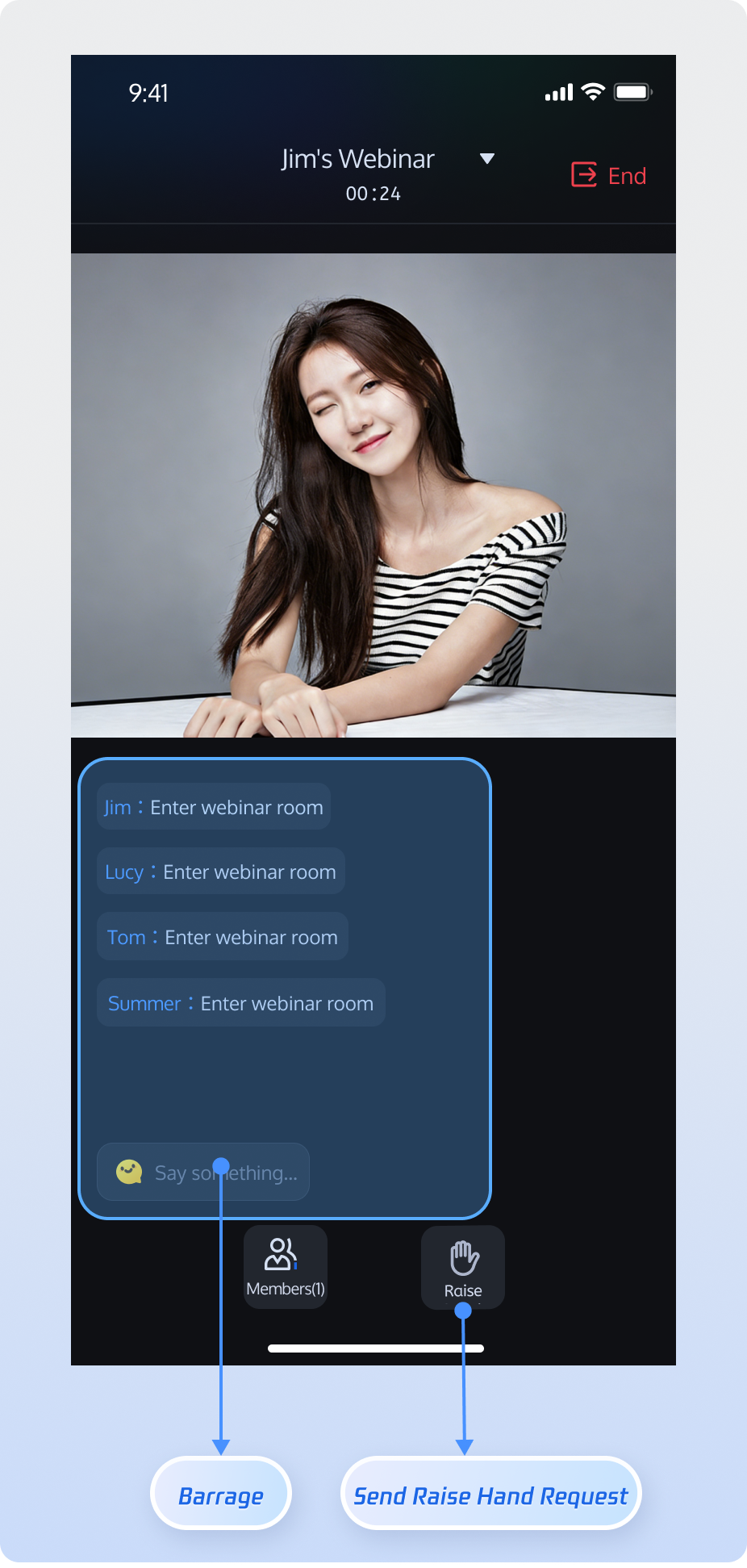
Supports unlimited concurrent audience entry, ultra-low latency viewing, and high-frequency chat. Audience can use "Raise Hand" to request guest access.


Core Features

AtomicXCore provides all the capabilities you need to build a professional webinar solution:
Dual-role system: Room members are classified as Guest (can speak via audio/video) and Audience (view-only). The host can dynamically invite audience members to participate or remove guests from the stage.
Screen sharing: Host can share their screen with all participants in real time to assist presentations and facilitate communication.
Member and permission management: Includes guest list, audience list, admin controls, mute/video-off, and other moderation tools.
Large-scale message interaction: Optimized message throttling for rooms with tens of thousands of participants, ensuring stable real-time chat and live comments.
Core modules of AtomicXCore include:
RoomStore: Handles room management tasks, including create, join, and lifecycle operations.
RoomParticipantStore: Manages room participants, including admin settings, guest/audience management, removing participants, device control, and more.

Preparation

Step 1: Activate the Service

Refer to Activate the Service to claim the TUILiveKit trial version or activate the official TUILiveKit version.
Note:
Webinar functionality is built on live streaming capabilities. Make sure you have claimed the TUILiveKit trial version or activated the official TUILiveKit version for full functionality.

Step 2: Environment Requirements

Android 5.0 (SDK API level 21) or above
Gradle 8.0 or above
Devices running Android 5.0+
Requires JDK version 17, 18, or 19

Step 3: Integrate the AtomicXCore SDK

Add the following dependencies to your build.gradle file, then sync your Gradle project:
dependencies {
implementation 'io.trtc.uikit:atomicx-core:4.0.6.181'
api "com.tencent.imsdk:imsdk-plus:8.7.7201"
}

Step 4: Implement Login Logic

Call LoginStore.shared.login in your project to authenticate. This step is required before using any feature of AtomicXCore.
Important:
We recommend calling LoginStore.shared.login only after your own user account login succeeds, to ensure clear and consistent login flow.
import android.os.Bundle
import androidx.appcompat.app.AppCompatActivity
import io.trtc.tuikit.atomicxcore.api.login.LoginStore
import io.trtc.tuikit.atomicxcore.api.CompletionHandler
import android.util.Log

class MainActivity : AppCompatActivity() {
override fun onCreate(savedInstanceState: Bundle?) {
super.onCreate(savedInstanceState)

LoginStore.shared.login(
this, // context
1400000001, // Replace with your project's sdkAppID
"test_001", // Replace with your project's userID
"xxxxxxxxxxx", // Replace with your project's userSig
object : CompletionHandler {
override fun onSuccess() {
// Login successful
Log.d("Login", "login success");
}

override fun onFailure(code: Int, desc: String) {
// Login failed
Log.e("Login", "login failed, code: $code, error: $desc");
}
}
)
}
}
Login API Parameters:
Parameter
Type
Description
sdkAppID
Int
userID
String
Unique ID for the current user. Use only English letters, numbers, hyphens, and underscores. Avoid simple IDs like 1 or 123 to prevent multi-device login conflicts.
userSig
String
Authentication token for Tencent Cloud.
For development, generate with GenerateTestUserSig.genTestSig or the UserSig Helper Tool.
For production, always generate UserSig server-side to protect your SecretKey. See Server-side UserSig Generation and How to Calculate and Use UserSig.

Setting Up a Webinar Room

Step 1: Create and Join a Webinar Room

Follow the steps below to set up a webinar room quickly.


Tip:
For business logic related to host room creation and joining, see the open-source TUIRoomKit project. Refer to RoomMainActivity.kt and RoomMainView.kt for complete implementation details.

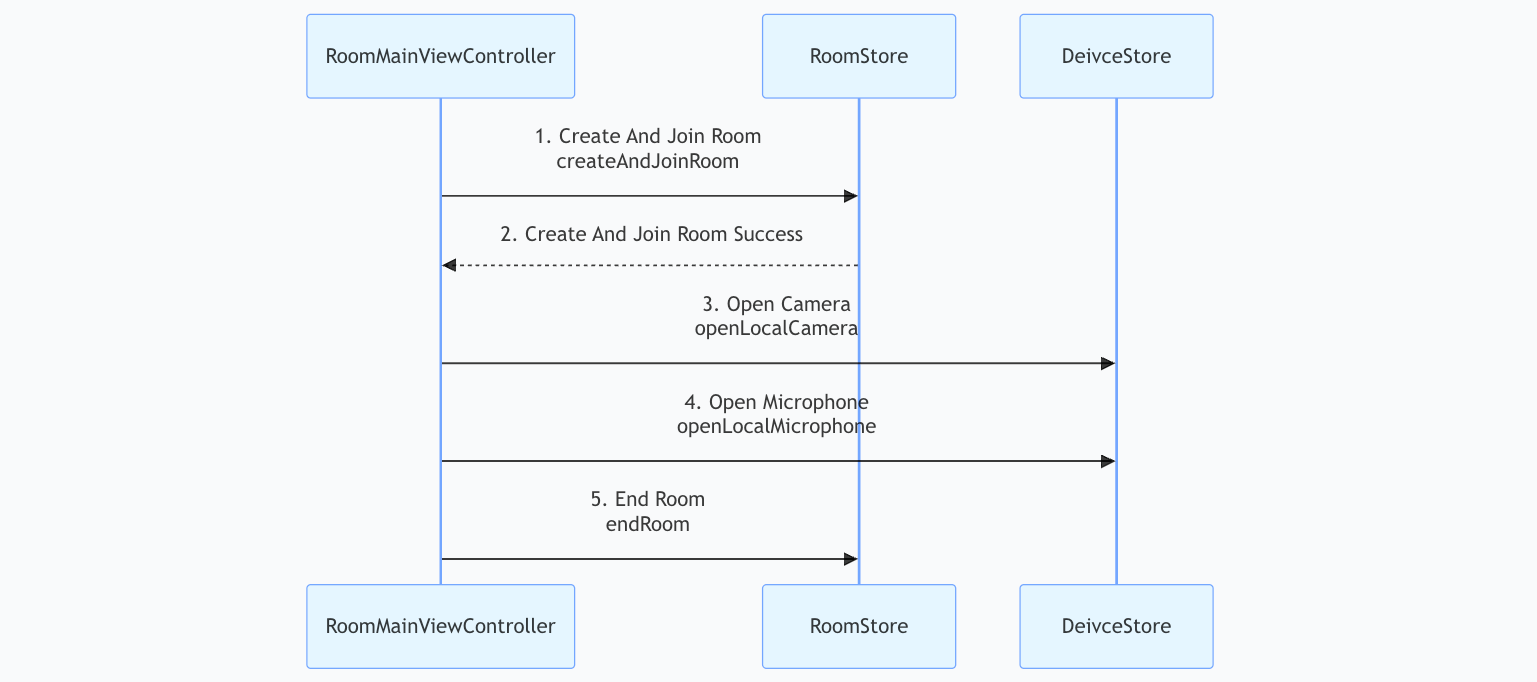
1. Creating and Joining a Room

Implementation Steps:
1.1 Configure Room Initialization Parameters: Create a CreateRoomOptions object and set room name and configuration.
1.2 Create and Join Room: Call RoomStore.createAndJoinRoom to execute the operation.
Example:
import android.os.Bundle
import android.util.Log
import androidx.appcompat.app.AppCompatActivity
import io.trtc.tuikit.atomicxcore.api.CompletionHandler
import io.trtc.tuikit.atomicxcore.api.room.CreateRoomOptions
import io.trtc.tuikit.atomicxcore.api.room.RoomStore
import io.trtc.tuikit.atomicxcore.api.room.RoomType

class RoomMainActivity : AppCompatActivity() {
private val roomID = "webinar_123456"

override fun onCreate(savedInstanceState: Bundle?) {
super.onCreate(savedInstanceState)
createAndJoinRoom()
}

private fun createAndJoinRoom() {
val options = CreateRoomOptions()
options.roomName = "My Webinar" // Room display name
options.password = "" // Not supported for webinar rooms

// Permission presets for initial room state
options.isAllCameraDisabled = false
options.isAllMessageDisabled = false
options.isAllMicrophoneDisabled = false
options.isAllScreenShareDisabled = false

RoomStore.shared().createAndJoinRoom(roomID, RoomType.WEBINAR, options, object : CompletionHandler {
override fun onSuccess() {
Log.d("Room", "Successfully created and joined webinar room")
}

override fun onFailure(code: Int, desc: String) {
Log.e("Room", "Failed to create and join webinar room [Error code: $code]: $desc")
}
})
}
}
createAndJoinRoom API Parameters
Parameter Name
Type
Required
Description
roomID
String
Yes
Unique room identifier.
0-48 bytes.
Use numbers, English letters, underscores (_), hyphens (-). Avoid spaces and Chinese characters.
roomType
RoomType
Yes
Room type:
STANDARD: Standard room.
WEBINAR: Webinar room.
Use WEBINAR for webinar scenarios.
options
CreateRoomOptions
Yes
Room configuration object.
See CreateRoomOptions Struct documentation.
completion
CompletionHandler
No
Callback for operation result; returns error code/message on failure.

CreateRoomOptions Struct

Parameter Name
Type
Required
Description
roomName
String
No
Room name (optional, defaults to empty).
0-60 bytes.
Supports English/Chinese, numbers, special characters.
password
String
No
Room password (empty means no password).
0-32 bytes.
Use 4-8 digit numbers for easy input. Avoid plain-text sensitive data. Passwords not supported for webinars; leave empty.
isAllMicrophoneDisabled
Boolean
No
Disable microphones for all. Only host/admin can open mic. Guests are muted by default.
true: Disabled.
false: Enabled (default).
isAllCameraDisabled
Boolean
No
Disable cameras for all. Only host/admin can open camera. Guests are video-off by default.
true: Disabled.
false: Enabled (default).
isAllScreenShareDisabled
Boolean
No
Disable screen sharing for all (only host/admin can share):
true: Disabled.
false: Enabled (default).
isAllMessageDisabled
Boolean
No
Disable chat messages for all (mute):
true: Disabled.
false: Enabled (default).

2. Role-Based Media Controls

Roles have distinct media device permissions:
Host: Can turn on the camera and microphone, publish audio/video, and share the screen.
Guest: Can turn on the microphone and publish audio for real-time discussion.
Audience: View-only; cannot turn on or publish audio/video.
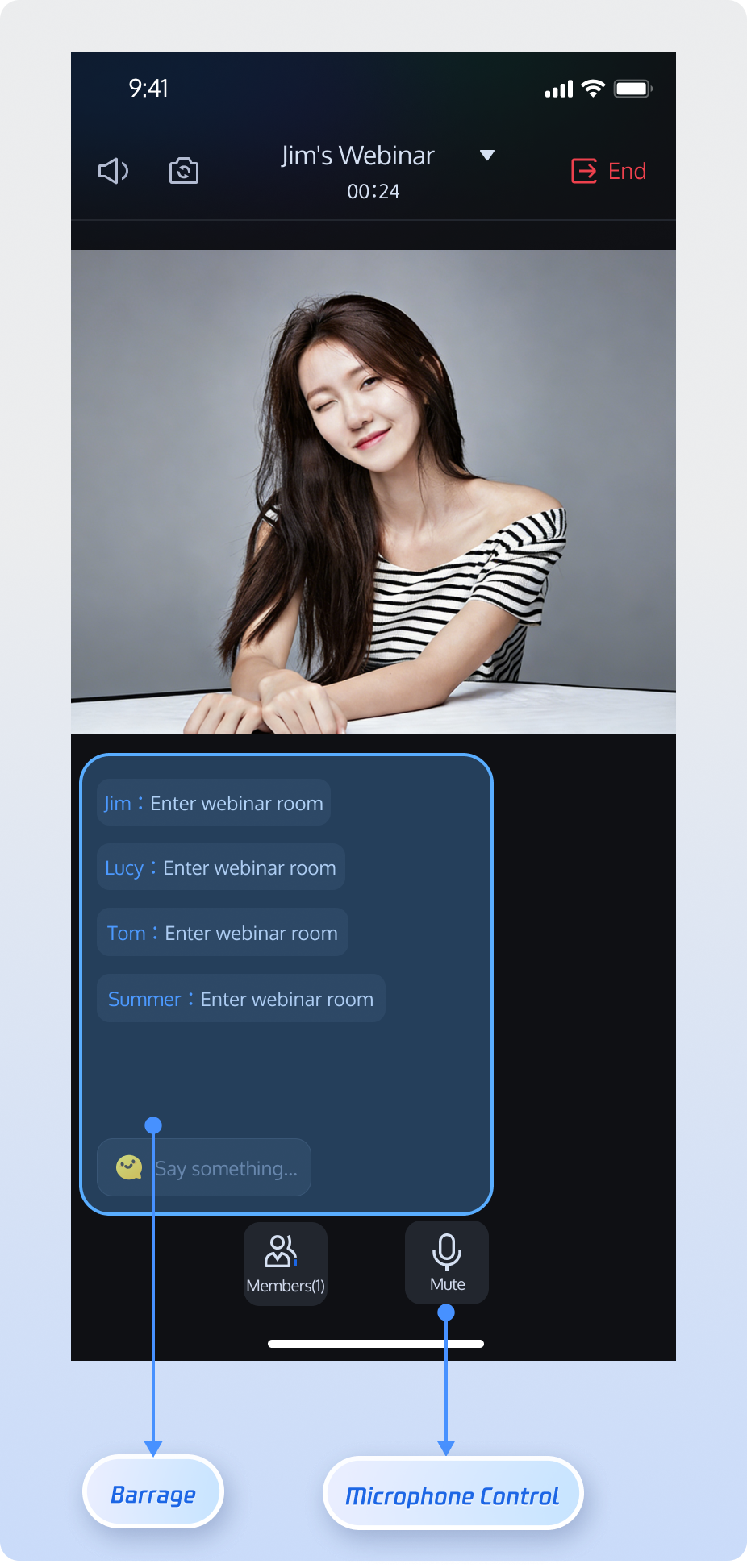
After entering the room, call DeviceStore.openLocalCamera and DeviceStore.openLocalMicrophone to enable local audio or video capturing. To start screen sharing, call startScreenShare (the camera must be turned off before screen sharing).
import android.os.Bundle
import androidx.appcompat.app.AppCompatActivity
import io.trtc.tuikit.atomicxcore.api.device.DeviceStore

class RoomMainActivity : AppCompatActivity() {
override fun onCreate(savedInstanceState: Bundle?) {
super.onCreate(savedInstanceState)
openDevices()
}

private fun openDevices() {
// Open front camera
DeviceStore.shared().openLocalCamera(true, completion = null)
// Open microphone
DeviceStore.shared().openLocalMicrophone(completion = null)
// Start screen sharing (camera must be closed first)
// DeviceStore.shared().closeLocalCamera()
// DeviceStore.shared().startScreenShare()
}
}
Note:
In webinar mode, mobile devices support only one upstream video stream. When the camera is enabled, screen sharing must be disabled, and vice versa.
openLocalCamera API Parameters:
Parameter Name
Type
Required
Description
isFront
Boolean
Yes
Use front camera:
true: Enable front camera.
false: Enable rear camera .
completion
CompletionHandler
No
Callback for camera activation result; returns error code/message on failure.

3. End a Room

To end the room, the host calls RoomStore.endRoom. All room members will receive a room ended event.
import android.os.Bundle
import android.util.Log
import androidx.appcompat.app.AppCompatActivity
import io.trtc.tuikit.atomicxcore.api.CompletionHandler
import io.trtc.tuikit.atomicxcore.api.room.RoomStore

class RoomMainActivity : AppCompatActivity() {
override fun onCreate(savedInstanceState: Bundle?) {
super.onCreate(savedInstanceState)
endRoom()
}

private fun endRoom() {
// Only the host can end the room. All members are removed and audio/video capture is stopped.
RoomStore.shared().endRoom(object : CompletionHandler {
override fun onSuccess() {
Log.d("Room", "Room ended successfully")
}

override fun onFailure(code: Int, desc: String) {
Log.e("Room", "Failed to end room [Error code: $code]: $desc")
}
})
}
}

Step 2: Join a Webinar Room

1. Join a Room

To join an existing room, call RoomStore.joinRoom.
import android.os.Bundle
import android.util.Log
import androidx.appcompat.app.AppCompatActivity
import io.trtc.tuikit.atomicxcore.api.CompletionHandler
import io.trtc.tuikit.atomicxcore.api.room.RoomStore
import io.trtc.tuikit.atomicxcore.api.room.RoomType

class RoomMainActivity : AppCompatActivity() {
private val roomID = "webinar_123456"

override fun onCreate(savedInstanceState: Bundle?) {
super.onCreate(savedInstanceState)
joinRoom()
}

private fun joinRoom() {
val targetRoomID = this.roomID

RoomStore.shared().joinRoom(targetRoomID, RoomType.WEBINAR, completion = object : CompletionHandler {
override fun onSuccess() {
Log.d("Room", "Joined room successfully")
}

override fun onFailure(code: Int, desc: String) {
Log.e("Room", "Failed to join room [Error code: $code]: $desc")
}
})
}
}
joinRoom API Parameters
Parameter Name
Type
Required
Description
roomID
String
Yes
Unique room identifier.
0-48 bytes.
Use numbers, English letters, underscores (_), hyphens (-). Avoid spaces and Chinese characters.
roomType
RoomType
Yes
Room type:
STANDARD: Standard room.
WEBINAR: Webinar room.
Use WEBINAR for webinar scenarios.
password
String
No
Room password (empty means no password).
0-32 bytes.
Use 4-8 digits for mobile input. Avoid plain-text sensitive data. Passwords not supported for webinars; leave empty.
completion
CompletionHandler
No
Callback for operation result; returns error code/message on failure.

2. Leave a Room

To leave a room, call RoomStore.leaveRoom.
import android.os.Bundle
import android.util.Log
import androidx.appcompat.app.AppCompatActivity
import io.trtc.tuikit.atomicxcore.api.CompletionHandler
import io.trtc.tuikit.atomicxcore.api.room.RoomStore

class RoomMainActivity : AppCompatActivity() {
override fun onCreate(savedInstanceState: Bundle?) {
super.onCreate(savedInstanceState)
leaveRoom()
}

private fun leaveRoom() {
// leaveRoom is used by ordinary members or the host to exit the room. The room remains if the host leaves.
RoomStore.shared().leaveRoom(object : CompletionHandler {
override fun onSuccess() {
Log.d("Room", "Left room successfully")
}

override fun onFailure(code: Int, desc: String) {
Log.e("Room", "Failed to leave room [Error code: $code]: $desc")
}
})
}
}

Step 3: Bind a Video View

The RoomView component encapsulates streaming logic for webinars. Simply render the RoomView component on your page to enable webinar room audio/video features. Pair video rendering with TUIRoomKit components.
RoomView built-in capabilities:
Host: Supports video and screen sharing.
Guest: Automatically plays the host’s real-time audio/video stream.
Audience: Automatically plays ultra-low latency live streams, providing smooth viewing even with massive concurrency..
Tip:
RoomView is a video rendering component for room streams. For full implementation details, see RoomView.kt in the open-source TUIRoomKit project.
<com.trtc.uikit.roomkit.view.main.RoomView
android:id="@+id/room_view"
android:layout_width="match_parent"
android:layout_height="match_parent"
app:layout_constraintStart_toStartOf="parent"
app:layout_constraintTop_toTopOf="parent" />

Step 4: Manage Guest and Audience Roles

As host or admin, call RoomParticipantStore.promoteAudienceToParticipant to promote an audience member to guest.
To demote a guest to audience, call RoomParticipantStore.demoteParticipantToAudience.
import android.util.Log
import io.trtc.tuikit.atomicxcore.api.CompletionHandler
import io.trtc.tuikit.atomicxcore.api.room.RoomParticipantStore

fun promoteAudienceToParticipant(userID: String) {
val participantStore = RoomParticipantStore.create(roomID = "webinar_123456")

participantStore.promoteAudienceToParticipant(userID = userID, completion = object : CompletionHandler {
override fun onSuccess() {
Log.d("Test", "Successfully promoted to guest")
}

override fun onFailure(code: Int, desc: String) {
Log.e("Test", "Failed to promote to guest [Error code: $code]: $desc")
}
})
}

fun demoteParticipantToAudience(userID: String) {
val participantStore = RoomParticipantStore.create(roomID = "webinar_123456")

participantStore.demoteParticipantToAudience(userID = userID, completion = object : CompletionHandler {
override fun onSuccess() {
Log.d("Test", "Successfully demoted to audience")
}

override fun onFailure(code: Int, desc: String) {
Log.e("Test", "Failed to demote to audience [Error code: $code]: $desc")
}
})
}

Step 5: Listen to Room Events

After joining a room, subscribe to passive room events by calling RoomStore.addRoomListener and handling events in RoomListener.
import android.os.Bundle
import android.util.Log
import androidx.appcompat.app.AppCompatActivity
import io.trtc.tuikit.atomicxcore.api.room.RoomInfo
import io.trtc.tuikit.atomicxcore.api.room.RoomListener
import io.trtc.tuikit.atomicxcore.api.room.RoomStore

class RoomMainActivity : AppCompatActivity() {
private val roomListener = object : RoomListener() {
override fun onRoomEnded(roomInfo: RoomInfo) {
Log.d("Room", "The current room has ended")
}
// ... handle other RoomListener events ...
}

override fun onCreate(savedInstanceState: Bundle?) {
super.onCreate(savedInstanceState)
subscribeRoomEvents()
}

private fun subscribeRoomEvents() {
RoomStore.shared().addRoomListener(roomListener)
}

override fun onDestroy() {
super.onDestroy()
RoomStore.shared().removeRoomListener(roomListener)
}
}

API Documentation

Store/Component
Description
API Documentation
RoomStore
Complete room lifecycle management: create & join, join, leave, end room, update/get room info, and listen to passive events (such as room disband, room info update, etc.).
RoomParticipantStore
In-room member management: assign admin, transfer host, retrieve guest list, retrieve audience list, remove members, control guest devices.

FAQs

Why am I seeing a compilation error about allowBackup after integrating the SDK?


Cause: The allowBackup attribute is defined in multiple modules' AndroidManifest.xml files, resulting in a conflict.
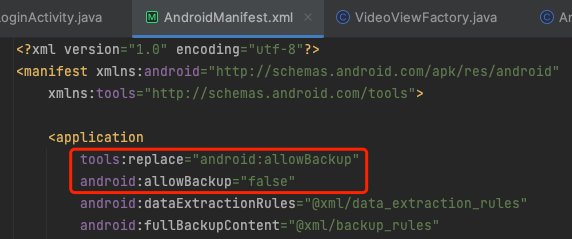
Solution: Remove the allowBackup attribute from your project's AndroidManifest.xml or set it to false to disable backup and restore. To override settings from other modules, add tools:replace="android:allowBackup" to your application's manifest node. Example fix:


Why can't the other party see video after enabling devices via DeviceStore API?

Check whether camera and microphone permissions have been requested
On Android 6.0 and above, you must request permissions dynamically:
1. Declare permissions in AndroidManifest.xml:
<uses-permission android:name="android.permission.CAMERA" />
<uses-permission android:name="android.permission.RECORD_AUDIO" />
2. Request permissions at runtime:
import android.Manifest
import android.content.pm.PackageManager
import android.os.Bundle
import android.util.Log
import androidx.appcompat.app.AppCompatActivity
import androidx.core.app.ActivityCompat
import androidx.core.content.ContextCompat
import io.trtc.tuikit.atomicxcore.api.device.DeviceStore

class RoomMainActivity : AppCompatActivity() {
private val PERMISSION_REQUEST_CODE = 1001

override fun onCreate(savedInstanceState: Bundle?) {
super.onCreate(savedInstanceState)
checkAndRequestPermissions()
}

private fun checkAndRequestPermissions() {
val permissions = arrayOf(
Manifest.permission.CAMERA,
Manifest.permission.RECORD_AUDIO
)

val permissionsToRequest = permissions.filter {
ContextCompat.checkSelfPermission(this, it) != PackageManager.PERMISSION_GRANTED
}

if (permissionsToRequest.isNotEmpty()) {
ActivityCompat.requestPermissions(
this,
permissionsToRequest.toTypedArray(),
PERMISSION_REQUEST_CODE
)
} else {
openDevices()
}
}

override fun onRequestPermissionsResult(
requestCode: Int,
permissions: Array<out String>,
grantResults: IntArray
) {
super.onRequestPermissionsResult(requestCode, permissions, grantResults)
if (requestCode == PERMISSION_REQUEST_CODE) {
if (grantResults.all { it == PackageManager.PERMISSION_GRANTED }) {
openDevices()
} else {
Log.e("Permission", "Some permissions were denied")
}
}
}

private fun openDevices() {
DeviceStore.shared().openLocalCamera(isFront = true, completion = null)
DeviceStore.shared().openLocalMicrophone(completion = null)
}

Why is there no video/audio when capturing in the background on Android 14 and above?

On Android 14+, apps that capture camera or microphone data in the background must start a foreground service and declare the corresponding service type. Otherwise, capture will not work. Solution:
1. Declare FOREGROUND_SERVICE, FOREGROUND_SERVICE_CAMERA, and FOREGROUND_SERVICE_MICROPHONE permissions and the service in AndroidManifest.xml.
<uses-permission android:name="android.permission.FOREGROUND_SERVICE" />
<uses-permission android:name="android.permission.FOREGROUND_SERVICE_CAMERA" />
<uses-permission android:name="android.permission.FOREGROUND_SERVICE_MICROPHONE" />

<service
android:name=".MediaCaptureService"
android:foregroundServiceType="camera|microphone" />
2. Start the background capture service after launching the interface.
import android.app.NotificationChannel
import android.app.NotificationManager
import android.app.Service
import android.content.Intent
import android.content.pm.ServiceInfo
import android.os.Bundle
import android.os.IBinder
import androidx.appcompat.app.AppCompatActivity
import androidx.core.app.NotificationCompat

class MainActivity : AppCompatActivity() {
override fun onCreate(savedInstanceState: Bundle?) {
super.onCreate(savedInstanceState)
startForegroundService(Intent(this, MediaCaptureService::class.java))
}
}

class MediaCaptureService : Service() {
override fun onCreate() {
super.onCreate()
val channel = NotificationChannel("media", "Media Capture", NotificationManager.IMPORTANCE_LOW)
getSystemService(NotificationManager::class.java).createNotificationChannel(channel)

val notification = NotificationCompat.Builder(this, "media")
.setContentTitle("Audio/Video Call in Progress")
.setSmallIcon(android.R.drawable.ic_menu_call)
.build()

startForeground(1, notification,
ServiceInfo.FOREGROUND_SERVICE_TYPE_CAMERA or ServiceInfo.FOREGROUND_SERVICE_TYPE_MICROPHONE)
}

override fun onBind(intent: Intent?): IBinder? = null
}

Contact Us

For integration or usage questions and feedback, contact info_rtc@tencent.com.

Bantuan dan Dukungan

Apakah halaman ini membantu?

masukan