tencent cloud

Tencent Cloud Distributed Cache (Redis OSS-Compatible)

Release Notes and Announcements
Release Notes
Announcements
User Tutorial
Product Introduction
Overview
Product Strengths
Use Cases
Storage Engine
Product Series
Product Versions
Specifications and Performance
Read/Write Separation
Multi-AZ Deployment
Regions and AZs
Terms
Service Regions and Service Providers
Purchase Guide
Billing Overview
Pricing Center
Instance Purchasing
Renewal (Yearly/Monthly Subscription)
Refund (Yearly/Monthly Subscription)
Overdue Payments
Switching from Pay-as-You-Go to Yearly/Monthly Subscription
Getting Started
Quickly Creating an Instance
Connecting to Redis Instance
Operation Guide
Operation Overview
Connecting to a Database Instance
Managing Instances
Upgrade Instance
Management Node (Redis/ValKey Edition)
Multi-AZ Deployment Management
Backup and Restoration
Managing Accounts
Parameter Configuration
Slow Query
Access Management
Network and Security
Monitoring and Alarms
Event Management (Redis/ValKey Edition)
Data Migration
Global Replication for Redis Edition
Database Audit
Performance Optimization
Sentinel Mode
Development Guidelines
Naming Rules
Basic Usage Guidelines
Design Principles of Key and Value
Command Usage Guidelines
Design Principles of Client Programs
Connection Pool Configuration
Command Reference
Command Reference Overview
Redis Edition and Valkey Edition Command Compatibility
Version Command Usage Differences
Differences Between the Proxy Architecture and Direct Connection Mode
More Command Operations (Redis/Valkey Edition)
Memcached Edition Command Compatibility
Practical Tutorial
Building TencentDB for Redis® Client Monitoring Based on Spring Boot
Redis Client Connection Configuration Policy and Practice
Global SCAN Guide for Cluster Architecture
Eliminating Instances Securely
Hot Key and Big Key
AZ Migration Scheme
Troubleshooting
Connection Exception
Exception Analysis and Solution of Redisson Client Timeout Reconnection
Performance Troubleshooting and Fine-Tuning
API Documentation
History
Introduction
API Category
Making API Requests
Instance APIs
Parameter Management APIs
Other APIs
Backup and Restoration APIs
Region APIs
Monitoring and Management APIs
Log APIs
Data Types
Error Codes
FAQs
General
Connection and Login
Purchase
Service Agreement
Service Level Agreement
Terms of Service
Glossary
Contact Us

Standard Architecture

PDF
フォーカスモード
フォントサイズ
最終更新日: 2026-03-17 16:36:34

Architecture Overview

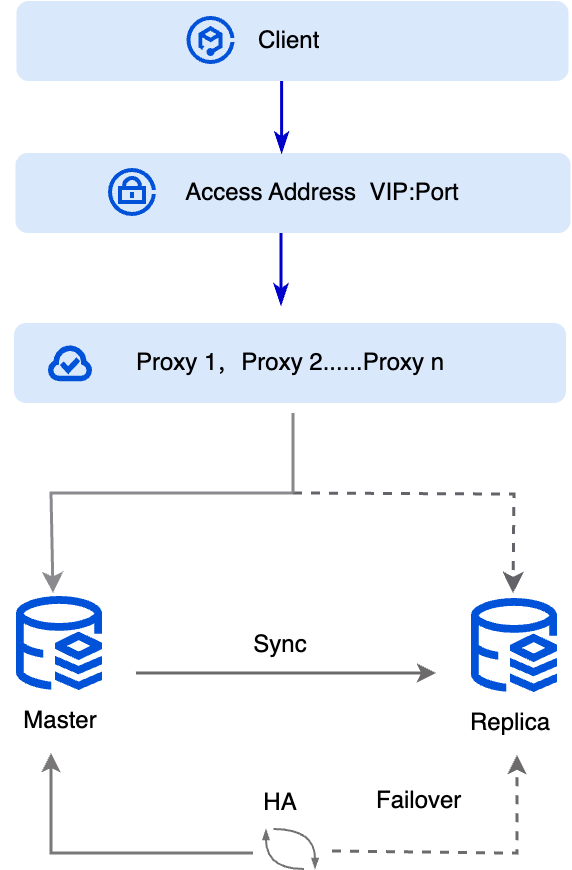
The standard architecture adopts the primary-secondary replication mode, supporting 1 to 5 replica nodes, and is compatible with Redis 4.0, 5.0, 6.2, and 7.0 as well as Valkey 8.0 protocols. The master node provides read/write services, while replica nodes provide high availability assurance. When the master node fails, the system automatically switches to a replica node, ensuring smooth business operation.

Core Components

Component
Description
Master node
The master node is responsible for handling read/write requests and synchronizing data to replica nodes. Each instance has one master node.
Replica node
A replica node is responsible for data redundancy and high availability. It synchronizes data from the master node in real time and automatically takes over as the new master node upon master node failure. The system supports 1 to 5 replicas, where more replicas result in higher availability.
Proxy
A built-in proxy component receives client requests and routes them to the corresponding nodes, providing load balancing and read/write separation capabilities.

Replica Configuration

A larger number of replicas provides higher availability. All replica nodes participate in high-availability failover. When the number of replicas is greater than or equal to 1, you can enable the read/write separation feature to vertically scale read performance. For more information, see Read/Write Separation.
Version
Supported Replica Quantity
Read/Write Separation
Redis 4.0, 5.0, 6.2, and 7.0
1–5
Supported
Valkey 8.0
1–5
Supported

Specification Limits

Item
Value
Description
Capacity
0.25–64 GB
Upgrade the architecture to the cluster architecture (up to 8 TB). For detailed instructions, see Upgrading the Instance Architecture.
Performance upper limit
100,000 QPS
Tencent Cloud conducts multiple stress tests in standard testing environments and uses stable values as official references. For details, see Specifications and Performance.

ヘルプとサポート

この記事はお役に立ちましたか?

フィードバック