tencent cloud

Elastic MapReduce

  • Release Notes and Announcements
  • Product Introduction
  • Purchase Guide
    • EMR on CVM Billing Instructions
    • EMR on TKE Billing Instructions
    • EMR Serverless HBase Billing Instructions
    • EMR Serverless TCBase Billing Overview
  • Getting Started
  • EMR on CVM Operation Guide
    • Planning Cluster
    • Administrative rights
    • Configuring Cluster
    • Managing Cluster
    • Managing Service
    • Monitoring and Alarms
    • TCInsight
  • EMR on TKE Operation Guide
  • EMR Serverless HBase Operation Guide
  • EMR Serverless TCBase Operation Guide
  • EMR Development Guide
    • Hadoop Development Guide
    • Spark Development Guide
    • Hbase Development Guide
    • Phoenix on Hbase Development Guide
    • Hive Development Guide
    • Presto Development Guide
    • Sqoop Development Guide
    • Hue Development Guide
    • Oozie Development Guide
    • Flume Development Guide
    • Kerberos Development Guide
    • Knox Development Guide
    • Alluxio Development Guide
    • Kylin Development Guide
    • Livy Development Guide
    • Kyuubi Development Guide
    • Zeppelin Development Guide
    • Hudi Development Guide
    • Superset Development Guide
    • Impala Development Guide
    • Druid Development Guide
    • TensorFlow Development Guide
    • Kudu Development Guide
    • Ranger Development Guide
    • Kafka Development Guide
    • StarRocks Development Guide
    • Flink Development Guide
    • JupyterLab Development Guide
    • MLflow Development Guide
  • Practical Tutorial
    • Practice of EMR on CVM Ops
    • Data Migration
    • Practical Tutorial on Custom Scaling
  • API Documentation
    • History
    • Introduction
    • API Category
    • Making API Requests
    • Cluster Resource Management APIs
    • Cluster Services APIs
    • User Management APIs
    • Information Query APIs
    • Scaling APIs
    • Configuration APIs
    • Other APIs
    • Cluster Lifecycle APIs
    • Serverless HBase APIs
    • YARN Resource Scheduling APIs
    • Data Types
    • Error Codes
  • FAQs
    • EMR on CVM
  • Service Level Agreement
  • Contact Us

Architecture

Download
포커스 모드
폰트 크기
마지막 업데이트 시간: 2025-01-24 09:49:24
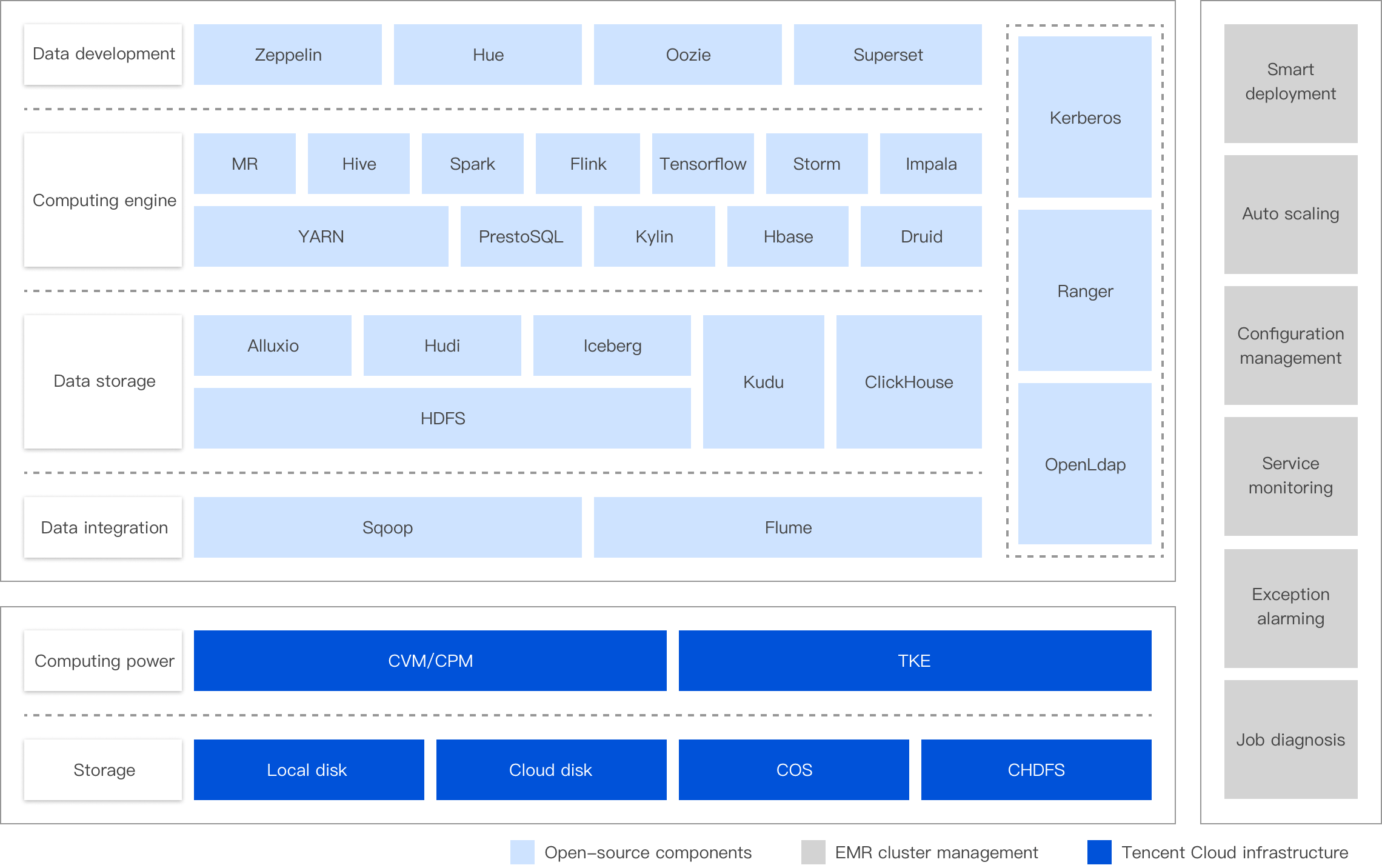
The logical architecture of EMR is as shown below:

An EMR cluster consists mainly of three parts: open-source components, Tencent Cloud infrastructure, and cluster management.
Open-source components
EMR integrates dozens of cutting-edge open-source big data components from the Apache community, such as Hadoop, Hive, Spark, HBase, Presto, Flink, Alluxio, and Iceberg. For more information, see Product Releases and Component Versions.
Based on optimized Iceberg, Alluxio and other open-source components, EMR offers Iceberg Z-Order algorithm, Alluxio transparent URI and other enhanced features.
Tencent Cloud infrastructure
EMR can be deployed based on multiple types of underlying computing resources, including CVM and CBM. It supports containerized deployment.
Data can be stored in a local disk, cloud disk, COS bucket, or CHDFS instance.
VPCs, network ACLs, and security groups provide EMR with a securely isolated network environment.
Cluster Management
EMR supports smart cloud deployment management, including fast creation, flexible scaling, and auto scaling.
EMR offers a great variety of convenient Ops tools, such as service configuration management, batch node management, and visual service Ops.
EMR provides complete cluster monitoring and diagnosis capabilities ranging from multidimensional metric monitoring, event, and inspection to alarming and log search.
도움말 및 지원

문제 해결에 도움이 되었나요?

피드백