Selection Related
Baixar
Modo Foco
Tamanho da Fonte
How to Select a Suitable TencentDB for MySQL Instance?
Before purchasing a TencentDB for MySQL instance, you need to understand the characteristics of different instances to select the appropriate one for your business. The following section describes how to choose a TencentDB for MySQL instance that suits your business needs.
Instance Selection Information
Before purchasing a TencentDB for MySQL instance, you need to consider factors such as price, performance, workload, and business use cases to ensure you can purchase a suitable instance with the best cost-effectiveness. The database storage engine, instance architecture, storage type, and isolation policy are closely related and mutually influential, which may cause confusion during selection. Therefore, this document briefly introduces these components to help you choose the appropriate instance.
I. Database Storage Engine
A storage engine refers to the type of table. The database storage engine determines how tables are stored in a computer.
InnoDB: The most commonly used OLTP storage engine. It adopts Multi-Version Concurrency Control (MVCC) and row-level locking technologies to deliver high-performance and reliable transaction processing capabilities. Compared to other MySQL storage engines, InnoDB supports better data integrity, including foreign keys and rollback, and provides more advanced query features. Meanwhile, Tencent Cloud has performed numerous kernel optimizations on InnoDB, giving it more significant performance advantages. InnoDB is widely used in high-performance, high-concurrency use cases.
RocksDB: A highly popular, high-performance, persistent key-value (KV) storage. TXRocks is a transactional storage engine developed by Tencent's TXSQL team based on RocksDB. By leveraging the LSM Tree storage structure of RocksDB, TXRocks minimizes wastage caused by partially filled InnoDB pages and fragmentation, while also supporting a compact data format. Consequently, TXRocks can achieve storage efficiency, using only half or even less space compared to InnoDB, without compromising on performance. It is particularly well-suited for applications that demand high transaction read/write performance and manage large volumes of data.
LibraDB: A self-developed OLAP storage engine. With capabilities such as columnar storage, large-scale concurrency execution, and the vectorized execution engine, LibraDB accelerates various complex and time-consuming SQL queries such as complex queries, slow SQL queries, and fuzzy matching in the business, effectively improving the overall SQL execution efficiency. LibraDB is suitable for use cases such as real-time reporting, online analysis, and HTAP. Currently, only read-only instances support the LibraDB engine.
II. Instance Architecture
TencentDB for MySQL supports four instance architectures: single-node, two-node, three-node, and Cluster Edition.

Architecture | Description | Scenarios |
Single-Node | Supported versions: MySQL 5.7 and 8.0 Node: a single node. | Personal learning, micro-websites, non-core small systems for enterprises, as well as development and testing environments for medium and large enterprises. |
Two-Node | Supported versions: MySQL 5.6, 5.7, and 8.0. Nodes: one primary and one secondary. Primary-secondary replication mode: asynchronous and semi-synchronous (default) | Gaming, Internet, IoT, retail e-commerce, logistics, insurance, and security industry applications. |
Three-Node | Supported versions: MySQL 5.6, 5.7, and 8.0. Nodes: one primary and two secondary nodes. Primary-secondary replication modes: asynchronous, strongly synchronous, or semi-synchronous (default). | Gaming, Internet, IoT, retail e-commerce, logistics, insurance, and security industry applications. |
Cluster Edition | Supported versions: MySQL 5.7 and 8.0 Node: one read-write node and up to 5 read-only nodes Primary-secondary replication mode: asynchronous and semi-synchronous (default) | Gaming, Internet, IoT, retail e-commerce, logistics, insurance, and security industry applications. |
III. Storage Types
The underlying storage of TencentDB for MySQL supports local SSD, Cloud SSD, Premium Disk, and Enhanced SSD.
Performance Metric | Tremendous SSD | Enhanced SSD | Premium Disk | SSD | Local SSD |
Maximum capacity of a single disk (GB) | 32000 | 32000 | 32000 | 30000 | 12000 |
Maximum IOPS of a single disk | Up to 1,000,000 after adding additional performance | Up to 100,000 after additional performance is added | 6000 | 26000 | 150000 |
Calculation formula for random IOPS performance. | Benchmark performance: Random IOPS = min{4000 + Capacity (GiB) x 100, 50000} Additional performance: Maximum IOPS = min{additional performance value x 128, 950000} | Benchmark performance: Random IOPS = min{1800 + Capacity (GiB) x 50, 50000}. Additional performance: Maximum IOPS = min{Additional Performance Value x 128, 50000}. | Random IOPS = min{1800 + Capacity (GiB) x 8, 6000} | Random IOPS = min{1800 + Capacity (GiB) x 30, 26000} | |
Maximum throughput of a single disk (MB/s) | Up to 4,000 MB/s after adding additional performance | Up to 1000 after additional performance is added | 150MB/s | 260 | - |
Calculation formula for throughput performance (MB/s) | Benchmark performance: Throughput = min{120 + Capacity (GiB) x 0.5, 350} Additional performance: Throughput = min{additional performance value x 1, 3650} | Benchmark performance: Throughput = min{120 + Capacity (GiB) x 0.5, 350}. Additional performance: Throughput = min{Additional Performance Value x 1, 650}. | Throughput = min{100 + Capacity (GiB) x 0.15, 150} | Throughput = min{120 + Capacity (GiB) x 0.2, 260} | - |
Single-path random read/write latency (ms) | 0.1ms - 0.5ms | 0.2 - 1 | 0.8ms - 5ms | 0.5 - 3 | microsecond level |
IV. Isolation Policy
The isolation policies of TencentDB for MySQL include basic, economical, general, exclusive, standard, enhanced, and flagship types.
Isolation Policy | Description |
Basic | Only single-node supports the basic isolation policy (formerly Basic Edition), featuring storage-computing separation and cloud disk storage at the underlying layer. |
Economical | Exclusive memory and disk allocation for instances. CPU resources are shared among general specification instances located on the same physical server.* Fixed instance specifications and disk capacity. Suitable for lightweight and low-load use cases such as small websites, Web applications, blogs, forums, and cloud development/test/learning environments, offering excellent cost performance. |
General | Exclusive memory and disk allocation for instances. CPU resources are shared among general specification instances located on the same physical server.* It offers high cost-effectiveness by leveraging economies of scale through resource sharing, with minimal CPU resource oversubscription. |
Exclusive | Fully exclusive CPU (core-bound), memory, and disk resources ensure long-term stable performance, unaffected by the activities of other instances on the same physical server. The top-tier dedicated configuration is a dedicated physical server, which exclusively occupies all resources of a single physical machine. |
Standard | Exclusive CPU and memory allocation for instances, with long-term stable performance. Storage-computing separation architecture with flexible configurations. |
Enhanced | Exclusive CPU and memory allocation for instances, with long-term stable performance. Storage-computing separation architecture with flexible configurations. Tremendous SSD is supported, providing stable and reliable performance. |
Flagship | CPU core with a higher frequency, offering outstanding performance. Exclusive CPU and memory allocation for instances, with long-term stable performance. Storage-computing separation architecture with flexible configurations. Tremendous SSD is supported, providing stable and reliable performance. |
*In extreme cases, resource contention may occur (extremely low probability) for the general isolation policies.
Starting Selection
You can refer to the following steps for instance selection:
1. Select a Database Storage Engine.
If you require full transaction support and robust read/write high-concurrency capabilities, it is recommended to choose InnoDB.
If you need to reduce storage costs, RocksDB is recommended. Compared to InnoDB, it can save half or more storage space while delivering similar performance.
If you have business needs for use cases such as real-time reporting, online analysis, and HTAP, it is recommended to add the read-only analysis engine LibraDB to your instances.
2. Select an Instance Architecture.
Single-node: suitable for personal learning, micro-websites, non-core small systems for enterprises, as well as development and testing environments for medium and large enterprises.
Two-node: It adopts a classic high-availability architecture with one primary and one standby node, making it suitable for industries such as the internet, IoT, retail e-commerce, logistics, and gaming, as well as for medium and large enterprises.
Three-node architecture: It requires financial-grade reliability, high security, high availability, and high disaster recovery capabilities, and is suitable for businesses similar to those in the finance, securities, and insurance industries, or for core databases of large enterprises.
Cluster Edition: suitable for complex businesses with frequent changes, large data volumes, high read performance requirements, and frequent scaling needs, or needs for addition/deletion of read-only instances. The enterprises also need to feature high reliability, security, availability, and disaster recovery capabilities.
3. Select a Storage Type.
In terms of storage types, the instances with two-node or three-node architecture support local SSD; the single-node architecture instances support Cloud SSD, Premium Disk, and Enhanced SSD; the Cluster Edition architecture instances support Tremendous SSD, Enhanced SSD, Premium Disk, and Cloud SSD.
The single-node cloud disk architecture instance is implemented based on a cloud-native architecture. It meets the needs of scenarios such as testing, development, and personal learning, and supports up to 30 TB of storage space. The storage space size affects IOPS.
For a comparison of performance metrics across different storage types, see Storage Types.
4. Select an Isolation Policy and Instance Specifications.
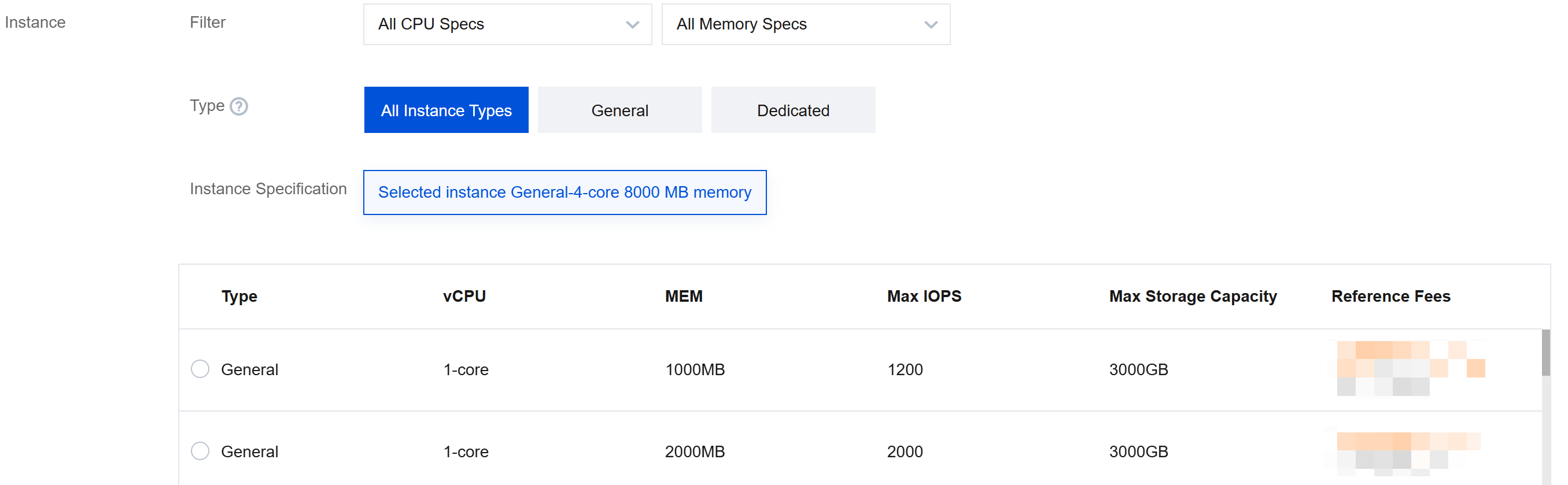
The single-node architecture supports the basic isolation policy; the two-node architecture supports economical, general, and exclusive isolation policies; the three-node architecture supports general and exclusive isolation policies; the Cluster Edition architecture supports standard, enhanced, and flagship isolation policies. Parameters of instance specifications include vCPU, memory, maximum IOPS, and maximum storage capacity, allowing you to choose suitable isolation policies and instance specifications based on your business needs.
Note:
Documentation
Ajuda e Suporte
Esta página foi útil?
Você também pode entrar em contato com a Equipe de vendas ou Enviar um tíquete em caso de ajuda.
comentários