AI Gateway Overview
Unduh
Mode fokus
Ukuran font
AI Gateway is a gateway product launched by Tencent Cloud Intelligent Gateway, designed for large models and intelligent scenarios. It focuses on addressing core challenges enterprises face when accessing, orchestrating, and managing multiple AI models, such as protocol complexity, governance difficulties, uncontrollable costs, and high barriers to legacy system modernization.
AI Gateway serves as the traffic ingress and governance hub for enterprise intelligent architectures. Through unified protocol adaptation, intelligent routing, and multi-dimensional observability, it helps enterprises integrate and utilize AI capabilities more conveniently and securely, accelerating business innovation and intelligent transformation.
Product Features
Intelligent Model Governance: It centrally accesses and intelligently orchestrates Tencent Cloud Hunyuan, open-source models, and third-party commercial models. Through CLB, circuit breaking, degradation, and cost optimization policies, it helps you achieve a better balance among performance, cost, and stability.
Rapid AI-Enablement for Legacy Systems: It features a powerful protocol conversion engine that supports bidirectional conversion between AI ecosystem protocols such as MCP and OpenAI and business protocols like HTTP/gRPC. This enables legacy business systems to quickly gain AI capabilities, effectively protecting existing enterprise IT investments.
Multi-Layer Security Protection: It builds a multi-layer security protection system spanning from access authentication and parameter filtering to DMask. It supports the integration of capabilities such as WAF and Anti-DDoS (some advanced security capabilities require separate activation or configuration, subject to the product documentation), helping to meet business security and compliance requirements.
Enterprise-Grade High Availability Assurance: It employs a multi-AZ high-availability deployment architecture, supports automatic failover and elastic scaling of instances, ensuring service availability.
Business Scenarios
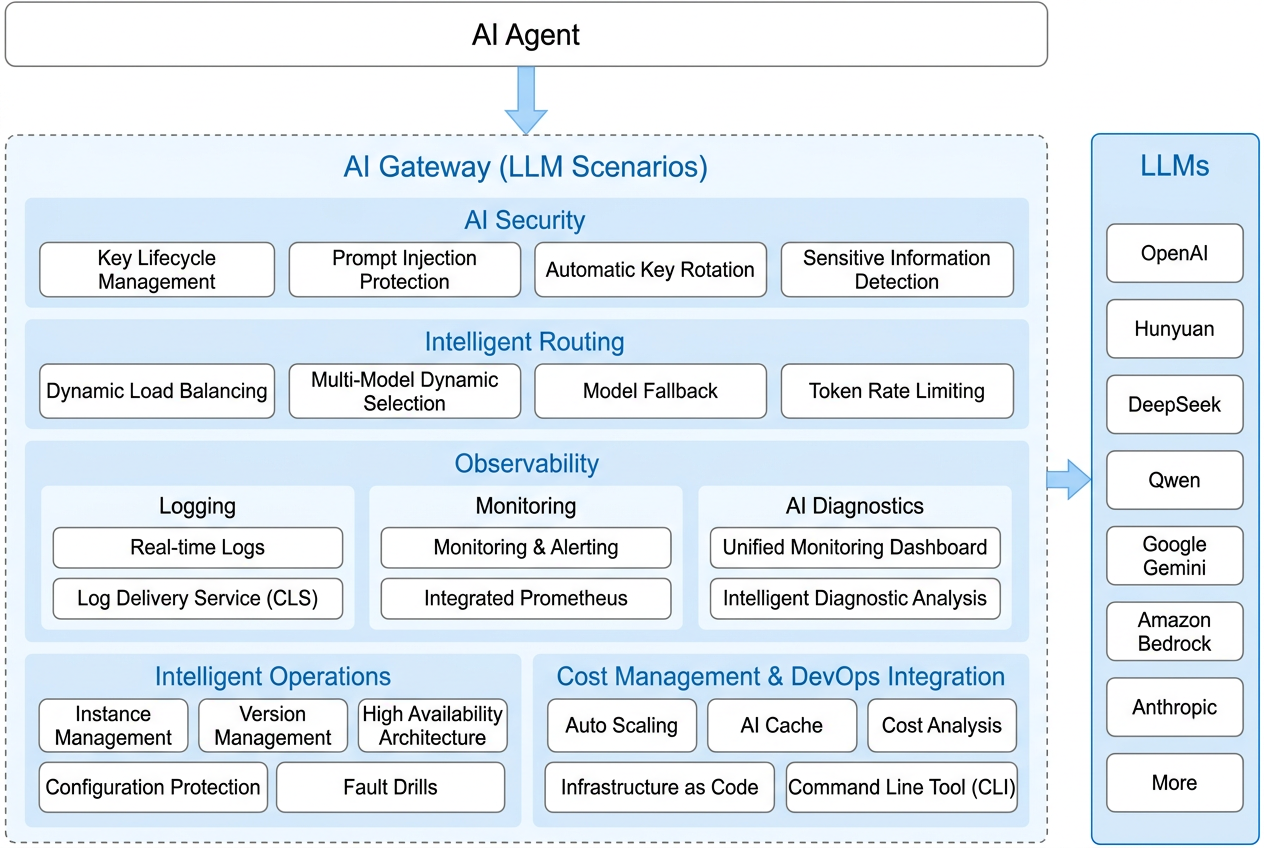
Scenario 1: Unified Governance and Intelligent Scheduling for Multiple Models
Core Problem: Enterprises need to use multiple AI models simultaneously but lack a unified platform, resulting in chaotic model usage, inefficient resource allocation, and uncontrollable costs.
Solution: AI Gateway serves as a unified ingress, enabling visual access and management for multiple models. Through intelligent routing policies, it selects the appropriate model after a comprehensive evaluation based on the policy weights you configure (such as response time, cost, accuracy, and so on). Combined with rate limiting and circuit breaking mechanisms, it ensures service stability, helping to optimize resource allocation and cost management.
Scenario 2: AI Transformation for Legacy Business Systems
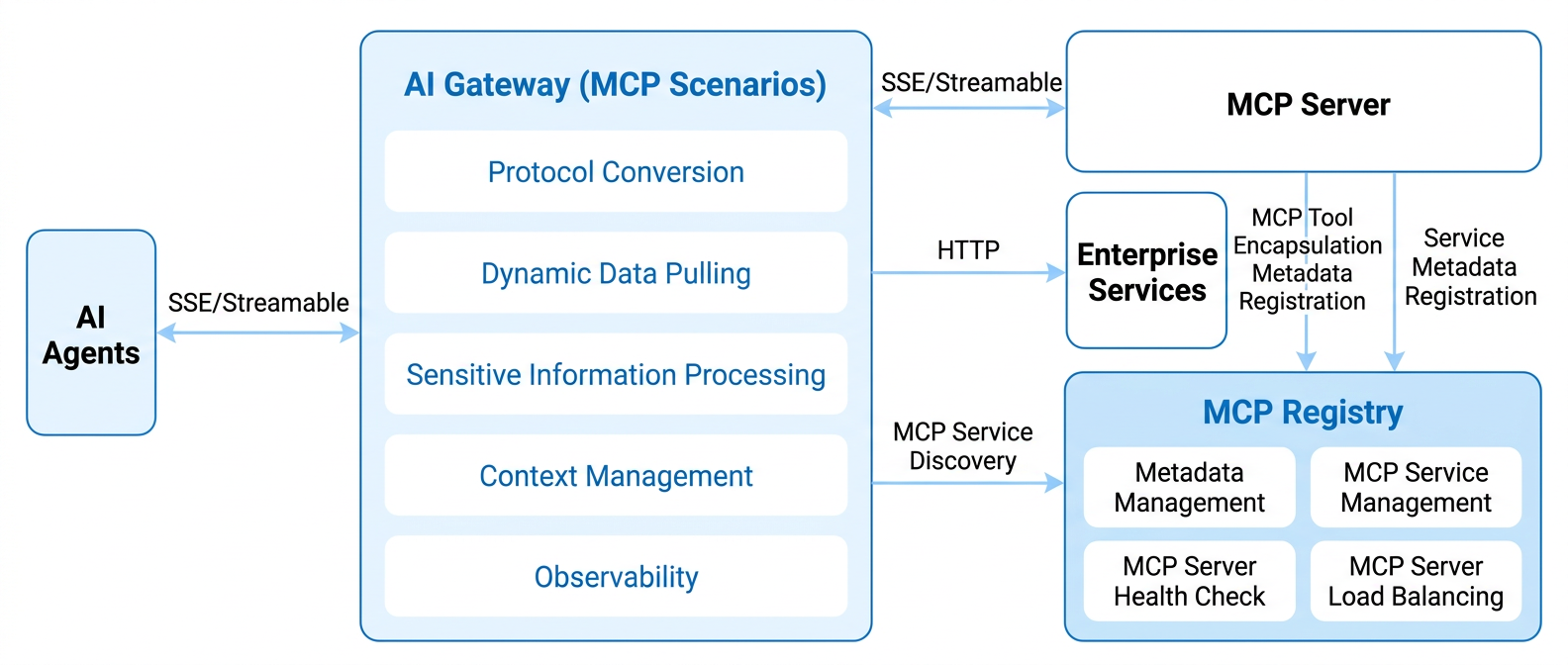
Core Problem: Enterprise legacy business systems have accumulated vast amounts of core data and business logic, constituting one of the enterprise's core assets. However, these systems typically expose services via REST/HTTP APIs, which cannot be directly invoked by AI Agents using the MCP protocol. This makes it difficult to quickly integrate AI capabilities with existing business functions, hindering the full reuse and extension of legacy system value in the AI era.
Solution: AI Gateway uses a protocol conversion engine to automatically wrap the standard APIs provided by legacy business systems into standardized tools (MCP Tools) that can be invoked by AI applications. This significantly reduces the coding effort required for AI-enabling business capabilities. Developers can quickly build intelligent applications without needing to focus on underlying integration details.
Features
Feature | Description |
Unified Protocol Access | Compatible with mainstream open-source gateway ecosystems, fully adapts to standard protocols in the AI field, supports MCP, OpenAI, SSE, and so on, provides conversion capabilities for traditional protocols such as RESTful and gRPC, and enables a single gateway to cover mainstream business traffic (for the specific list of supported protocols and versions, refer to the product documentation). |
Model Service Management | Provides full lifecycle management for model services, supports configuring keys and API endpoints for multiple model vendors. Provides model-level traffic control, Fallback disaster recovery, and fine-grained monitoring. |
Intelligent Routing and Orchestration | Supports intelligent routing based on policies such as content semantics, cost, and performance. Can orchestrate and chain multiple model invocations or business APIs to complete complex tasks. |
Fine-grained Traffic Governance | Provides rate limiting, circuit breaking, and degradation capabilities across multiple dimensions such as consumers, APIs, and models, ensuring the stability of backend services and model APIs. |
Built-in Security Protection | Integrates security capabilities such as authentication and authorization, access control, sensitive information desensitization, and replay attack prevention, provides enterprise-grade security protection, and helps meet business security and compliance requirements (some advanced security capabilities require separate activation or configuration, for details, refer to the product documentation). |
End-to-end Observability | Provides end-to-end tracing from user requests to model responses, monitors multi-dimensional metrics such as API call latency, Token consumption, and model costs, supports intelligent diagnosis and alarms, and facilitates Ops and cost optimization. |
Fine-grained Permission Management | Enables secure isolation and convenient sharing of AI capabilities across different teams and projects through a multi-level permission model based on consumers and consumer groups, supporting platform-based operations. |
Bantuan dan Dukungan
Apakah halaman ini membantu?
Anda juga dapat Menghubungi Penjualan atau Mengirimkan Tiket untuk meminta bantuan.
masukan