tencent cloud

Elastic MapReduce

Release Notes and Announcements
Release Notes
Announcements
Security Announcements
Product Introduction
Overview
Strengths
Architecture
Features
Use Cases
Constraints and Limits
Technical Support Scope
Product release
Purchase Guide
EMR on CVM Billing Instructions
EMR on TKE Billing Instructions
EMR Serverless HBase Billing Instructions
Getting Started
EMR on CVM Quick Start
EMR on TKE Quick Start
EMR on CVM Operation Guide
Planning Cluster
Administrative rights
Configuring Cluster
Managing Cluster
Managing Service
Monitoring and Alarms
TCInsight
EMR on TKE Operation Guide
Introduction to EMR on TKE
Configuring Cluster
Cluster Management
Service Management
Monitoring and Ops
Application Analysis
EMR Serverless HBase Operation Guide
EMR Serverless HBase Product Introduction
Quotas and Limits
Planning an Instance
Managing an Instance
Monitoring and Alarms
Development Guide
EMR Development Guide
Hadoop Development Guide
Spark Development Guide
Hbase Development Guide
Phoenix on Hbase Development Guide
Hive Development Guide
Presto Development Guide
Sqoop Development Guide
Hue Development Guide
Oozie Development Guide
Flume Development Guide
Kerberos Development Guide
Knox Development Guide
Alluxio Development Guide
Kylin Development Guide
Livy Development Guide
Kyuubi Development Guide
Zeppelin Development Guide
Hudi Development Guide
Superset Development Guide
Impala Development Guide
Druid Development Guide
TensorFlow Development Guide
Kudu Development Guide
Ranger Development Guide
Kafka Development Guide
Iceberg Development Guide
StarRocks Development Guide
Flink Development Guide
JupyterLab Development Guide
MLflow Development Guide
Practical Tutorial
Practice of EMR on CVM Ops
Data Migration
Practical Tutorial on Custom Scaling
API Documentation
History
Introduction
API Category
Cluster Resource Management APIs
Cluster Services APIs
User Management APIs
Data Inquiry APIs
Scaling APIs
Configuration APIs
Other APIs
Serverless HBase APIs
YARN Resource Scheduling APIs
Making API Requests
Data Types
Error Codes
FAQs
EMR on CVM
Service Level Agreement
Contact Us

MLflow Development Guide

PDF
フォーカスモード
フォントサイズ
最終更新日: 2025-08-21 16:52:48
MLflow is an open-source platform designed to help machine learning practitioners and teams manage the complexities of the machine learning process. MLflow focuses on the entire lifecycle of machine learning projects, ensuring that each stage is manageable, traceable, and reproducible. This article provides a simple introduction on using MLflow on EMR with an example. For detailed documentation, see MLflow Official Documentation.

Prerequisites

A machine learning cluster of EMR on TKE has been created and the MLflow service has been selected. For details, see Creating a Cluster.

Access the MLflow WebUI

1. You can enable public network access on the Edit Deployment page of the MLflow service when purchasing a cluster, or enter the cluster console Cluster Service after purchasing the cluster. Select MLflow service, and click Enable Network Access in Role Management.
2. After enabling network access, click View WebUI in the upper right corner to open the MLflow WebUI (the security group needs to enable port 5000).

Usage Example

MLflow Tracking is one of the main service components of MLflow. We take notebook as an example to demonstrate how to use MLflow Tracking. For the examples on code, see MLflow Official Website Quick Start.
Operation steps can be divided into preparing the dataset, training the model and recording the model and its metadata into MLflow, loading the model as a Python function, and using the loaded model to predict new data.
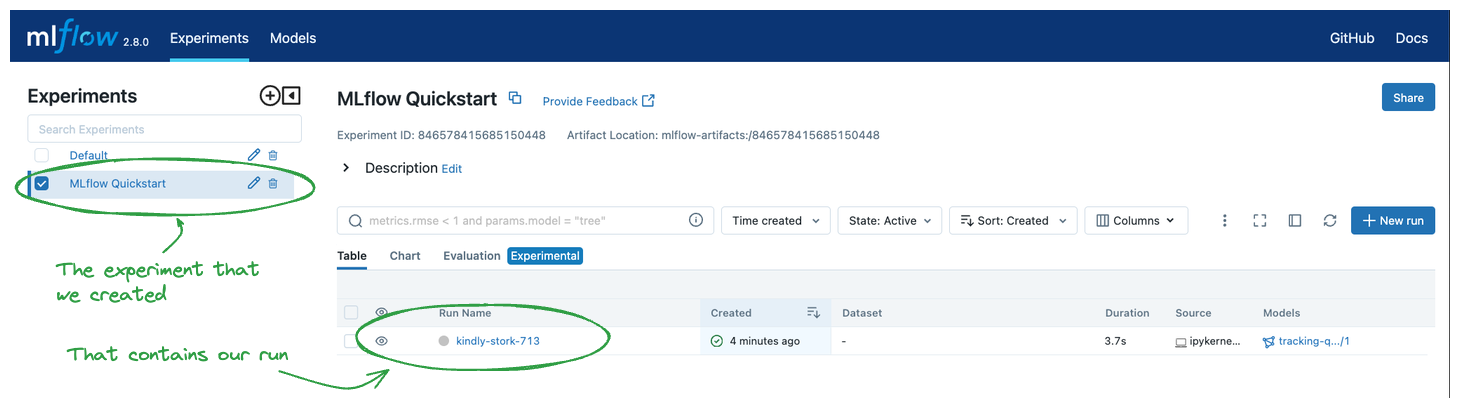
After executing the above, you can view the execution results in the MLflow UI, as shown below. Click Run Task Name to enter Details Page for more information.


ヘルプとサポート

この記事はお役に立ちましたか?

フィードバック