Free Handoff is a model-driven task transfer method. Its basic feature can cover most task scenes. When creating a Multi-Agent Mode application, the collaboration method is selected by default as Free Handoff, and a primary Agent is created by default.
The main advantage of Free Handoff is its simple configuration. By setting the transfer relationship, the model can autonomously judge when to transfer, with extremely high freedom. The primary defect is the instability caused by high freedom, requiring relatively high configuration requirements for Agent prompt content.
In Free Handoff collaboration mode, it supports creating one Agent or more. Multiple agents complete tasks through transfer collaboration.
Setting Method
Step 1: Add and Configure Agents
The Agent collaboration method defaults to Free Handoff. You can create or add necessary Agents within the application according to business needs. If only a single Agent scenario is required, no need to add extra Agents. For configuration method, refer to Agent Creation, Configuration and Deletion.
Step 2: Configure Transfer Relationship
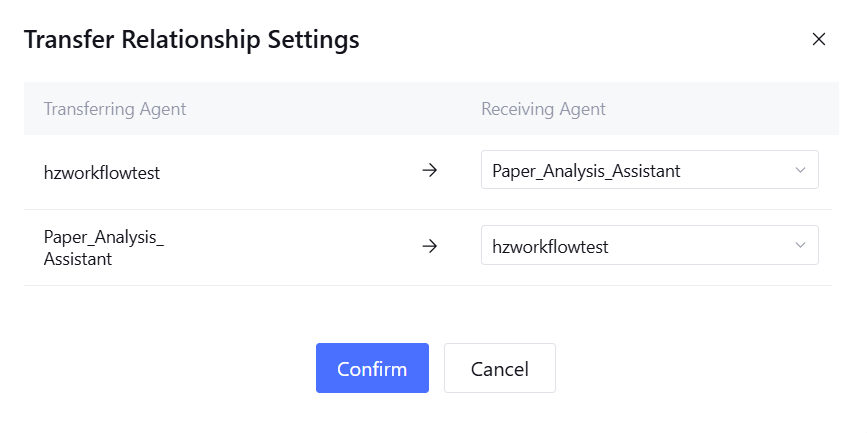
When two or more Agents are added in application, the system supports configuring transfer relationships between multiple Agents. Please note, by default, these Agents will not take effect immediately after creation. The Main Agent can accurately allocate dialogue to specific Sub-Agents based on "Agent description" only after establishing transfer relationships with them. If a Sub-Agent fails to establish an association with the Main Agent through transfer relationships (single-layer or multi-layer), it will be deemed as free status with the incapability of Activation Use.
The recommended configuration is a centralized architecture where the Main Agent transfers tasks to multiple Sub-Agents, and each Sub-Agent also transfers back to the Main Agent.
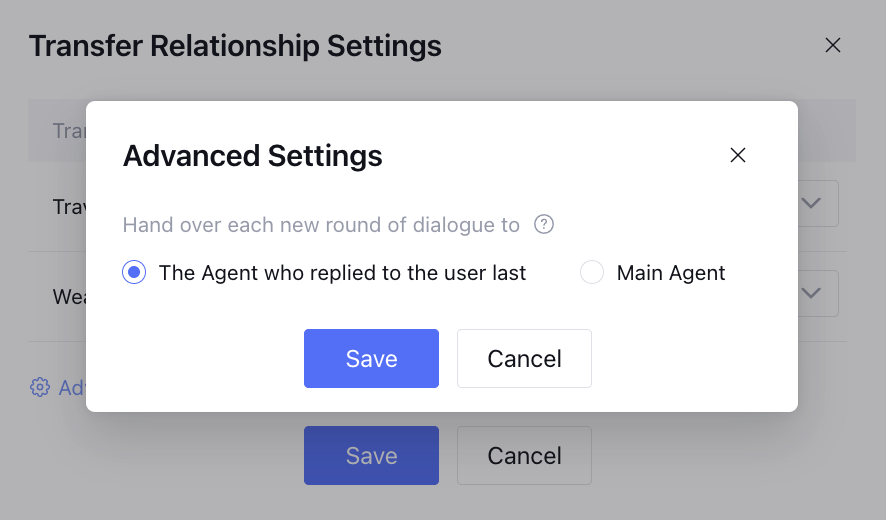
Advanced Settings
Transfer Relationship Settings- Advanced Settings supports configuring the starting Agent for each round of dialogue: after the task ends, the next round of dialogue can be received by the Agent that replied last time or the Main Agent.