tencent cloud

Tencent Cloud Agent Development Platform

Release Notes and Announcements
Release Notes
Product Announcement
Product Introduction
Product Overview
Advantages
Use Cases
Model Introduction
Purchase Guide
Package Subscription
Previous Version
Getting Started
Agent Application and Its Three Modes
Creating a "Content Summary Assistant" in Standard Mode
Creating a “Webpage Scraping Assistant” in Single Workflow Mode
Creating a “Stand-up Comedy Content Creation Assistant” in Multi-Agent Mode
Operation Guide
Application Development
Workflow
Multi-Agent
Knowledge Base
Widget
Plugin Marketplace
Model List 
Prompt Templates
Application Templates
Platform Management
Business, Workspace and Permissions
API Documentation
History
API Category
Making API Requests
Atomic Capability APIs
Operation Optimization APIs
Document Library APIs
Q&A Database APIs
Knowledge Tag APIs
Application Management APIs
Enterprise Management APIs
Billing APIs
Release Management APIs
Dialogue Endpoint APIs
Data Statistics APIs
Data Types
Error Codes
Application API Documentation
Dialogue API Overview
Dialog API Documentation (WebSocket)
Dialog API Documentation (HTTP SSE)
Image Chat or File Chat (Real-time Document Parsing + Chat)
Offline Document Upload
Tencent Cloud Agent Development Platform Operation COS Guide
ADP Document Parsing Protocol
FAQs
Product FAQs
Technical FAQs
Related Agreements
Tencent Cloud Agent Development Platform Service Level Agreement
Tencent Cloud Agent Development Platform Service Specific Terms
Tencent Cloud Agent Development Platform Privacy Policy
Tencent Cloud Agent Development Platform Data Processing and Security Agreement
Open-Source License Statement
Lighthouse OpenClaw Connector Plugin Service Agreement
Contact Us
Glossary

What Is Knowledge Management

PDF
Focus Mode
Font Size
Last updated: 2026-02-05 09:50:02
Knowledge Management is the feature entrance to manage knowledge base within application in a unified way. Each application has a default knowledge base, only available for this application, with no support for sharing across applications. If necessary, you can add platform-level knowledge base in Knowledge Management to reuse other knowledge content. You can also import File, generate Knowledge Base Schema or adjust Knowledge Base Settings, making it easy for Intelligent Agent to retrieve information more accurately.

Adding Knowledge Base

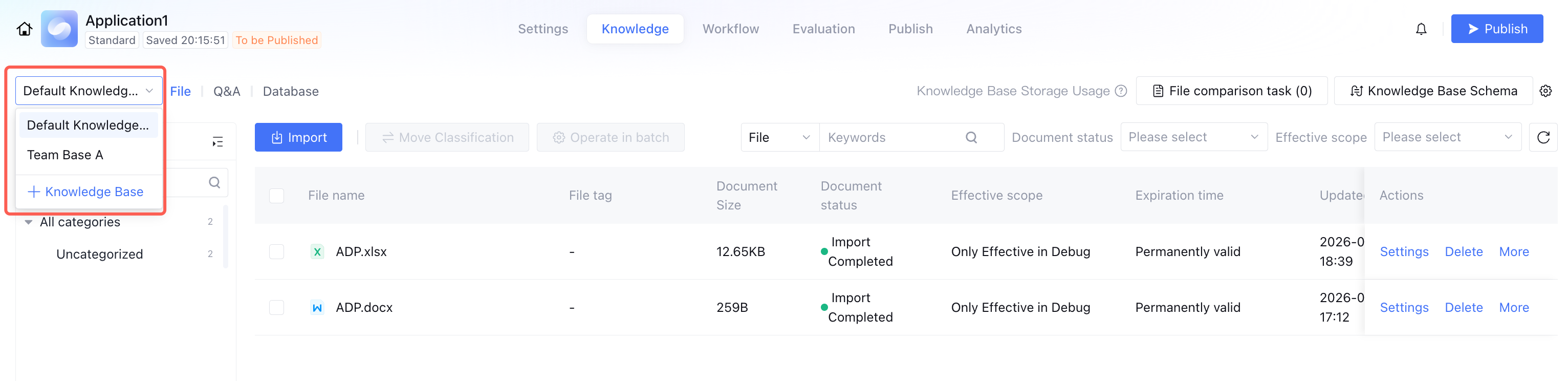
Each application has a preset default knowledge base, and the data in this knowledge base cannot be referred by other applications. If needed, to add a platform-level knowledge base within the application, click Application > Knowledge > Add Knowledge Base.
If needed, to upload more content in the added knowledge base, return to the console homepage, click Knowledge Base, find the referenced knowledge base and import more knowledge.


Importing Knowledge

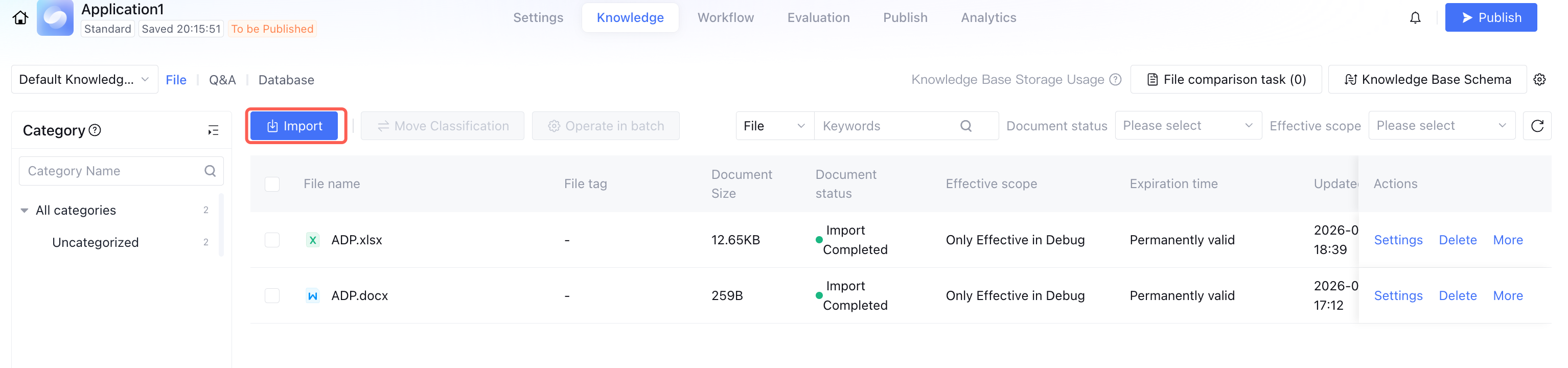
The stored data in the Knowledge Base is called knowledge, which includes File, Q&A, and Database. You can import documents, create Q&A or databases in the default knowledge base.
The management module does not support modification of associated shared knowledge bases. If you hope to import more documents into the shared knowledge base, return to the Console, click on the left Knowledge Base, select target and import more knowledge.


Adjusting Knowledge Base Settings

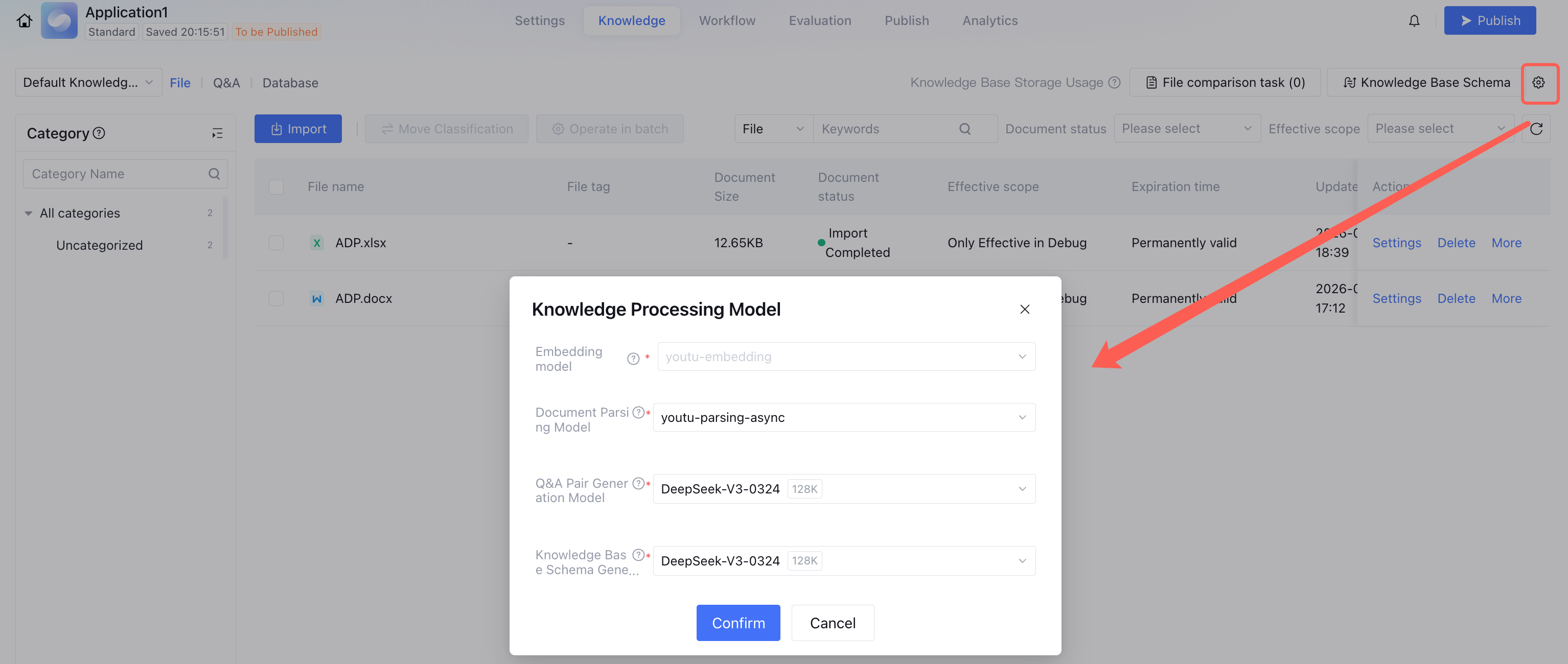
You can adjust the recall mechanism, search scope, and model configuration used by different types of knowledge in the default knowledge base based on actual business needs. For more information, please refer to Knowledge Base Settings Overview.


Canceling Knowledge Base Reference

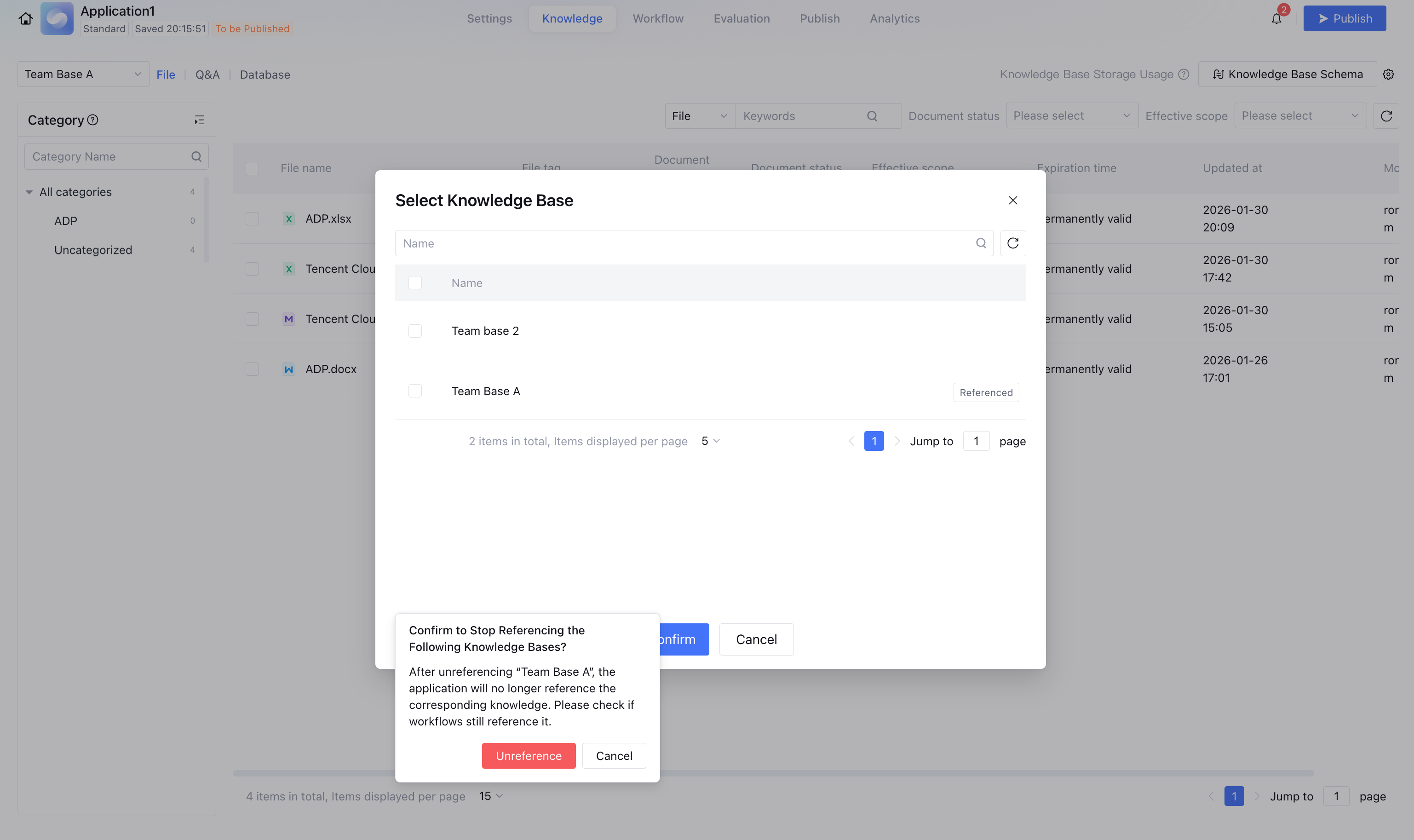
To disassociate from a certain knowledge base, click Add Knowledge Base, uncheck the targeted knowledge base, then click Confirm to disassociate.
Help and Support

Was this page helpful?

Help us improve! Rate your documentation experience in 5 mins.

Feedback