Analysis Plan
Download
Focus Mode
Font Size
Scenarios
An analysis plan associates an analysis template with video channels, specifying which recognition capabilities the platform uses to perform visual understanding analysis on which channels, as well as the storage period and callback method for analysis results. After channels are created and associated, the platform automatically captures frames, calls the VLM for analysis, and saves the results within the effective time period configured in the template.
Note:
Each tenant can create 2 analysis plans by default, and each plan can have up to 2 channels bound to it. To request a higher quota, please contact us.
Prerequisites
You have activated the ISS service, and visual understanding is available in the current region. For the regions where each feature is supported, see Specifications and Limits.
An analysis template has been created. An analysis plan must be associated with an existing analysis template, which determines the recognition capabilities (prompts) and screenshot configuration (screenshot frequency and effective time period).
Device access has been completed, and an available video channel exists. If no channel is available, you can create a plan first and then associate channels with it.
Operation Steps
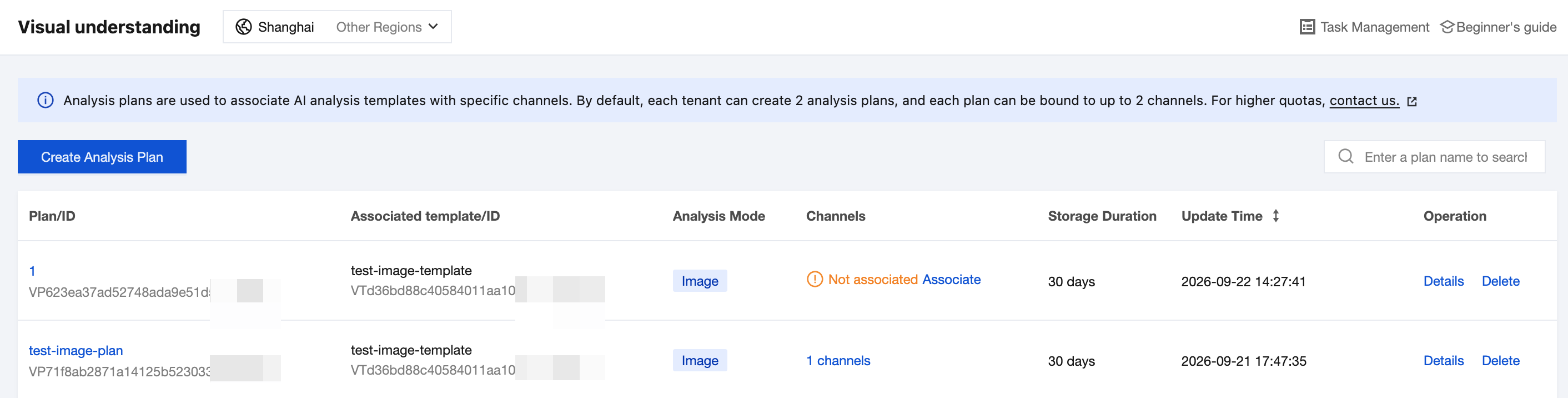
Creating an Analysis Plan
1. Click Create Analysis Plan and configure the following parameters in the dialog box that appears.
Parameter | Required | Description |
Plan Name | Yes | Only Chinese characters, English letters, digits, underscores (_), and hyphens (-) are supported. The length cannot exceed 32 characters. |
Plan Description | No | Describes the purpose of the plan. The length cannot exceed 128 characters. |
Associated Analysis Template | Yes | Select a created analysis template from the drop-down list. The template determines the recognition capability, frame capture frequency, and effective period of the plan. If no suitable template is available, click Create Template to create one. |
Enable Callback | No | Controls whether to push callback notifications to the business side after analysis is completed. This feature is enabled by default. After it is disabled, notifications are no longer pushed, and you need to query analysis results through the console or API. |
Callback URL | Yes (when callback is enabled) | The address for receiving callback notifications must start with http:// or https://. |
Callback Token | No | Used to verify the source of callback requests. Only uppercase and lowercase letters and digits are supported. The length cannot exceed 64 characters. |
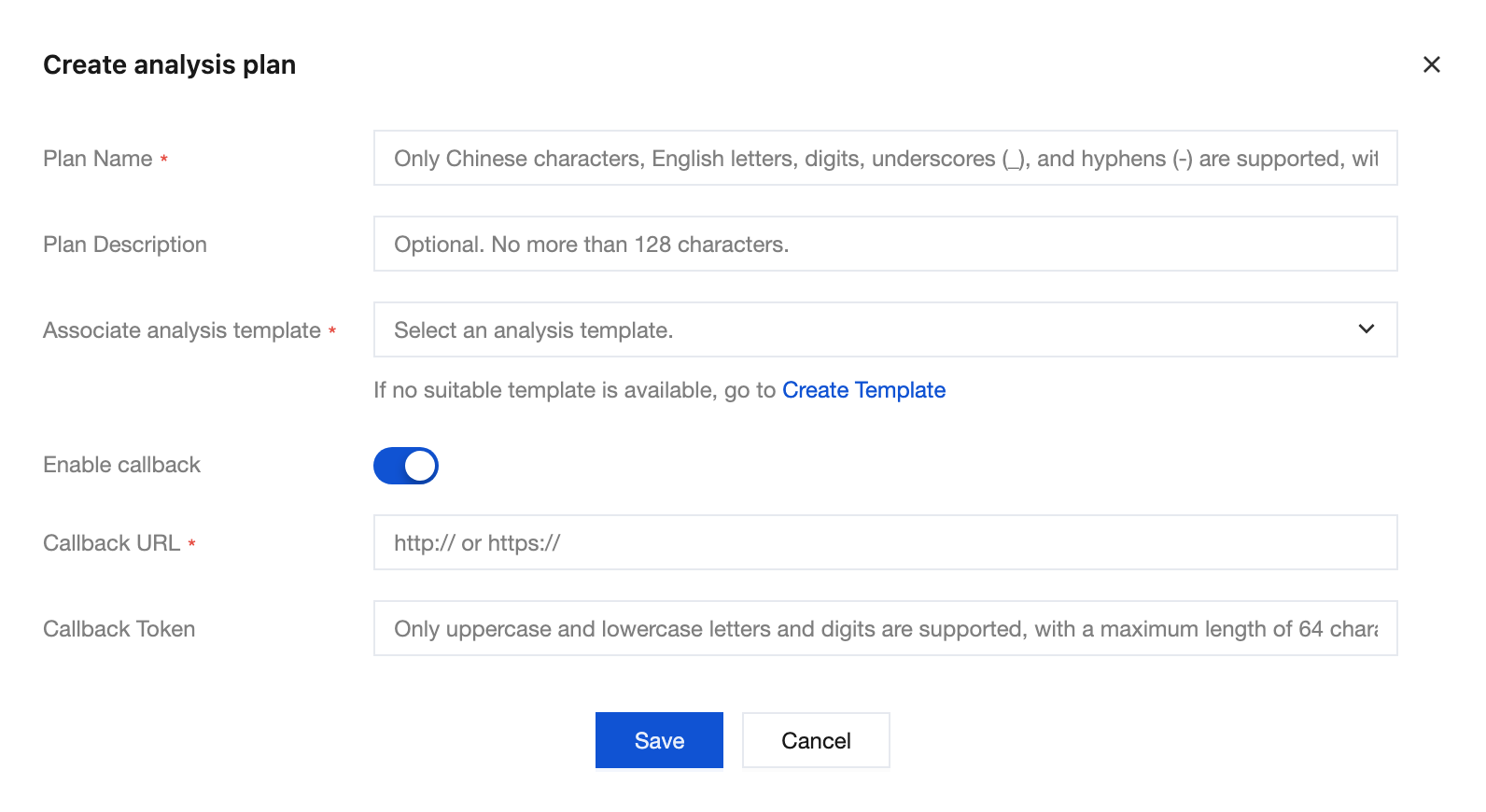
2. Click Save to complete the creation. After the plan is created, it appears in the plan list with the Associated Channels column showing Unassociated. You need to associate video channels with the plan before the analysis starts.
Viewing Analysis Plans
1. In the plan list on the Analysis Plans page, view the information of created plans, including Plan Name/ID, Associated Template/ID, Analysis Mode, Associated Channels, Storage Period, and Update Time.
2. Enter a plan name keyword in the search box in the upper-right corner to quickly locate the target plan. Click the sort icon in the Update Time column to sort plans by update time.
Managing Analysis Plans
You can perform the following operations on a created analysis plan.
1. To associate video channels: In the Associated Channels column of the target plan, if Unassociated is displayed, click Associate. Alternatively, click Details in the operation column to go to the plan details page and manage channels in the Channel Information section.
2. In the Channel Information section, manage the video channels associated with the plan.
Click Add Channel, select the target channels in the dialog box that appears, and confirm to add associated channels to the plan.
Select the target channels and click Batch Delete, or click the delete button in the operation column of the target channel to disassociate the channel from the plan. After the disassociation, the channel no longer performs analysis, and the generated analysis results are not affected.
Switch the search dimension and enter a keyword in the upper-right corner to quickly locate channels by conditions such as device name. The list displays Channel Name, Associated Device, and Associated Organization.

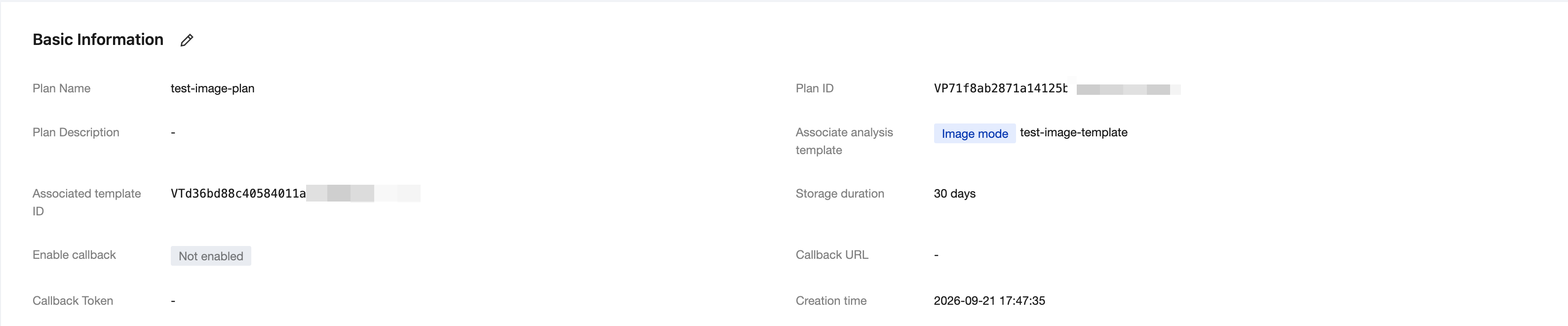
3. To modify basic information: In the Basic Information section of the plan details page, click the edit icon to the right of the title, modify the following parameters in the dialog box that appears, and click Save to apply the changes.
Parameter | Description |
Plan Name | Same as the naming rule used during creation. |
Plan Description | The length cannot exceed 128 characters. |
Associated Analysis Template | Switch to another created analysis template. |
Storage Period | The retention period of analysis results can be set to 7, 15, 30, 60, 90, 180, 270, 360, 540, or 720 days, with a default of 30 days. After expiration, results are automatically deleted based on lifecycle rules. |
Enable Callback | Enable or disable callback notifications. |
Callback URL, Callback Token | Same as the requirements for filling in during creation. |
Note:
The plan ID is generated by the system and cannot be modified. Switching the associated analysis template will change the recognition capabilities and screenshot configuration of the plan. Confirm that the new template meets your business expectations before saving.
4. To delete a plan: On the Analysis Plans page, click Delete in the operation column of the target plan, and confirm the prompt in the dialog box that appears to complete the deletion.
Warning:
After deletion, the plan stops running, and the generated recognition results are retained according to the lifecycle rules. A deleted plan cannot be recovered, and the associated channels immediately stop analysis.
Related Documentation
After creating an analysis plan and associating channels, you can query the VLM analysis pipeline and model output on the Visual Understanding > Analysis Results page.
Help and Support
Was this page helpful?
You can also Contact sales or Submit a Ticket for help.
Help us improve! Rate your documentation experience in 5 mins.
Feedback