tencent cloud

Tencent Real-Time Communication

お知らせ・リリースノート
製品アップデート情報
Tencent Cloudオーディオビデオ端末SDKの再生アップグレードおよび承認チェック追加に関するお知らせ
TRTCアプリケーションのサブスクリプションパッケージサービスのリリースに関する説明について
製品の説明
製品概要
基礎概念
製品の機能
製品の強み
ユースケース
性能データ
購入ガイド
Billing Overview
無料時間の説明
Monthly subscription
Pay-as-you-go
TRTC Overdue and Suspension Policy
課金に関するよくあるご質問
Refund Instructions
初心者ガイド
Demo体験
Call
コンポーネントの説明(TUICallKit)
Activate the Service
Run Demo
クイック導入
オフライン通知
Conversational Chat
クラウドレコーディング(TUICallKit)
AI Noise Reduction
インターフェースのカスタマイズ
Calls integration to Chat
Additional Features
No UI Integration
Server APIs
Client APIs
Solution
ErrorCode
公開ログ
よくある質問
ライブ配信
Billing of Video Live Component
Overview
Activating the Service (TUILiveKit)
Demo のクイックスタート
No UI Integration
UI Customization
Live Broadcast Monitoring
Video Live Streaming
Voice Chat Room
Advanced Features
Client APIs
Server APIs
Error Codes
Release Notes
FAQs
RTC Engine
Activate Service
SDKのダウンロード
APIコードサンプル
Usage Guidelines
クライアント側 API
高度な機能
RTC RESTFUL API
History
Introduction
API Category
Room Management APIs
Stream mixing and relay APIs
On-cloud recording APIs
Data Monitoring APIs
Pull stream Relay Related interface
Web Record APIs
AI Service APIs
Cloud Slicing APIs
Cloud Moderation APIs
Making API Requests
Call Quality Monitoring APIs
Usage Statistics APIs
Data Types
Appendix
Error Codes
コンソールガイド
アプリケーション管理
使用統計
監視ダッシュボード
開発支援
Solution
Real-Time Chorus
よくあるご質問
課金関連問題
機能関連
UserSig関連
ファイアウォールの制限の対応関連
インストールパッケージの圧縮に関するご質問
AndriodおよびiOS関連
Web端末関連
Flutter関連
Electron関連
TRTCCalling Web関連
オーディオビデオ品質関連
その他のご質問
旧バージョンのドキュメント
TUIRoom(Web)の統合
TUIRoom (Android)の統合
TUIRoom (iOS)の統合
TUIRoom (Flutter)の統合
TUIRoom (Electron)の統合
TUIRoom APIのクエリー
クラウドレコーディングと再生の実現(旧)
Protocols and Policies
セキュリティコンプライアンス認証
セキュリティホワイトペーパー
情報セキュリティの説明
Service Level Agreement
Apple Privacy Policy: PrivacyInfo.xcprivacy
TRTC ポリシー
プライバシーポリシー
データ処理とセキュリティ契約
用語集

Audience Viewing (Web Desktop Browser)

PDF
フォーカスモード
フォントサイズ
最終更新日: 2025-11-18 15:02:19
This article provides a detailed introduction to the watch page in TUILiveKit Demo. You can directly refer to this document to integrate the watch page we developed in your existing project, or you can deeply customize the page style, layout, and functional items according to your needs according to the content in the document.

Function Overview

Functional classification
Specific capabilities
Live video playback
HD and smooth live streaming experience
Barrage Interaction
Real-time Barrage chat
Viewer List
View online viewer information
Follow Streamer
Follow your favorite streamers with one click
Full Screen Play
Immersive viewing experience

Function Display

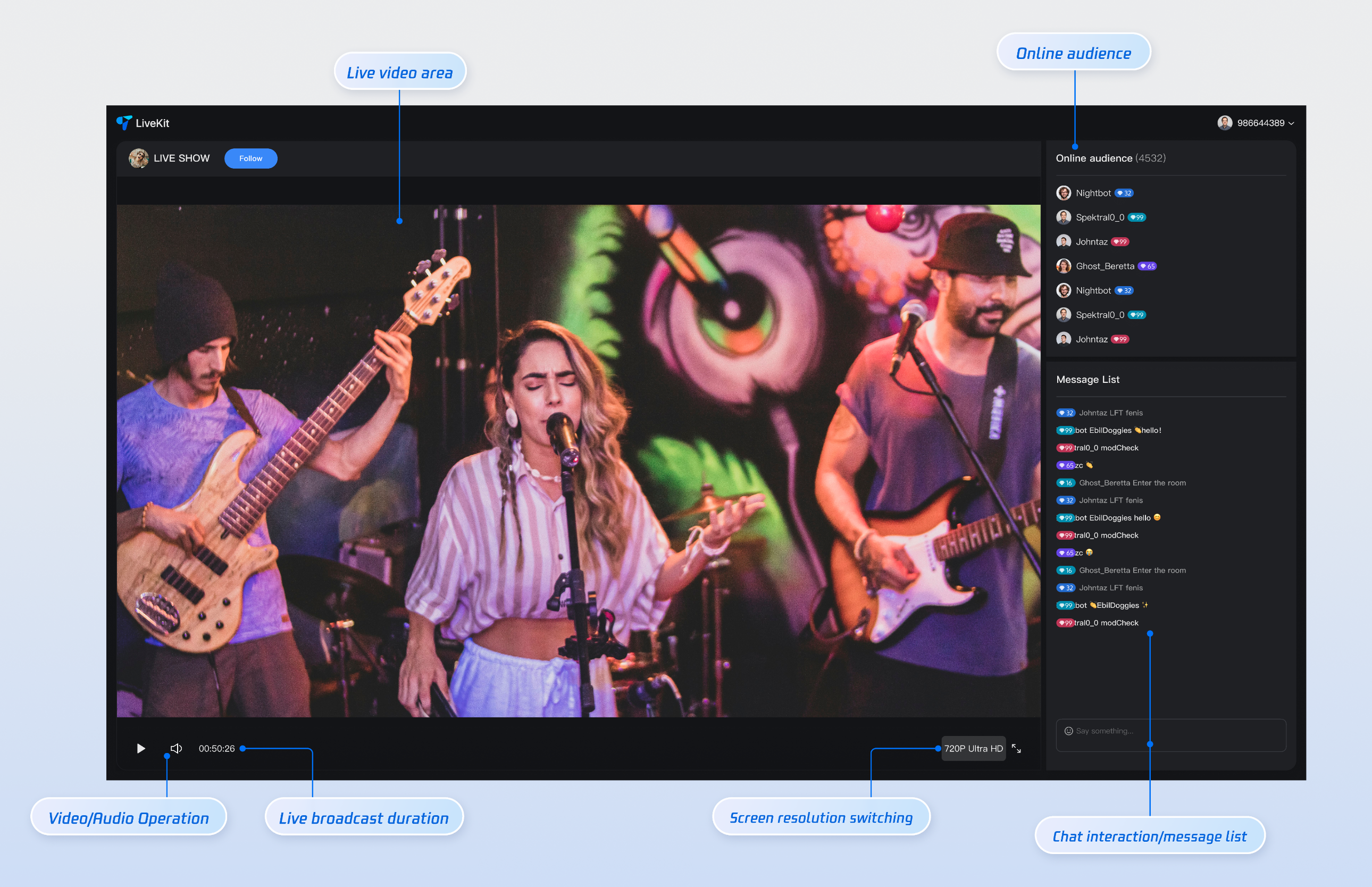
The watch page provides default behavior and style, but if the default behavior and style don't fully meet your needs, you can also customize the UI. The numbers shown in the figure correspond to categories in the specific function list. These mainly include live broadcast information display, video broadcast area, online audience, audio and video operation, live broadcast duration, screen resolution switching, full screen function, chat interaction, message list, etc.


Quick Access

Step 1: Environment Configuration and Service Activation

Before using Quick Access, you need to refer to Preparations configuration requirements and activate the corresponding services.
npm
pnpm
yarn
npm install tuikit-atomicx-vue3 @tencentcloud/uikit-base-component-vue3 --save
pnpm add tuikit-atomicx-vue3 @tencentcloud/uikit-base-component-vue3
yarn add tuikit-atomicx-vue3 @tencentcloud/uikit-base-component-vue3

Step 2: Access the viewing page

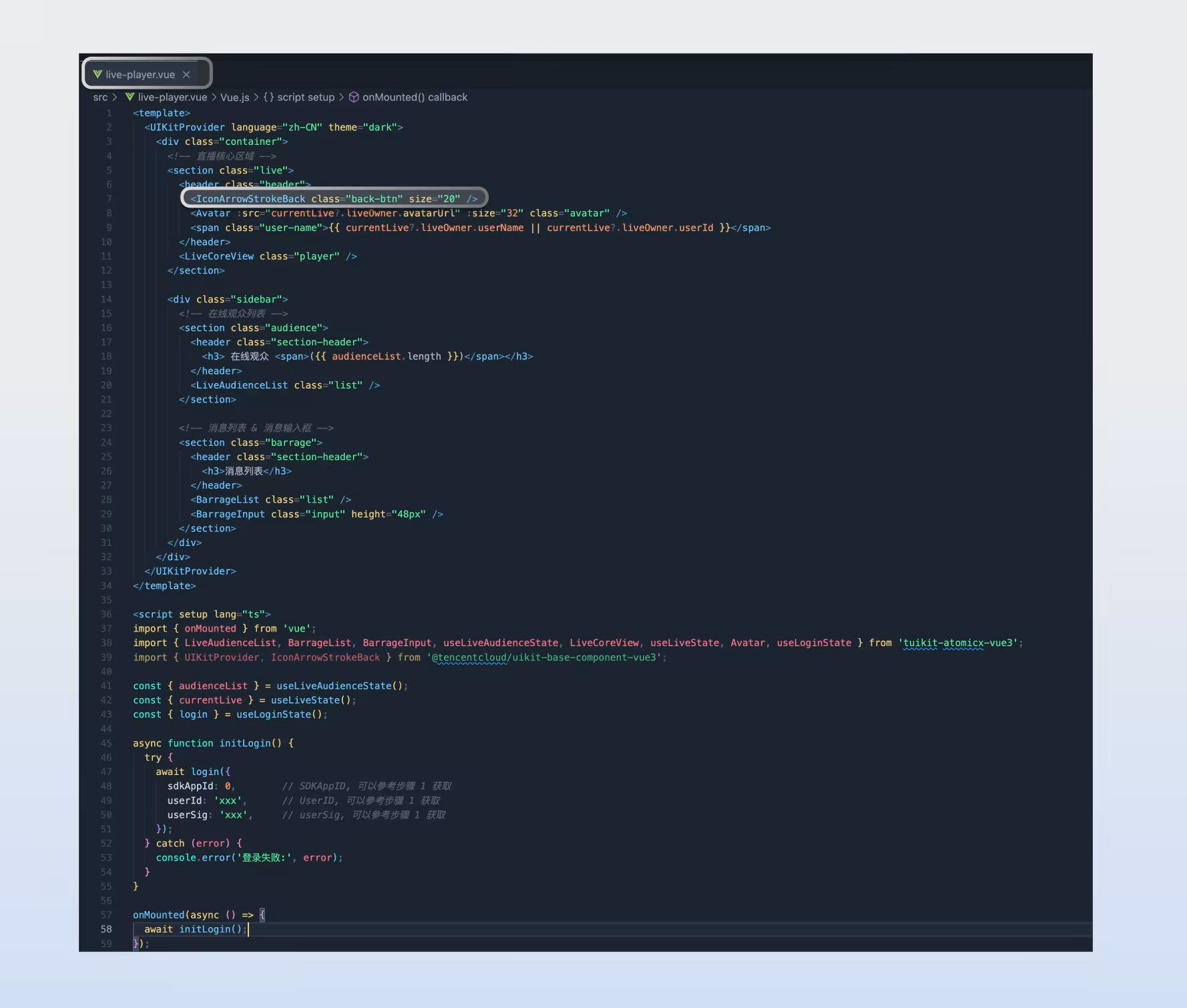
Create a live-player.vue file in your project and copy the following code to integrate the watch page into your project.
<template>
<UIKitProvider language="zh-CN">
<div class="container">
<!-- Live core area -->
<section class="live">
<header class="header">
<IconArrowStrokeBack class="back-btn" size="20" />
<Avatar :src="currentLive?.liveOwner.avatarUrl" :size="32" class="avatar" />
<span class="user-name">{{ currentLive?.liveOwner.userName || currentLive?.liveOwner.userId }}</span>
</header>
<LiveCoreView class="player" />
</section>

<div class="sidebar">
<!-- Online viewers list -->
<section class="audience">
<header class="section-header">
<h3> online viewers <span>({{ audienceList.length }})</span></h3>
</header>
<LiveAudienceList class="list" />
</section>

<!-- Message List & Message List -->
<section class="barrage">
<header class="section-header">
<h3>MessageList</h3>
</header>
<BarrageList class="list" />
<BarrageInput class="input" height="48px" />
</section>
</div>
</div>
</UIKitProvider>
</template>

<script setup lang="ts">
import { LiveAudienceList, BarrageList, BarrageInput, useLiveAudienceState, LiveCoreView, useLiveState, Avatar, useLoginState } from 'tuikit-atomicx-vue3';
import { UIKitProvider, IconArrowStrokeBack } from '@tencentcloud/uikit-base-component-vue3';

const { audienceList } = useLiveAudienceState();
const { currentLive } = useLiveState();
const { login } = useLoginState();

async function initLogin() {
try {
await login({
sdkAppId: 0, // SDKAppId, refer to step 1 to obtain
userId: '', // UserID, refer to step 1 to obtain
userSig: '', // userSig, refer to step 1 to obtain
});
} catch (error) {
console.error('Login Failed:', error);
}
}

onMounted(async () => {
await initLogin();
});

</script>

<style>:global(body){height:100vh;width:100vw;margin:0;padding:0;overflow:hidden;font-size:15px;line-height:1.6;text-rendering:optimizeLegibility;}:global(*),:global(*::before),:global(*::after){box-sizing:border-box;margin:0;}.container{display:grid;grid-template-columns:70% 30%;height:100vh;width:100vw;gap:16px;padding:16px;background:var(--bg-color-default);box-sizing:border-box;overflow:hidden;}.live{display:flex;flex-direction:column;background:var(--bg-color-operate);border-radius:12px;overflow:hidden;box-shadow:0 2px 8px var(--shadow-color);}.header{display:flex;align-items:center;gap:12px;padding:16px;border-bottom:1px solid var(--stroke-color-primary);}.back-btn{cursor:pointer;color:var(--text-color-tertiary);transition:color 0.2s;}.back-btn:hover{color:var(--text-color-link-hover);}.avatar{border:1px solid var(--uikit-color-white-7);}.user-name{color:var(--text-color-primary);font-weight:500;}.player{flex:1;background:var(--uikit-color-black-1);}.sidebar{display:flex;flex-direction:column;gap:16px;height:100%;overflow:hidden;}.audience{display:flex;flex-direction:column;background:var(--bg-color-operate);border-radius:12px;overflow:hidden;box-shadow:0 2px 8px var(--shadow-color);flex:1;min-height:0;}.barrage{display:flex;flex-direction:column;background:var(--bg-color-operate);border-radius:12px;overflow:hidden;box-shadow:0 2px 8px var(--shadow-color);flex:1;min-height:0;}.section-header{padding:16px;border-bottom:1px solid var(--stroke-color-primary);background:var(--bg-color-operate);}.section-header h3{margin:0;font-size:16px;font-weight:600;color:var(--text-color-primary);}.section-header span{font-weight:400;color:var(--text-color-secondary);font-size:14px;}.list{flex:1;min-height:0;overflow-y:auto;}.input{border-top:1px solid var(--stroke-color-primary);flex-shrink:0;height:48px;}@media (max-width:1200px){.container{grid-template-columns:1fr;grid-template-rows:60% 20% 20%;gap:12px;}.sidebar{gap:12px;}.audience,.barrage{min-height:200px;}}@media (max-width:768px){.container{padding:8px;gap:8px;grid-template-rows:50% 25% 25%;}.header,.section-header{padding:12px;}.sidebar{gap:8px;}}</style>


Step 3: Start the project

npm run dev

Customizable

As shown in the functional diagram above, we also support customizing the UI of the watch page based on your project needs. The following table lists the main customizable features.
Category
Function
Description
Live information display
Customize the display of the watch page information area
Supports:
Show/hide the logo, replace it with your desired logo
UI customization, show/hide the follow button, and replace it with your desired button style
Online viewers
Customize audience information display
Supports:
Show/hide audience level
Customize audience information font and color UI
Replace icon style with your desired style
MessageList
Custom message barrage area display
Supports:
Show/hide chat input area
Supports UI customization for chat bubble style, audience level, etc.

Playing a Live Stream

Method 1: Playing by Specifying a LiveId

If you need to specify a LiveId for playback, you need to add the following code based on the code in step 3 of the Quick Access section above. The reference method is as follows:
// live-player.vue
import { onMounted } from 'vue';
import { useLiveState } from 'tuikit-atomicx-vue3';

const { joinLive } = useLiveState();

onMounted(async () => {
// Enter liveId to join the live broadcast room. For the specific meaning of the parameters,
// please refer to the preparation work in step 1.
await joinLive({ liveId: 'xxx' });
});

Method 2: Routing Configuration

Because of the logic involved in redirecting from the live stream list (or homepage) to the live stream room, you'll need to configure Vue Router. Create a new router folder in the project's src directory and create an index.ts file. Then, import and use the router in your main file (e.g., main.ts or index.ts). See the GitHub code examples for more information. For a live stream list, see the Live Stream List documentation.
// src/router/index.ts
import { createRouter, createWebHistory } from 'vue-router';

const routes = [
{
path: '/live-player',
component: () => import('../views/live-player.vue'),
},
// If you need the live broadcast list function, you can add the following route
// {
// path: '/live-list',
// component: () => import('../views/live-list.vue'),
// },
];

const router = createRouter({
history: createWebHistory(),
routes,
});
export default router;

// src/main.ts
import { createApp } from 'vue';
import App from './App.vue';
import router from './router';

const app = createApp(App);
app.use(router);
app.mount('#app');

Next Steps

Congratulations! You've successfully integrated the watch page. Next, you can implement content such as the anchor's start page and live broadcast list page. Please refer to the table below:
Function
Description
Integration Guide
Host Streaming
The complete workflow for a host to start a stream, including pre-stream setup and various in-stream interactions.
Live Stream List
Display the live broadcast list interface and functions, including live broadcast list and room information display function


ヘルプとサポート

この記事はお役に立ちましたか?

フィードバック