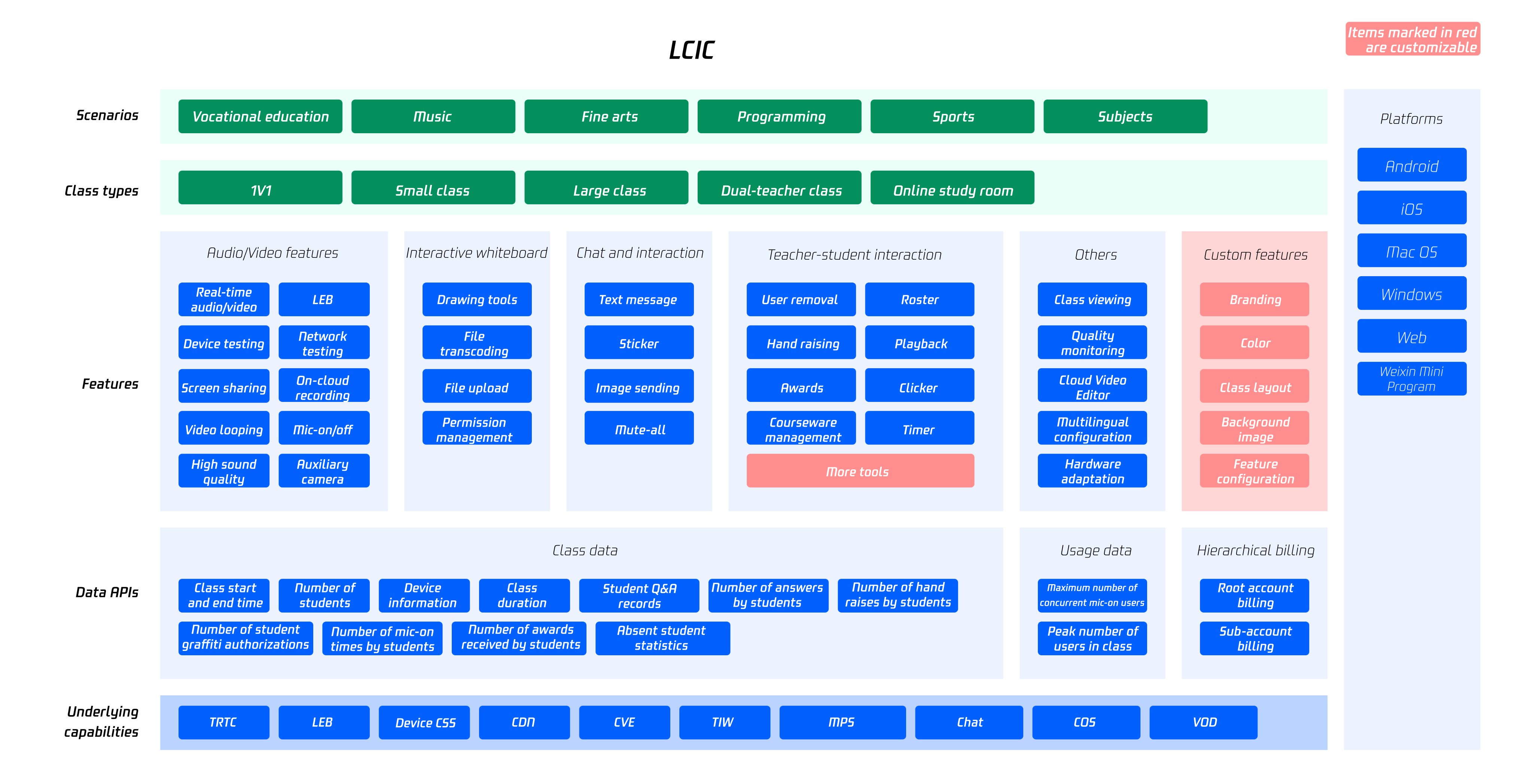
The entire product architecture of LCIC is as shown below:
Basic features
Feature
Description
Audio/Video interaction
Multi-person real-time audio/video interaction: Up to 17 users can turn on their camera simultaneously. SD, HD, and FHD image quality levels are supported.
Mic connect: Users can mic on/off smoothly without waiting for switchover.
Mic rotation: The teacher can enable mic rotation to let every student speak in turn. The teacher sets the duration for each student’s mic to stay connected, and each student will mic on in sequence.
Screen sharing: The local computer desktop, a webpage window, or an application can be shared to others.
Auxiliary camera: The teacher can use two cameras for teaching. For example, a piano teacher can set one camera to show their face and set the other camera to show their hands during a piano lesson.
Video wall: The teacher/teaching assistant can enable the video wall to take a group photo with students, perform video sign-in, or watch multiple students giving a presentation together.
Interactive whiteboard
Features such as moving, box selection, pen, laser pointer, text editing, shape drawing, eraser, screencapturing, zooming, and page turning are supported.
Student graffiti permissions: The teacher/teaching assistant can grant students the graffiti permission so that students can graffiti, add text annotations, and turn pages on the whiteboard or in courseware documents.
The teacher can copy and paste images from chat messages to the interactive whiteboard to show and write notes on them.
Courseware management
The teacher/teaching assistant can upload courseware before or during the class through the API for teaching. The following courseware document formats are supported: PPT, PPTX, DOC, DOCX, PDF, PNG, JPG, JPEG, GIF, BMP, MP3, and MP4.
The teacher/teaching assistant can select a courseware document to show it on the interactive whiteboard. Supported operations include page turning, graffiti, text annotation, audio/video playback, and sync display on students’ screens.
Chat messages
Users can send text, emojis, and images (PNG, JPEG, and JPG) in the chat and on-screen comment areas.
Mute all: The teacher/teaching assistant can mute all students to prevent them from sending text, images, or emojis in the chat area.
Member management
Roster: Comprehensive role (teacher, teaching assistant, spectator, and student) permission control capabilities are supported. The teacher/teaching assistant can manage members by granting/revoking permissions for sharing, graffiti, message sending, and turning on/off audio and video devices.
Interactive teaching tools
Class awards: The teacher can give awards such as trophies to students during the class.
Clicker: The teacher can use the clicker to raise questions and ask all students to answer them. The teacher can configure answer options in the clicker and then start a Q&A. After the Q&A ends, the clicker can collect statistics and display the number of students who have submitted their answers and the percentage of correct answers.
Timer: The teacher can open the timer and set a timed duration. After the timer starts, the time is displayed on the students' screen.
Notifications: The teacher/teaching assistant can send notifications to students during the class.
Advanced features
Module
Feature
Room
Configure custom room attributes, such as audio class, audio/video class, and streaming permission approval.
Configure the class start time. This can be used for class scheduling and automatic start of a class.
Configure the class duration. This can be used for class scheduling and automatic ending of a class.
Configure a duration to prolong a class. After the duration elapses, the room will be closed, users in the room will be removed immediately, and other users cannot join the room.
Configure the maximum number of concurrent mic-on students. By default, up to 17 users can mic on simultaneously.
Configure whether students automatically mic on upon entering the class.
Configure whether to enable a student to automatically mic on when there is an available seat for mic connect.
Configure the region to ensure that the class is in the same region where courseware and recording files are stored.
Listen for events during the class to sync them in real time.
User
Configure custom user attributes, including profile photo and age.
Display the roster. Information such as camera and mic status and number of awards of all users in class are displayed.
Customize awards.
Invite a student to mic on and speak.
Configure permissions of roles such as teacher, teaching assistant, spectator, and student.
Stream
Configure video encoding attributes, including bitrate, resolution, and mirrored video.
Encrypt and moderate audio/video streams.
Configure beauty filters and special effects. Various value-added capabilities including smart beauty filters, special effect filters, makeup stickers, virtual backgrounds, and gesture recognition are provided.
Device and media
Detect and turn on/off audio and video devices like headsets and microphones.
Control video rendering.
Control audio playback.
UIKit
Configure multiple languages. Chinese, English, and Japanese are supported.
Adjust the class layout. The teacher can switch the class layout based on their own teaching characteristics.
Change the class color.
Widget
Implement custom plugins like interactive whiteboard, clicker, and timer.