Product Overview
Download
Focus Mode
Font Size
Product Definition
Tencent Healthcare Data Services (THDS) is a standardized healthcare data processing technology service provided by Tencent Cloud. It is an interface solution built on the international healthcare data exchange standard FHIR. THDS provides capabilities for the structured construction, management, and cross-institution exchange of Electronic Health Records (EHRs). It enables authorized users to securely access their self-managed health data via APIs.
Tencent Healthcare Data Services strictly adheres to the FHIR standard to ensure data semantic consistency and long-term compatibility. It incorporates built-in identity authentication mechanisms and comprehensive audit trail capabilities. This rigorously safeguards the security and compliance of patient privacy and sensitive healthcare data throughout its entire lifecycle of storage, transmission, and use.
The Tencent Healthcare Data Services platform is designed to support Auto Scaling (AS). This makes it an ideal foundation for securely migrating healthcare data to the cloud and for building hybrid or multi-cloud architectures.
Feature Introduction
The FHIR-standardized API enables authorized users to store and securely access their self-managed healthcare data.
It provides visual browsing of stored resources and visual debugging of FHIR-standardized APIs.
It supports the import of electronic health data in various formats and intelligently converts it into the FHIR format.
It supports multi-level de-identification operations on healthcare data and data export.
Product Architecture
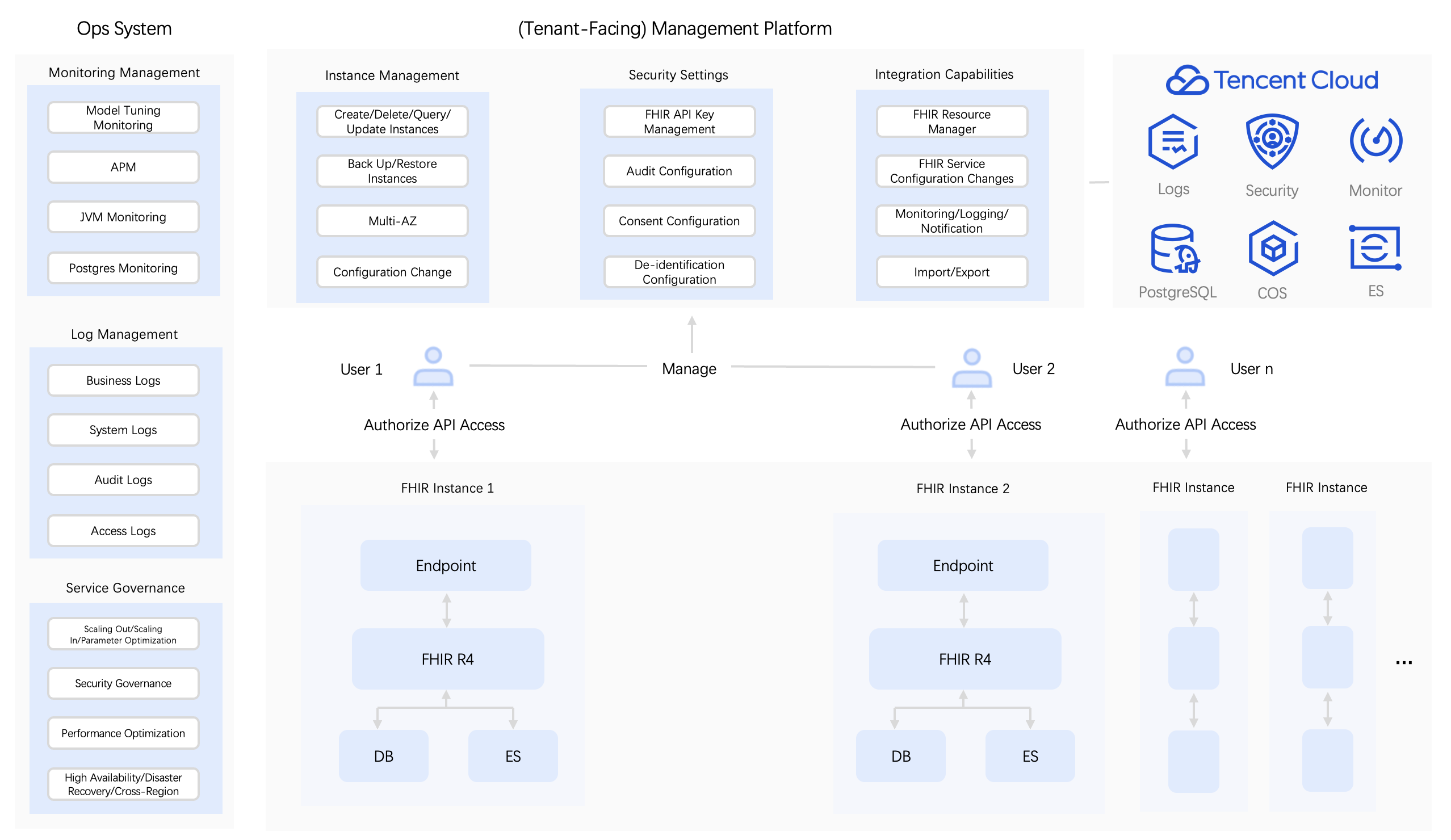
The underlying architecture of Tencent Healthcare Data Services is built on a cloud-native framework. It utilizes multiple Tencent Cloud components, including those for logging, security, monitoring, and storage.
The Ops layer provides administrators with various capabilities to ensure normal system operation:
Monitoring Management: Monitors the operational status of each component.
Log Management: Collects and manages runtime logs.
Service Governance: Manages and optimizes system services.
The application layer provides a tenant-oriented management platform with the following capabilities:
Instance Management: Basic features such as FHIR instance creation.
Security Settings: Features for API key management, CloudAudit, authorized access, and data masking.
Integration Capabilities: Centrally manages FHIR resources and services, views monitoring, logs, and notifications, and provides data import and export features.
Help and Support
Was this page helpful?
You can also Contact sales or Submit a Ticket for help.
Help us improve! Rate your documentation experience in 5 mins.
Feedback