tencent cloud

TDSQL-C for MySQL

Release Notes and Announcements
Release Notes
Product Announcements
Beginner's Guide
Product Introduction
Overview
Strengths
Use Cases
Architecture
Product Specifications
Instance Types
Product Feature List
Database Versions
Regions and AZs
Common Concepts
Use Limits
Suggestions on Usage Specifications
Kernel Features
Kernel Overview
Kernel Version Release Notes
Optimized Kernel Version
Functionality Features
Performance Features
Security Features
Stability Feature
Analysis Engine Features
Inspection and Repair of Kernel Issues
Purchase Guide
Billing Overview
Product Pricing
Creating Cluster
Specification Adjustment Description
Renewal
Payment Overdue
Refund
Change from Pay-as-You-Go to Yearly/Monthly Subscription
Change from Pay-as-You-Go to Serverless Billing
Value-Added Services Billing Overview
Viewing Billing Statements
Getting Started
Database Audit
Overview
Viewing Audit Instance List
Enabling Audit Service
Viewing Audit Logs
Log Shipping
Post-Event Alarm Configuration
Modifying Audit Rule
Modifying Audit Service
Disabling Audit Service
Audit Rule Template
Viewing Audit Task
Authorizing Sub-User to Use Database Audit
Serverless Service
Serverless Introduction
Creating and Managing a Serverless Cluster
Elastic Scaling Management Tool
Serverless Resource Pack
Multi-AZ Deployment
Configuration Change
FAQs
Serverless Cost Estimator
Operation Guide
Operation Overview
Switching Cluster Page View in Console
Database Connection
Instance Management
Configuration Adjustment
Instance Mode Management
Cluster Management
Scaling Instance
Database Proxy
Account Management
Database Management
Database Management Tool
Parameter Configuration
Multi-AZ Deployment
GD
Backup and Restoration
Operation Log
Data Migration
Parallel Query
Columnar Storage Index (CSI)
Analysis Engine
Database Security and Encryption
Monitoring and Alarms
Basic SQL Operations
Connecting to TDSQL-C for MySQL Through SCF
Tag
Practical Tutorial
Classified Protection Practice for Database Audit of TDSQL-C for MySQL
Upgrading Database Version from MySQL 5.7 to 8.0 Through DTS
Usage Instructions for TDSQL-C MySQL
New Version of Console
Implementing Multiple RO Groups with Multiple Database Proxy Connection Addresses
Strengths of Database Proxy
Selecting Billing Mode for Storage Space
Creating Remote Disaster Recovery by DTS
Creating VPC for Cluster
Data Rollback
Solution to High CPU Utilization
How to Authorize Sub-Users to View Monitoring Data
White Paper
Security White Paper
Performance White Paper
Troubleshooting
Connection Issues
Performance Issues
API Documentation
History
Introduction
API Category
Making API Requests
Instance APIs
Multi-Availability Zone APIs
Other APIs
Audit APIs
Database Proxy APIs
Backup and Recovery APIs
Parameter Management APIs
Billing APIs
serverless APIs
Resource Package APIs
Account APIs
Performance Analysis APIs
Data Types
Error Codes
FAQs
Basic Concepts
Purchase and Billing
Compatibility and Format
Connection and Network
Features
Console Operations
Database and Table
Performance and Log
Database Audit
Between TDSQL-C for MySQL and TencentDB for MySQL
Service Agreement
Service Level Agreement
Terms of Service
TDSQL-C Policy
Privacy Policy
Data Privacy and Security Agreement
General References
Standards and Certifications
Glossary
Contact Us

Deleting a GD

PDF
Focus Mode
Font Size
Last updated: 2025-07-25 15:50:49
This document introduces the operations and instructions for deleting a global database (GD).

Prerequisites

Precautions

Once the GD is deleted, all clusters will be disconnected. Proceed with caution.
Once the GD is deleted, the primary cluster will become an independent cluster, having the same capabilities as a standard provisioned resource cluster. The secondary clusters will be isolated in the recycle bin. If you want to continue using them, you can restore the instance during the isolation period.
Once the GD is deleted, applications that are connected to the GD will no longer be able to access the database. Update the related connection addresses of applications promptly.

Directions

1. Log in to the TDSQL-C for MySQL console.
2. Click GDN in the left sidebar.
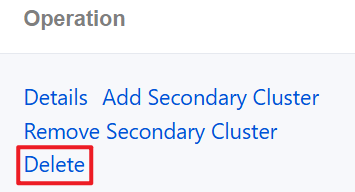
3. Find the GD that needs to be deleted in the list, and click Delete in the operation column.
4. In the pop-up window, check and confirm the cluster information, and then click OK.

Help and Support

Was this page helpful?

Help us improve! Rate your documentation experience in 5 mins.

Feedback