Single-Node (Formerly Basic Edition and Cluster Edition)
Download
Focus Mode
Font Size
TencentDB for MySQL supports multiple deployment architectures. This document describes the single-node architecture.
A single-node architecture can be divided into basic (formerly Basic Edition) and basic (cloud disk) based on different isolation policies. See Isolation Policy. The architecture adopts single-node deployment, so read-only instances also belong to the single-node architecture.
Single-Node - Basic (Cloud Disk)
For this architecture, the console displays it as: single-node (cloud disk). You can create a single-node (cloud disk) instance through the console or by calling the API. Creating instances through the API is more suitable for scenarios that require automated deployment and batch creation. Since the API has many configurable parameters, see API Creation Guide for Single-Node (Cloud Disk) Instances for details.
Scenarios
With a single-node deployment architecture that contains only one node, it offers excellent cost-effectiveness and is suitable for business scenarios that do not require high availability or a highly available architecture, such as testing, development, and personal learning.
Architecture Features
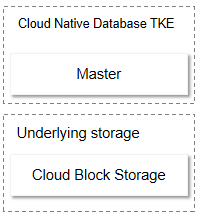
The underlying storage uses Cloud SSD, Premium Disk, and Enhanced SSD.
Cloud SSD: a full-flash storage type provided by Tencent Cloud based on NVMe SSD storage media, offering I/O capabilities with low latency, high random IOPS and throughput, and storage services with data security up to 99.9999999%. Cloud SSD is suitable for scenarios that require high I/O performance.
Enhanced SSD: a product type designed by Tencent Cloud based on a new-generation storage engine and built on all-NVMe SSD storage media and the latest network infrastructure, offering I/O capabilities with low latency, high random IOPS and throughput, and storage services with data security up to 99.9999999%. Enhanced SSD is suitable for I/O-intensive scenarios that require very low latency.
Calculation formula for random IOPS performance of Cloud SSD: Random IOPS = min{1800 + capacity (GiB) x 30, 26000}.
Calculation formula for throughput performance (MB/s) of Cloud SSD: Throughput = min{120 + capacity (GiB) x 0.2, 260}.
Calculation formula for random IOPS performance of Premium Disk: Random IOPS = min{1800 + capacity (GiB) x 8, 6000}.
Calculation formula for throughput performance (MB/s) of Premium Disk: Throughput = min{100 + capacity (GiB) x 0.15, 150}.
Calculation formula for random IOPS performance of Enhanced SSD: Random IOPS = min{1800 + capacity (GiB) x 50, 50000}.
Calculation formula for throughput performance (MB/s) of Enhanced SSD: Throughput = min{120 + capacity (GiB) x 0.5, 350}.
Attention:
Single-node (cloud disk) instances do not provide an SLA, and recovery from a failure takes a long time. For production environments, instances with two-node, three-node, or four-node architecture are recommended, which can provide up to 99.99% availability guarantee.
To ensure data availability and recoverability of database instances, a small portion of disk space (expected to be 5%) is reserved as system protection space. This space is used for data protection of database instances and cannot store data.
When a single-node (cloud disk) instance is created, nearly 2 GB of redo log files (four ib_logfile files of about 512 MB each) are generated. These are inherent files of TencentDB for MySQL.
Enhanced SSD is only supported in certain regions. For details, see the cloud disk options available during the purchase of single-node (cloud disk) instances.
Basic Framework Diagram of the Architecture
Single-Node - Basic (Formerly Basic Edition)
This architecture is referred to as single-node (formerly Basic Edition) architecture in this product document and is currently offline. If you need to use a single-node instance, purchase a single-node (cloud disk) instance.
Scenarios
It is not recommended for official business environments; the single-node (formerly Basic Edition) architecture is suitable for personal learning, micro-websites, non-core small systems for enterprises, as well as development and testing environments for medium and large enterprises.
Architecture Features
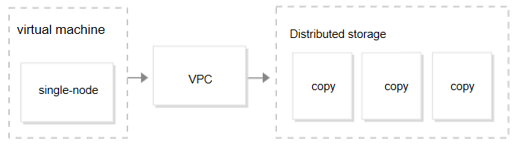
With compute-storage separation, if a compute node fails, rapid recovery can be achieved by replacing the node. The underlying data is stored on cloud disks with three replicas, ensuring a certain level of data reliability. Disk failures can be quickly recovered through disk snapshots.
The single-node (formerly Basic Edition) architecture offers over 20 monitoring metrics across multiple dimensions, such as database connections, access, and resource, and corresponding alarm policies can be configured, making it easier to manage compared to self-built cloud servers. Additionally, it features significant cost strengths, saving up to 40% compared to cloud servers. This architecture is deployed on cloud servers, offering better database performance than systems built by users.
The single-node (formerly Basic Edition) architecture uses Premium Disk as the underlying storage medium, which is suitable for 90% of I/O scenarios, providing excellent quality at a low price, with stable performance. The specific IOPS range calculation formula is: {min 1,500 + 8 x hard disk capacity, max 4,500}. For example, if the disk capacity is 50 GB, the IOPS range is {min 1,900, max 4,500}.
Basic Framework Diagram of the Architecture
Attention:
Because the single-node (formerly Basic Edition) architecture has only one node, recovery from a failure takes slightly longer than that of CVM when the node fails, as it involves instance startup and data recovery. For businesses that require high availability, use MySQL instances with two-node, three-node, or four-node architecture.
Single-Node - Read-Only Instance
Read-only instances are deployed on a single node and are attached to two-node, three-node, or four-node instances. They cannot be created independently without a primary instance. In the console, this architecture is displayed as: single-node (local disk).
Note:
The Cluster Edition architecture instances support adding read-only nodes to improve the read load capability of the instance. Read-only nodes can only be displayed under the primary instances of the corresponding Cluster Edition architecture. Additionally, the Cluster Edition architecture instances also support adding independent read-only instances, which are displayed in the console as Cluster Edition (Cloud Disk), with the underlying storage using cloud disks.
Scenarios
Applications in various industries that require read-write separation are currently only applied to read-only instances.
Architecture Features
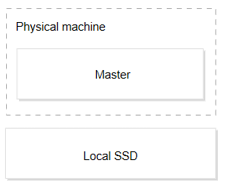
The underlying storage uses local NVMe SSD drives, providing powerful IO performance. It is currently applied to read-only instances to help businesses distribute read pressure.
Basic Framework Diagram of the Architecture
Attention:
Single-node deployment has a single point of failure risk. If only one read-only instance is purchased, high availability cannot be guaranteed. A failure of a single read-only instance will cause business interruption and affect customers.
The recovery time of a single read-only instance is affected by the volume of business data and cannot be guaranteed. Therefore, for businesses that require high availability, purchase at least two read-only instances in a RO group to ensure availability.
Related Documentation
TencentDB for MySQL allows you to create one or more read-only instances to support read-write separation and one-primary-multiple-replica scenarios. For more information, see Creating Read-Only Instances.
TencentDB for MySQL allows you to create one or more read-only instances to form a read-only instance RO group, ensuring availability. For more information, see Managing Read-Only Instance RO Groups.
Help and Support
Was this page helpful?
You can also Contact sales or Submit a Ticket for help.
Help us improve! Rate your documentation experience in 5 mins.
Feedback