Economical Instance
Download
Focus Mode
Font Size
TencentDB for MySQL supports creating economical instances to provide database services that can better meet the business needs of small and medium-sized enterprises and individual developers. This document describes economical instances of TencentDB for MySQL.
Overview
Economical instance is a cloud database service product of TencentDB for MySQL designed for lightweight application scenarios. The instance architecture is two-node, and a high availability mode with one primary and one replica node is adopted. Economical instances are sold in the form of fixed packages with high cost-effectiveness. Such instances are usually used in lightweight and low-load application scenarios such as small websites, web applications, blogs, and forums. They are also applicable for cloud development, testing, and learning environments. In these scenarios, economical instances can provide stable services and meet the computing and storage needs of the business. The specifications of economical instances are fixed. You can select a proper specification according to your actual needs for optimal resource utilization. They can ensure service quality and greatly reduce the operation costs of enterprises. They are applicable for small and medium-sized enterprises and individual developers.
Note:
Compared with two-node general instances of TencentDB for MySQL with the same specifications, economical instances are more cost-effective.
The specifications of economical instances are fixed. If you expect more instance specifications to support more complex business scenarios, you can use TencentDB for MySQL Cluster Edition or general/exclusive two-node/three-node TencentDB for MySQL instances.
Supported Database Versions and Engines
Supported database versions: MySQL 5.7 and MySQL 8.0.
Supported engines: InnoDB and RocksDB.
Supported Regions and AZs
The supported regions and AZs are listed in the table below and may be updated. Please refer to the supported regions and AZs on the purchase page.
Region | AZ |
Beijing | Beijing Zone 3 and Beijing Zone 6 |
Shanghai | Shanghai Zone 2 |
Guangzhou | Guangzhou Zone 3 and Guangzhou Zone 4 |
Chengdu | Chengdu Zone 1 and Chengdu Zone 2 |
Billing Mode
Economical instances only support the yearly/monthly subscription mode.
Product Specifications
Currently, economical instances have four fixed specifications. For all instance specifications supported by TencentDB for MySQL, see Database Instance Specification.
Type | CPU and Memory | Disk |
Economical | 1-core 2,000 MB | 50GB |
| 2-core 4,000 MB | 100GB |
| 4-core 8,000 MB | 150GB |
| 8-core 16,000 MB | 200GB |
Quota Limitation
Note:
The quota limit refers to the maximum quantity of economical instances of each fixed specification that an account (UIN) can own at the same time in a single region.
If the current quota cannot meet your needs, you can submit a ticket to apply for more quotas. Tencent Cloud will assess and process your application based on the application reason.
Instance Type | Quota Limitation |
Primary instance | You can purchase up to 5 economical primary instances of any specification in each region. |
Read-only instances | One economical primary instance can be mounted with up to 2 economical read-only instances. Note: Economical read-only instances can only be mounted to economical primary instances instead of general/exclusive primary instances. |
Disk (Storage Space) Usage
Warning:
Economical instances are sold with fixed specifications (disk package mode). If the disk (storage space) is about to be used up, you need to upgrade the configuration promptly. If the storage space of an instance is fully occupied, the instance will become read-only and be locked 24 hours later. In this case, the instance cannot be written. After you upgrade the configuration, the instance recovers and allows writing.
To prevent instances from becoming read-only and being locked when you fail to pay attention to disk (storage space) usage, you can subscribe to the instance read-only (disk usage exceeding limit) event in the event bus. For operations, see Setting Event Alarms. You can also set disk utilization alarms. For operations, see Alarm Policies (TCOP).
Features
The features supported by economical instances are similar to those of TencentDB for MySQL. For details about the supported and restricted features, see Feature List.
Comparison
The comparison between economical instances and two-node general instances of TencentDB for MySQL is as follows.
Comparison Item | Two-Node General TencentDB for MySQL Instance | Two-Node Economical TencentDB for MySQL Instance |
Applicable user | Medium and large-sized enterprises. | Small and medium-sized enterprises and individual developers. |
Business Scenario | Complex business scenarios, such as games, Internet, IoT, retail e-commerce, logistics, insurance, and securities. | Lightweight business scenarios, such as small websites, web applications, blogs, forums, cloud development, cloud testing, and cloud learning. |
Sales mode | Flexible selection of computing/storage resources. More instance specifications are available. | Fixed specifications with higher cost-effectiveness. |
Billing Mode | Yearly/monthly subscription and pay-as-you-go. | Yearly/monthly subscription only. |
Purchasing Economical Instances
1. Log in to the TencentDB for MySQL purchase page.
2. Select Two-node as the architecture.
3. Select Economical for Type in the Instance Configuration area.
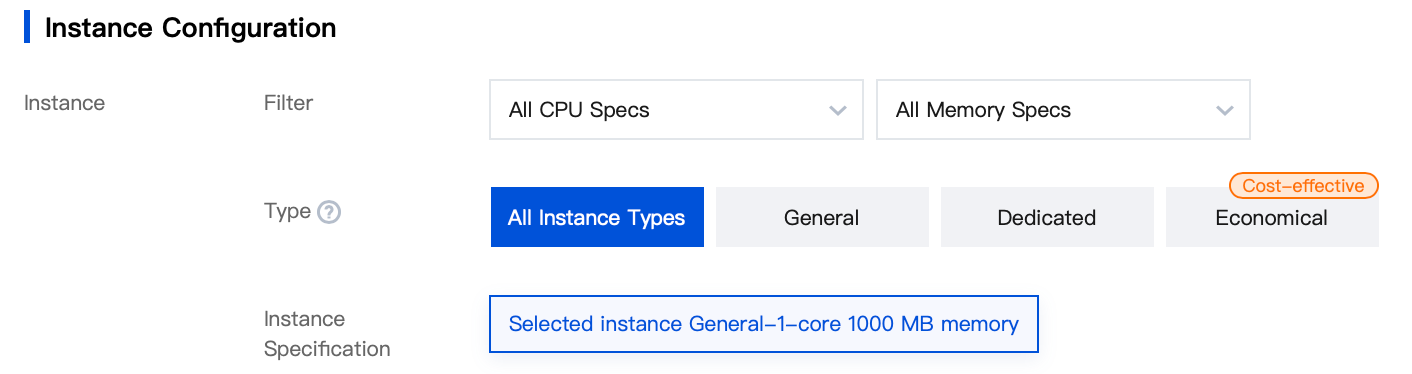
4. Select the instance specification, complete other configurations, and click Buy Now.
Note:
Help and Support
Was this page helpful?
You can also Contact sales or Submit a Ticket for help.
Help us improve! Rate your documentation experience in 5 mins.
Feedback