Introduction to TencentDB for MySQL Cluster Edition
Download
Focus Mode
Font Size
TencentDB for MySQL supports the Cluster Edition product architecture, offering high elasticity, high performance, flexibility, and reliability. It combines the simplicity and openness of open-source cloud databases with efficient iteration advantages. The Cluster Edition provides unique features such as automatic failover, the ability to switch any replica node (read-only node) to a primary node (read-write node), read-only replica nodes, on-demand scaling of nodes by adding or deleting them, multi-availability zone disaster recovery, granular node monitoring, and cluster node topology management. It helps users tackle complex business scenarios, enabling a single database deployment to meet a variety of business requirements.
What is the Cluster Edition?
The database Cluster Edition is based on a cloud-native high availability deployment model, featuring multiple read replica database nodes. It provides both read-write and read-only access addresses. Replica databases in two-node/three-node instances serve only for high availability purposes and do not provide direct access. Considering performance and cost factors, the Cluster Edition's architecture is suitable for more complex business scenarios where there are substantial business fluctuations, large data volumes, high read performance requirements, business systems that require frequent configuration adjustment or the addition/removal of read-only instances.
In the TencentDB for MySQL Cluster Edition, async and semi-sync replication are supported. You can choose the replication mode on the purchase page, and modify it later in the console's instance details page. For more details on replication modes, see Database Instance Replication.
The storage type for the TencentDB for MySQL Cluster Edition is cloud disk, supporting Tremendous SSD, Enhanced SSD, and SSD. The cloud disk type can only be selected on the purchase page. For more details on the performance of each cloud disk, see Cloud Disk Types.
Supported regions
The current regions that support creating cluster edition instances of TencentDB for MySQL are: Guangzhou, Shanghai, Beijing, Chengdu, Singapore, and Frankfurt.
Architecture Diagram
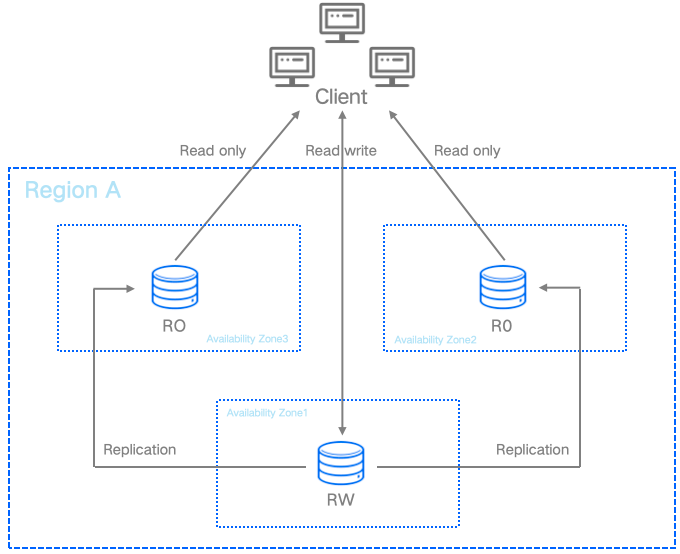
Architecture Applications
Users can freely deploy the number of primary and replica nodes according to actual business needs to meet the most suitable database deployment method required for business operation, achieving the best balance between cost and performance.
For example, the following are some common deployment methods (representing only some scenarios).
1 Primary, 1 Replica: The read-write node is used for online business and the read-only node is used for failover preparation and lightweight read queries. It is suitable for scenarios with low to moderate availability requirements for the production environment.
1 Primary, 2 Replicas: The read-write node is used for online business, and read-only node 1 is used for online analytical reads and read-only node 2 is used for failover preparation. It is suitable for scenarios needing high availability and better flexibility.
1 Primary, Multiple Replicas: The read-write node is used for online business and multiple read-only nodes are used for distributing the load of read requests, significantly enhancing the capability to handle a high volume of read requests. It is suitable for businesses with particularly high read request demands.
Advantages
Performance Enhancement: Significant improvements from various kernel optimizations such as atomic writes, code segment optimization, and Buffer Pool pre-warming.
Read-Only Replica Nodes: Replica databases support for the configuration of read-only addresses, eliminating the need for creating inaccessible replica instances.
High Elasticity: Can quickly adjust configurations up or down based on business needs, rapidly complete scaling out, and achieve cost optimization for compute resources.
Flexibility: Can quickly add or delete read-only nodes based on business needs. A Cluster Edition instance can quickly accommodate the addition or deletion of 1 to 5 read-only nodes.
Security and Reliability: Offering both async and semi-sync replication as options, combined with multiple replica nodes, ensures business continuity by maintaining proper primary-replica sync under normal circumstances.
Billing
To understand the billing methods and items for the TencentDB for MySQL Cluster Edition, see Billing Overview.
To know the prices for the TencentDB for MySQL Cluster Edition, see Price Calculator.
For information on the TencentDB for MySQL Cluster Edition storage free space and the billing for backup beyond the free space, see Backup Space Billing.
Supported Features
The features supported by the TencentDB for MySQL Cluster Edition instances are basically the same as those of the MySQL two-node/three-node instances. For a specific feature comparison, see Feature List.
For features and operations that differentiate the TencentDB for MySQL Cluster Edition instances from the MySQL two-node/three-node instances, see Subsequent Articles in This Section.
Help and Support
Was this page helpful?
You can also Contact sales or Submit a Ticket for help.
Help us improve! Rate your documentation experience in 5 mins.
Feedback