tencent cloud

TencentDB for MySQL

Release Notes and Announcements
Release Notes
Product Announcements
User Tutorial
Product Introduction
Overview
Strengths
Use Cases
Database Architecture
Resource Isolation Policy
Economical Instance
Feature List
Database Instance
High Availability (Multi-AZ)
Regions and AZs
Service Regions and Service Providers
Kernel Features
Overview
Kernel Version Release Notes
Functionality Features
Performance Features
Security Features
Stability Features
TXRocks Engine
LibraDB Engine
Checking and Fixing Kernel Issues
Purchase Guide
Billing Overview
Selection Guide
Purchase Methods
Renewal
Payment Overdue
Refund
Pay-as-You-Go to Monthly Subscription
Instance Adjustment Fee
Backup Space Billing
Database Audit Billing Overview
Commercial Billing and Activity Description for Database Proxy
Description of the Database Proxy Billing Cycle
Viewing Bills
Getting Started
Overview
Creating MySQL Instance
Connecting to MySQL Instance
SQL Insight (Database Audit)
Overview
Viewing Audit Instance List
Enabling Audit Service
Viewing Audit Log
Log Shipping
Configuring Post-Event Alarms
Modifying Audit Rule
Modifying Audit Services
Disabling Audit Service
Audit Rule Template
SQL Audit Rule (Legacy)
Viewing Audit Task
Authorizing Sub-User to Use Database Audit
MySQL Cluster Edition
Introduction to TencentDB for MySQL Cluster Edition
Creating TencentDB for MySQL Cluster Edition Instance
Maintenance Management Instance
Viewing Instance Monitoring
Adjusting Instance Configuration
Operations for Other Features
Migrate or upgrade to TencentDB for MySQL Cluster Edition
Operation Guide
Use Limits
Operation Overview
Instance Management and Maintenance
Instance Upgrade
CPU Elastic Expansion
Read-Only/Disaster Recovery Instances
Database Proxy
Database Management Center (DMC)
Account Management
Parameter Configuration
Backup and Rollback
Data Migration
Network and Security
Monitoring and Alarms
Log Center
Read-Only Analysis Engine
Tag
Practical Tutorial
Using TencentDB for MySQL to Upgrade MySQL 5.7 to MySQL 8.0
Methods and Instructions for Upgrading from MySQL 5.6 to MySQL 5.7
Cybersecurity Classified Protection Practice for Database Audit of TencentDB for MySQL
Building All-Scenario High-Availability Architecture
Usage Specifications of TencentDB for MySQL
Configuring Automatic Application Reconnection
Impact of Modifying MySQL Source Instance Parameters
Limits on Automatic Conversion from MyISAM to InnoDB
Creating VPCs for TencentDB for MySQL
Enhancing Business Load Capacity with TencentDB for MySQL
Setting up 2-Region-3-DC Disaster Recovery Architecture
Improving TencentDB for MySQL Performance with Read/Write Separation
Migrating Data from InnoDB to RocksDB with DTS
Building LAMP Stack for Web Application
Building Drupal Website
Calling MySQL APIs in Python
The primary and secondary instances have inconsistent query data
White Paper
Performance White Paper
Security White Paper
Troubleshooting
Connections
Performance
Instance Data Sync Delay
Failure to Enable Case Insensitivity
Failure to Obtain slow_query_log_file via a Command
API Documentation
History
Introduction
API Category
Instance APIs
Making API Requests
Data Import APIs
Database Proxy APIs
Database Audit APIs
Security APIs
Task APIs
Backup APIs
Account APIs
Rollback APIs
Parameter APIs
Database APIs
Monitoring APIs
Log-related API
Data Types
Error Codes
FAQs
Related to Selection
Billing
Backup
Rollback
Connection and Login
Parameter Modifications
Instance Upgrade
Account Permissions
Performance and Memory
Ops
Data Migration
Features
Console Operations
Logs
Event
Database audit
Instance Switch Impact
API 2.0 to 3.0 Switch Guide
Service Agreement
Service Level Agreement
Terms of Service
Reference
Standards and Certifications
Contact Us
Glossary
DocumentationTencentDB for MySQLPractical TutorialBuilding LAMP Stack for Web Application

Building LAMP Stack for Web Application

PDF
Focus Mode
Font Size
Last updated: 2023-07-31 17:27:05
LAMP (Linux + Apache + MySQL/MariaDB + Perl/PHP/Python) is a set of open-source software programs often used to set up dynamic websites or servers. These independent programs are usually used together and increasingly compatible with one another to form a powerful web application platform. This tutorial guides you through the following process: starting a TencentDB instance and configuring a LAMP application with a CVM instance to connect to the highly available environment of the TencentDB instance. The database can be separated from the environment lifecycle after you run the TencentDB instance. This allows you to connect the same database from multiple servers for simplified database operation and maintenance, so that you no longer need to worry about database installation, deployment, version update, and troubleshooting, etc.
The TencentDB and CVM instances used in the tutorial reside in the same region. If this is not the case, see Connecting to MySQL Instance

Initializing the TencentDB Instance

For more information on how to purchase and initialize TencentDB instances, see Purchase Methods and Creating MySQL Instance.

Logging in to the CVM Instance

For more information on how to purchase and access CVM instances, see Getting Started with Linux-based CVM. CentOS is used in this tutorial.

Installing the MySQL Client

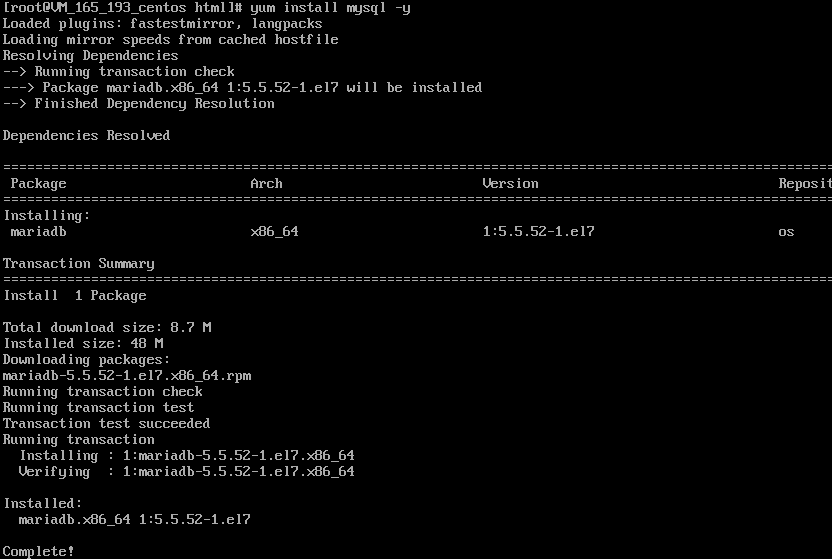
1. Install the MySQL client to the CVM instance with yum.
yum install mysql -y

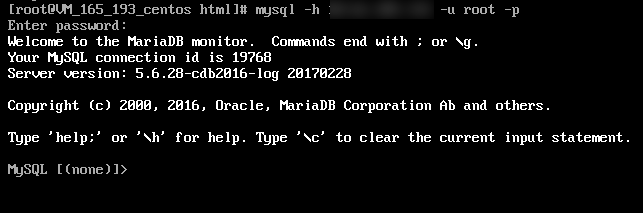
2. Connect to the TencentDB instance after the installation is completed.
mysql -h hostname -u username -p

Here, "hostname" is the private IP of the TencentDB instance and "username" is the username of your database.
3. After the connection is successful, you can close the instance and proceed to the next step.
quit;

Installing the Apache Service

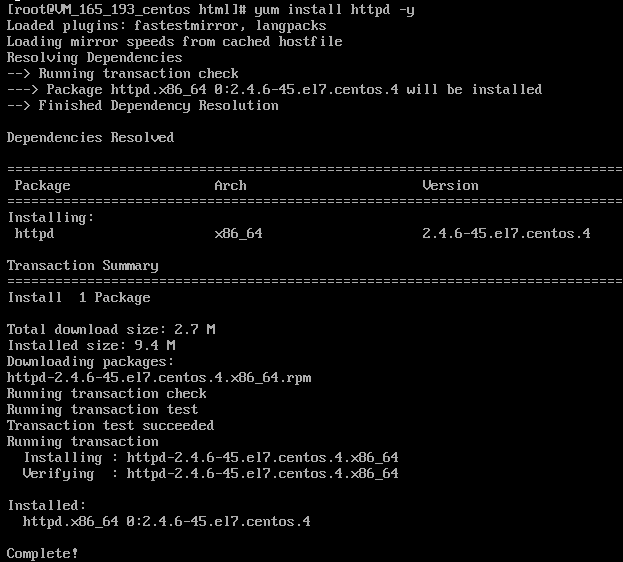
1. Install Apache in the CVM instance with yum.
yum install httpd -y

2. Start the Apache service.
service httpd start
3. Test Apache.
In this step, you should configure an inbound rule with the source being all and the port protocol being TCP:80 in the security group of your CVM instance. For more information on how to configure the security group, see Security Group.
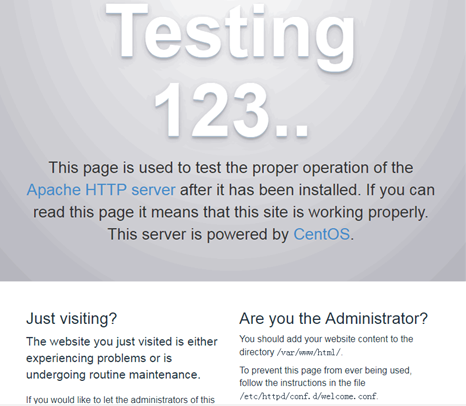
Enter http://xxx.xxx.xxx.xxx/ in your local browser (where xxx.xxx.xxx.xxx is the public IP of your CVM instance). If the following page appears, Apahce has started successfully.


Installing PHP

1. Install PHP in the CVM instance with yum.
yum install php -y


Creating a Project to Test the LAMP Environment

1. Create an info.php file in the /var/www/html directory of the CVM instance. Below is the sample code:
<?php phpinfo(); ?>
2. Restart the Apache service.
service httpd restart
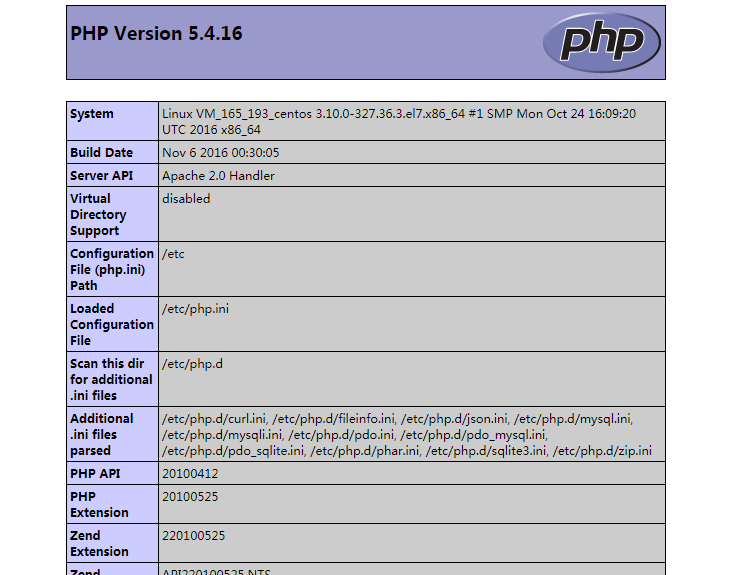
3. Enter http://xxx.xxx.xxx.xxx/info.php in your local browser (where xxx.xxx.xxx.xxx is the public IP of your CVM instance). If the following page appears, the LAMP service has been deployed successfully.
Help and Support

Was this page helpful?

Help us improve! Rate your documentation experience in 5 mins.

Feedback