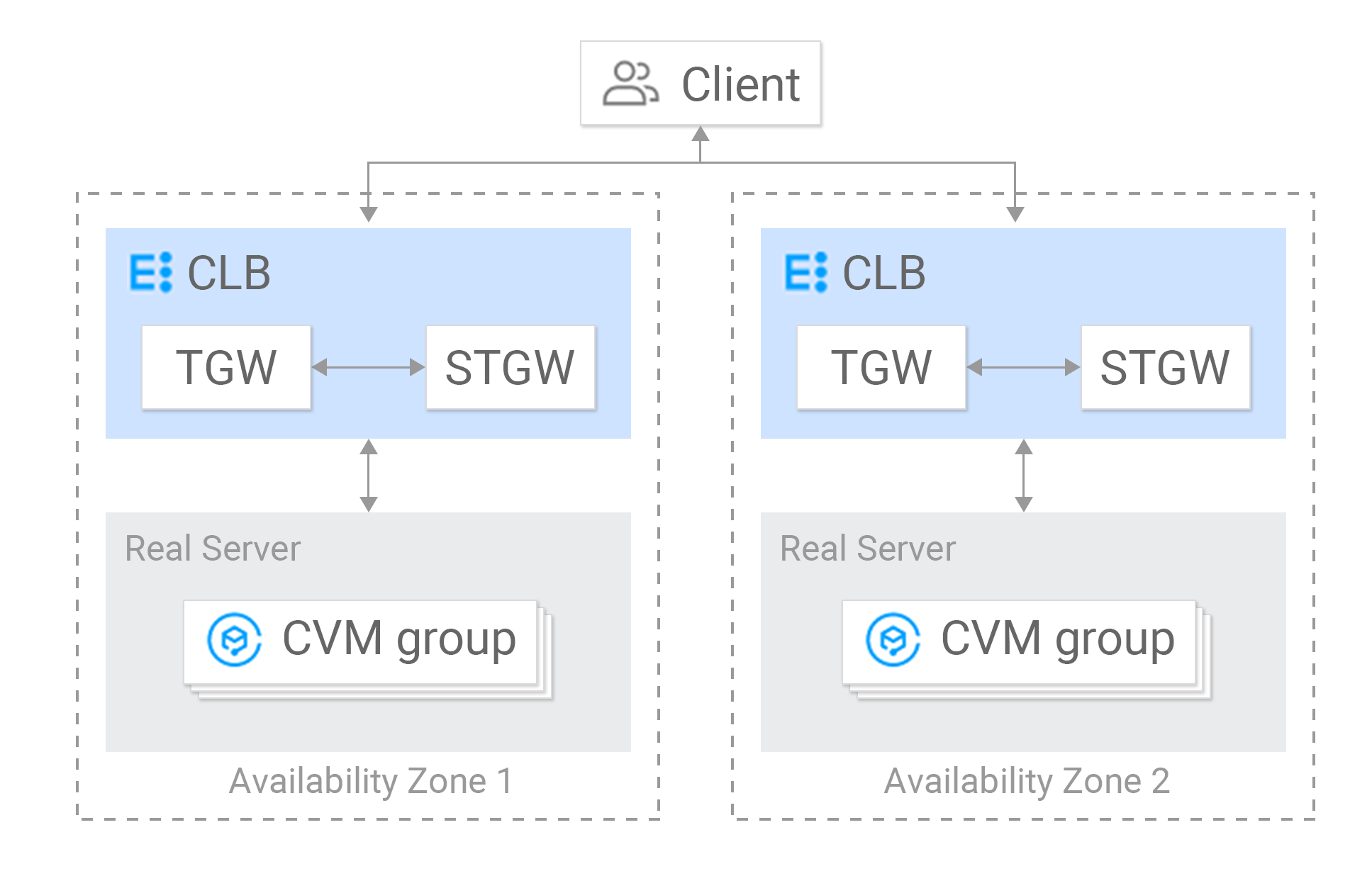
CLB provides Layer-4 (TCP, UDP, and TCP SSL protocols) and Layer-7 (HTTP and HTTPS protocols) load balancing. You can use CLB to distribute business traffic to multiple real servers to eliminate single point of failure and guarantee business availability. CLB adopts cluster deployment to achieve session synchronization, eliminating server’s single point of failure and improving system redundancy to ensure service stability. CLB can be deployed in multiple data centers in the same region to implement intra-city disaster recovery.
At Layer-4, load balancing is implemented based on the unified Tencent Gateway (TGW). TGW has features such as high availability, high scalability, high performance, and strong anti-attack capability. It supports high-performance forwarding based on Data Plane Development Kit (DPDK). With TGW, a single cluster can support hundreds of millions of concurrent requests and tens of millions of packets per second (PPS). Many Tencent businesses, such as Tencent Games, Tencent Video, use TGW for service access.
At Layer-7, load balancing is implemented based on Secure Tencent Gateway (STGW). It is a load balancing service developed by Tencent based on Nginx that supports large-scale concurrence. It carries a large amount of Tencent’s Layer-7 business traffic, such as Tencent News, Tencent Games.
Forwarding Path
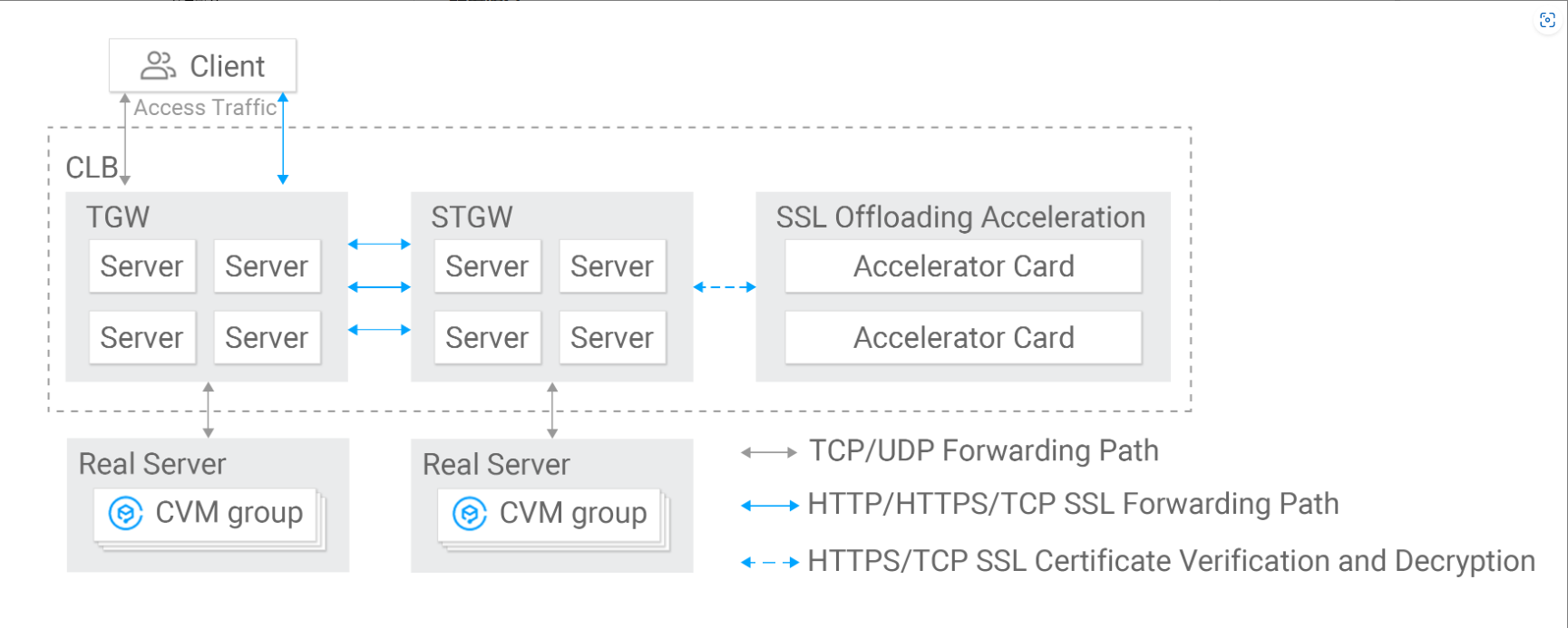
CLB forwards business traffic and real servers process business requests. CLB communicates with real servers via Tencent Cloud private network. Both TGW and STGW are deployed on multiple servers, and provide load balancing services through clusters. The forwarding path of CLB is as shown below:
1. TCP and UDP protocol:
The forwarding logic of TCP/UDP protocol is processed by TGW cluster.
After receiving the business traffic, TGW forwards it to real servers via Tencent Cloud's private network. The return packets from real servers are also returned to the client via TGW.
2. TCP SSL protocol
When TCP SSL protocol is processed, business traffic passes through the TGW cluster and then STGW cluster, which forwards the traffic to real servers.
Before a new session is established, it must pass through the accelerator card cluster for certificate verification, encryption, decryption and other operations.
When business traffic arrives, it passes through TGW, STGW, and real servers in sequence via Tencent Cloud's private network. The return packets are sent to the client in reverse sequence.
3. HTTP and HTTPS protocols
When HTTP or HTTPS protocol is processed, business traffic passes through the TGW cluster and then STGW cluster, which identifies the HTTP protocol and forwards the traffic to real servers.
Before a new HTTPS session is established, it must pass through the accelerator card cluster for certificate verification, encryption, decryption and other operations. HTTPS will be converted to HTTP protocol and then forwarded to real servers.
When business traffic arrives, it passes through TGW, STGW, and real servers in sequence via Tencent Cloud's private network. The return packets are sent to the client in reverse sequence.