tencent cloud

TencentDB for MySQL

Release Notes and Announcements
Release Notes
Product Announcements
User Tutorial
Product Introduction
Overview
Strengths
Use Cases
Database Architecture
Resource Isolation Policy
Economical Instance
Feature List
Database Instance
High Availability (Multi-AZ)
Regions and AZs
Service Regions and Service Providers
Kernel Features
Overview
Kernel Version Release Notes
Functionality Features
Performance Features
Security Features
Stability Features
TXRocks Engine
LibraDB Engine
Checking and Fixing Kernel Issues
Purchase Guide
Billing Overview
Selection Guide
Purchase Methods
Renewal
Payment Overdue
Refund
Pay-as-You-Go to Monthly Subscription
Instance Adjustment Fee
Backup Space Billing
Database Audit Billing Overview
Commercial Billing and Activity Description for Database Proxy
Description of the Database Proxy Billing Cycle
Viewing Bills
Getting Started
Overview
Creating MySQL Instance
Connecting to MySQL Instance
SQL Insight (Database Audit)
Overview
Viewing Audit Instance List
Enabling Audit Service
Viewing Audit Log
Log Shipping
Configuring Post-Event Alarms
Modifying Audit Rule
Modifying Audit Services
Disabling Audit Service
Audit Rule Template
SQL Audit Rule (Legacy)
Viewing Audit Task
Authorizing Sub-User to Use Database Audit
MySQL Cluster Edition
Introduction to TencentDB for MySQL Cluster Edition
Creating TencentDB for MySQL Cluster Edition Instance
Maintenance Management Instance
Viewing Instance Monitoring
Adjusting Instance Configuration
Operations for Other Features
Migrate or upgrade to TencentDB for MySQL Cluster Edition
Operation Guide
Use Limits
Operation Overview
Instance Management and Maintenance
Instance Upgrade
CPU Elastic Expansion
Read-Only/Disaster Recovery Instances
Database Proxy
Database Management Center (DMC)
Account Management
Parameter Configuration
Backup and Rollback
Data Migration
Network and Security
Monitoring and Alarms
Log Center
Read-Only Analysis Engine
Tag
Practical Tutorial
Using TencentDB for MySQL to Upgrade MySQL 5.7 to MySQL 8.0
Methods and Instructions for Upgrading from MySQL 5.6 to MySQL 5.7
Cybersecurity Classified Protection Practice for Database Audit of TencentDB for MySQL
Building All-Scenario High-Availability Architecture
Usage Specifications of TencentDB for MySQL
Configuring Automatic Application Reconnection
Impact of Modifying MySQL Source Instance Parameters
Limits on Automatic Conversion from MyISAM to InnoDB
Creating VPCs for TencentDB for MySQL
Enhancing Business Load Capacity with TencentDB for MySQL
Setting up 2-Region-3-DC Disaster Recovery Architecture
Improving TencentDB for MySQL Performance with Read/Write Separation
Migrating Data from InnoDB to RocksDB with DTS
Building LAMP Stack for Web Application
Building Drupal Website
Calling MySQL APIs in Python
The primary and secondary instances have inconsistent query data
White Paper
Performance White Paper
Security White Paper
Troubleshooting
Connections
Performance
Instance Data Sync Delay
Failure to Enable Case Insensitivity
Failure to Obtain slow_query_log_file via a Command
API Documentation
History
Introduction
API Category
Instance APIs
Making API Requests
Data Import APIs
Database Proxy APIs
Database Audit APIs
Security APIs
Task APIs
Backup APIs
Account APIs
Rollback APIs
Parameter APIs
Database APIs
Monitoring APIs
Log-related API
Data Types
Error Codes
FAQs
Related to Selection
Billing
Backup
Rollback
Connection and Login
Parameter Modifications
Instance Upgrade
Account Permissions
Performance and Memory
Ops
Data Migration
Features
Console Operations
Logs
Event
Database audit
Instance Switch Impact
API 2.0 to 3.0 Switch Guide
Service Agreement
Service Level Agreement
Terms of Service
Reference
Standards and Certifications
Contact Us
Glossary

MySQL 5.6 Test Results

PDF
Focus Mode
Font Size
Last updated: 2024-07-23 17:42:20
This document describes the performance test results of a general TencentDB for MySQL 5.6 instance.

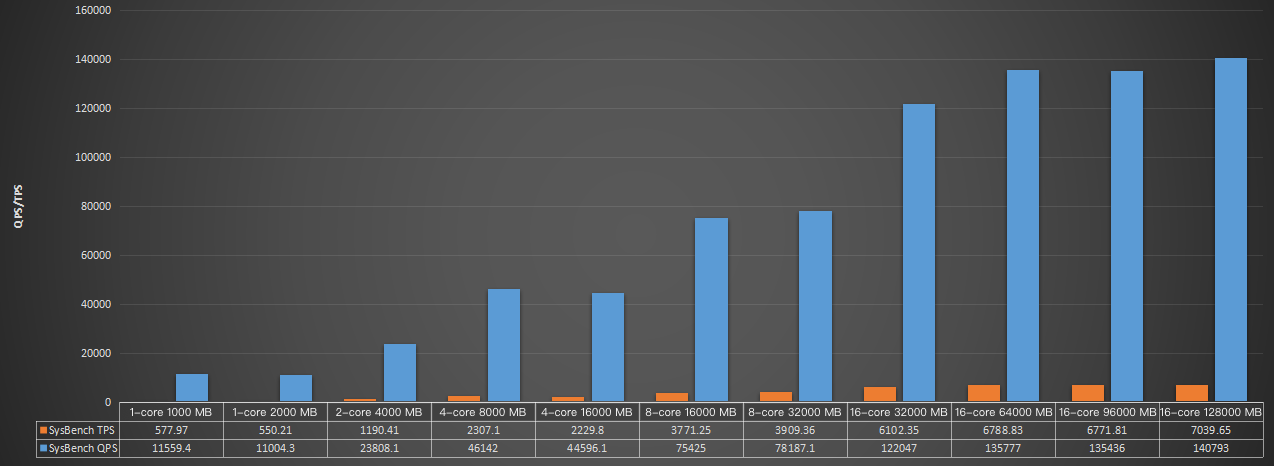
Scenario 1: Full Cache

In the full cache scenario, as all data can be put into the cache, the disk doesn't need to be read and written to update the cache during queries.


CPU
(Core)
Memory
(MB)
Concurrency
Data Volume/Table
Total Tables
SysBench TPS
SysBench QPS
avg_lat
1
1000
8
25000
150
577.97
11559.4
13.84
1
2000
8
25000
150
550.21
11004.3
14.54
2
4000
16
25000
150
1190.41
23808.1
13.44
4
8000
32
25000
150
2307.1
46142
13.87
4
16000
32
25000
150
2229.8
44596.1
14.35
8
16000
64
25000
150
3771.25
75425
16.97
8
32000
64
25000
150
3909.36
78187.1
16.37
16
32000
128
25000
150
6102.35
122047
20.97
16
64000
128
25000
150
6788.83
135777
18.85
16
96000
128
25000
150
6771.81
135436
18.9
16
128000
128
25000
150
7039.65
140793
18.18

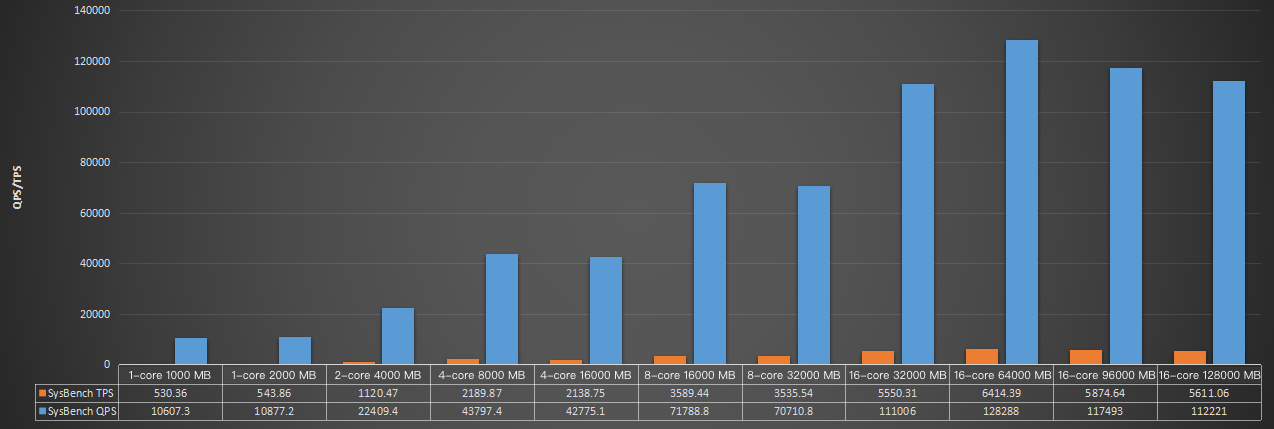
Scenario 2: Disk I/O

In the disk I/O scenario, as only part of the data can be put into the cache, the disk needs to be read and written to update the cache during queries.
CPU
(Core)
Memory
(MB)
Concurrency
Data Volume/Table
Total Tables
SysBench TPS
SysBench QPS
avg_lat
1
1000
8
800000
6
530.36
10607.3
15.08
1
2000
8
800000
12
543.86
10877.2
14.71
2
4000
16
800000
24
1120.47
22409.4
14.28
4
8000
32
800000
48
2189.87
43797.4
14.61
4
16000
32
6000000
13
2138.75
42775.1
14.96
8
16000
64
6000000
13
3589.44
71788.8
17.83
8
32000
64
6000000
25
3535.54
70710.8
18.1
16
32000
128
6000000
25
5550.31
111006
23.06
16
64000
128
6000000
49
6414.39
128288
19.95
16
96000
128
6000000
74
5874.64
117493
21.78
16
128000
128
6000000
98
5611.06
112221
22.81

Help and Support

Was this page helpful?

Help us improve! Rate your documentation experience in 5 mins.

Feedback