tencent cloud

TencentDB for MySQL

Release Notes and Announcements
Release Notes
Product Announcements
User Tutorial
Product Introduction
Overview
Strengths
Use Cases
Database Architecture
Resource Isolation Policy
Economical Instance
Feature List
Database Instance
High Availability (Multi-AZ)
Regions and AZs
Service Regions and Service Providers
Kernel Features
Overview
Kernel Version Release Notes
Functionality Features
Performance Features
Security Features
Stability Features
TXRocks Engine
LibraDB Engine
Checking and Fixing Kernel Issues
Purchase Guide
Billing Overview
Selection Guide
Purchase Methods
Renewal
Payment Overdue
Refund
Pay-as-You-Go to Monthly Subscription
Instance Adjustment Fee
Backup Space Billing
Database Audit Billing Overview
Commercial Billing and Activity Description for Database Proxy
Description of the Database Proxy Billing Cycle
Viewing Bills
Getting Started
Overview
Creating MySQL Instance
Connecting to MySQL Instance
SQL Insight (Database Audit)
Overview
Viewing Audit Instance List
Enabling Audit Service
Viewing Audit Log
Log Shipping
Configuring Post-Event Alarms
Modifying Audit Rule
Modifying Audit Services
Disabling Audit Service
Audit Rule Template
SQL Audit Rule (Legacy)
Viewing Audit Task
Authorizing Sub-User to Use Database Audit
MySQL Cluster Edition
Introduction to TencentDB for MySQL Cluster Edition
Creating TencentDB for MySQL Cluster Edition Instance
Maintenance Management Instance
Viewing Instance Monitoring
Adjusting Instance Configuration
Operations for Other Features
Migrate or upgrade to TencentDB for MySQL Cluster Edition
Operation Guide
Use Limits
Operation Overview
Instance Management and Maintenance
Instance Upgrade
CPU Elastic Expansion
Read-Only/Disaster Recovery Instances
Database Proxy
Database Management Center (DMC)
Account Management
Parameter Configuration
Backup and Rollback
Data Migration
Network and Security
Monitoring and Alarms
Log Center
Read-Only Analysis Engine
Tag
Practical Tutorial
Using TencentDB for MySQL to Upgrade MySQL 5.7 to MySQL 8.0
Methods and Instructions for Upgrading from MySQL 5.6 to MySQL 5.7
Cybersecurity Classified Protection Practice for Database Audit of TencentDB for MySQL
Building All-Scenario High-Availability Architecture
Usage Specifications of TencentDB for MySQL
Configuring Automatic Application Reconnection
Impact of Modifying MySQL Source Instance Parameters
Limits on Automatic Conversion from MyISAM to InnoDB
Creating VPCs for TencentDB for MySQL
Enhancing Business Load Capacity with TencentDB for MySQL
Setting up 2-Region-3-DC Disaster Recovery Architecture
Improving TencentDB for MySQL Performance with Read/Write Separation
Migrating Data from InnoDB to RocksDB with DTS
Building LAMP Stack for Web Application
Building Drupal Website
Calling MySQL APIs in Python
The primary and secondary instances have inconsistent query data
White Paper
Performance White Paper
Security White Paper
Troubleshooting
Connections
Performance
Instance Data Sync Delay
Failure to Enable Case Insensitivity
Failure to Obtain slow_query_log_file via a Command
API Documentation
History
Introduction
API Category
Instance APIs
Making API Requests
Data Import APIs
Database Proxy APIs
Database Audit APIs
Security APIs
Task APIs
Backup APIs
Account APIs
Rollback APIs
Parameter APIs
Database APIs
Monitoring APIs
Log-related API
Data Types
Error Codes
FAQs
Related to Selection
Billing
Backup
Rollback
Connection and Login
Parameter Modifications
Instance Upgrade
Account Permissions
Performance and Memory
Ops
Data Migration
Features
Console Operations
Logs
Event
Database audit
Instance Switch Impact
API 2.0 to 3.0 Switch Guide
Service Agreement
Service Level Agreement
Terms of Service
Reference
Standards and Certifications
Contact Us
Glossary

Network Architecture Performance Comparison

PDF
Focus Mode
Font Size
Last updated: 2024-07-23 17:42:37
TencentDB for MySQL has upgraded the network architecture of database instances for a higher performance and lower latency. This document describes the performance tests on the old and new versions.
Note:
Starting from November 9, 2022, the new network architecture has been applied to newly purchased instances to deliver lower latency and higher performance.
On January 21, 2023, all existing database instances have been switched to the new network architecture.
Single-node instances of cloud disk edition are already in the optimal network architecture, so their details page does not indicate whether the network architecture is new.
The new network architecture cannot be used in the classic network. To use it, switch to VPC as instructed in Network Switch and wait for the network architecture to upgrade.
For more information, see Network Architecture Upgrade.

Test environment

Region/AZ: Beijing - Beijing Zone 6.
Client specification: S5.2XLARGE16 (8 CPU cores and 16 GB memory).
Client OS: TencentOS Server 3.2.
Network: Both the CVM and TencentDB for MySQL instances are in the same VPC subnet.
Storage type: Local SSD disk
Instance specification: General (4 CPU cores and 16 GB memory).
Parameter template: High-performance template
Replication method: Async replication

Test tool

SysBench is a modular, cross-platform, and multi-threaded benchmark tool for evaluating OS parameters that are important for a system running a database under intensive load. The idea of this benchmark suite is to quickly get an impression about system performance without setting up complex database benchmarks or even without installing a database at all. This stress test uses SysBench 1.0.20.

Test scenario

This stress test involves write-only, read-only, and read-write scenarios, each with 2–3,000 threads tested. The QPS is used as the performance metric.

Test method

Step 1. Prepare the data Run the following command:
sysbench --db-driver=mysql --mysql-host=XXX --mysql-port=XXX
--mysql-user=XXX --mysql-password=XXX --mysql-db=sbtest --table_size=10000000
--tables=10 --events=0 --time=300 --threads={2~3000} oltp_read_write prepare
Step 2. Run the workload Run the workload in write-only, read-only, and read-write scenarios. Make sure that the configuration is correct.
OLTP write-only scenario Run the following command:
sysbench --db-driver=mysql --mysql-host=XXX --mysql-port=XXX
--mysql-user=XXX --mysql-password=XXX --mysql-db=sbtest --table_size=10000000
--tables=10 --events=0 --time=300 --threads={2~3000} --percentile=95 --report-interval=1 oltp_write_only
run
OLTP read-only scenario Run the following command:
sysbench --db-driver=mysql --mysql-host=XXX --mysql-port=XXX
--mysql-user=XXX --mysql-password=XXX --mysql-db=sbtest --table_size=10000000
--tables=10 --events=0 --time=300 --threads={2~3000} --percentile=95 --skip-trx=1 --report-interval=1
oltp_read_only
run
OLTP read-write scenario Run the following command:
sysbench --db-driver=mysql --mysql-host=XXX --mysql-port=XXX
--mysql-user=XXX --mysql-password=XXX --mysql-db=sbtest --table_size=10000000
--tables=10 --events=0 --time=300 --threads={2~3000} --percentile=95 --report-interval=1 oltp_read_write
run
Step 3. Clear the data Run the following command to clear the data after the test is executed:
sysbench --db-driver=mysql --mysql-host=XXX --mysql-port=XXX --mysql-user=XXX --mysql-password=XXX
--mysql-db=sbtest --table_size=25000 --tables=250 --events=0 --time=600 --threads=XXX --percentile=95 oltp_read_write cleanup

Test metric

The test metric is queries per second (QPS).

Test result

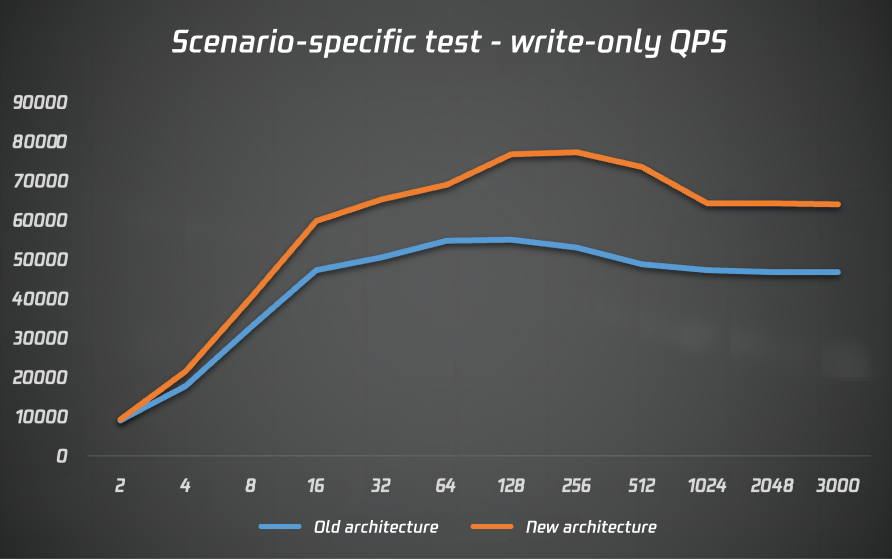
Test result in the write-only scenario In the write-only scenario, the new architecture of TencentDB for MySQL always outperforms the old architecture as the thread quantity increases, with the QPS peaking at 256 threads and being 20% higher than the old architecture's at 512 threads.

Test result in the read-only scenario In the read-only scenario, the new architecture of TencentDB for MySQL sees a great linear QPS rise as the thread quantity increases from a small number, with the QPS 22% being higher than the old architecture's at 16 threads and going up steadily at 64 threads or more.


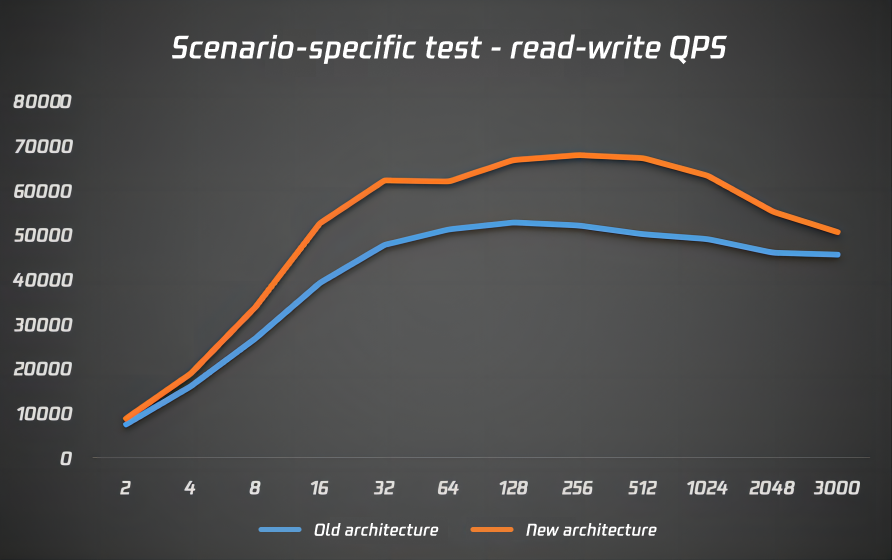
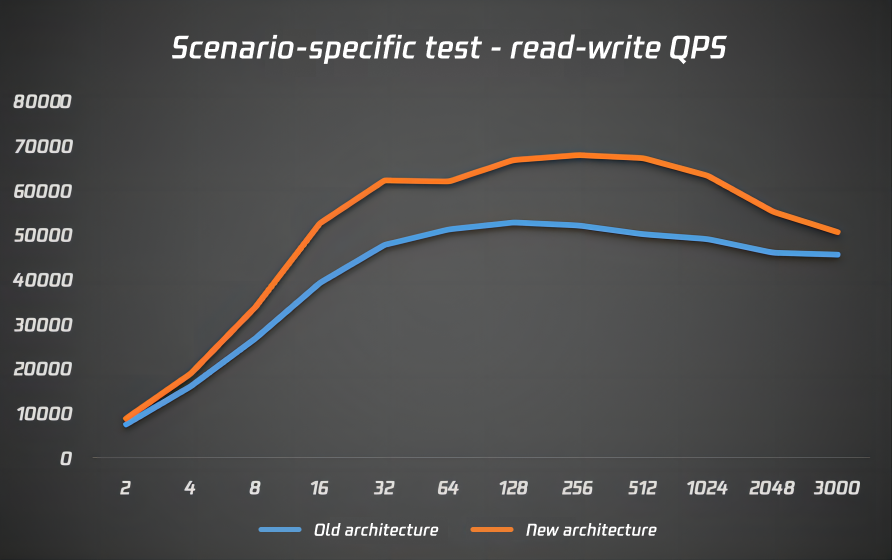
Test result in the read-write scenario In the read-write scenario, the new architecture of TencentDB for MySQL sees a great QPS rise as the thread quantity increases from a small number, with the QPS hitting the peak (18% higher than the old architecture's) at 512 threads and falling steadily after that.


Conclusion

Note:
The above performance test results are for reference only.
The above scenario tests show that the new network architecture of TencentDB for MySQL greatly outperforms the old architecture. In the range of 2–3,000 threads, the QPS is improved by 20% on average.
Help and Support

Was this page helpful?

Help us improve! Rate your documentation experience in 5 mins.

Feedback