tencent cloud

Content Delivery Network

Updates and Announcements
Release Notes
Announcements
User Tutorial
Product Introduction
Product Overview
Strengths
Use Cases
Term
Use Limits
CDN Performance Descriptions (Spot-check)
Purchase Guide
CDN Purchase Guide
ECDN Purchase Guide
Getting Started
Configuring CDN from Scratch
Adding Domain Names
CNAME Configuration
Domain Name Ownership Verification
FAQs about Domain Name Connection
Configuration Guide
Domain Management
Domain Name Configurations
Statistical Analysis
Purge and Prefetch
Log Management
EdgeOne
Service Query
Offline Cache
Permission Management
Permission Configuration
Console Permissions
Activate Real-time Logging as Sub-account/Collaborator
Use Cases
Accelerating Resources on COS with CDN
Practical Tutorial
Guide to Using the EdgeOne Tool for Migrating Content Delivery Network (CDN) Related Services
CDN - CVM
CDN - COS
Configuring CNAME via DNSPod
Regularly Storing CDN Logs
API Documentation
History
Introduction
API Category
Content Management APIs
Real-time Log APIs
Service Query APIs
Data Query APIs
Making API Requests
Log Query APIs
StopCdnDomain
Configuration Management APIs
Obsoleted APIs
Other APIs
Data Types
Error Codes
FAQ
Features
Billing
FAQs about Domain Name Connection
Cache Configuration FAQs
Purge and Prefetch
Statistical Analysis
FAQs about HTTPS
Connection
Errors
Troubleshooting Methods
Status Codes and Solutions
Node Cache Inconsistency
Slow Access Speed After CDN Activation
Low Traffic Hit Rate
404 Status Code
Page Display - CORS error
Resource Cache Failure
Service Level Agreement
Glossary

Billing

PDF
Focus Mode
Font Size
Last updated: 2024-12-30 22:01:14

Can CDN be billed by the number of requests?

No. Currently, CDN does not support billing by the number of requests.

What will happen if my account falls into arrears?

For more information, please see the note on arrears in the billing description document.

If the origin server uses COS, will I be charged for traffic generated by origin-pull from CDN to COS?

No. The traffic generated by origin-pull from CDN to COS is billed by COS instead of CDN. For more information, please see COS as Origin Server.

When CDN is disabled (or deactivated), will it generate traffic and incur fees?

After the CDN domain name acceleration service is disabled, if the domain name is still configured with CNAME, a 404 status code will be returned for requests resolved to the node and a small amount of traffic will be consumed. The console will record this traffic data for your reference. Corresponding logs will also be generated. However, since your domain name has been disabled, you will not be billed for this traffic consumption and log packets. We recommend you modify the origin-pull resolution first before disabling the acceleration service.

How do I change the billing mode of CDN?

If you find the selected billing mode unsuitable for your actual business conditions (for more information on how to select the right billing mode for you, please see Choosing a Billing Plan), you can change it by following the steps below:
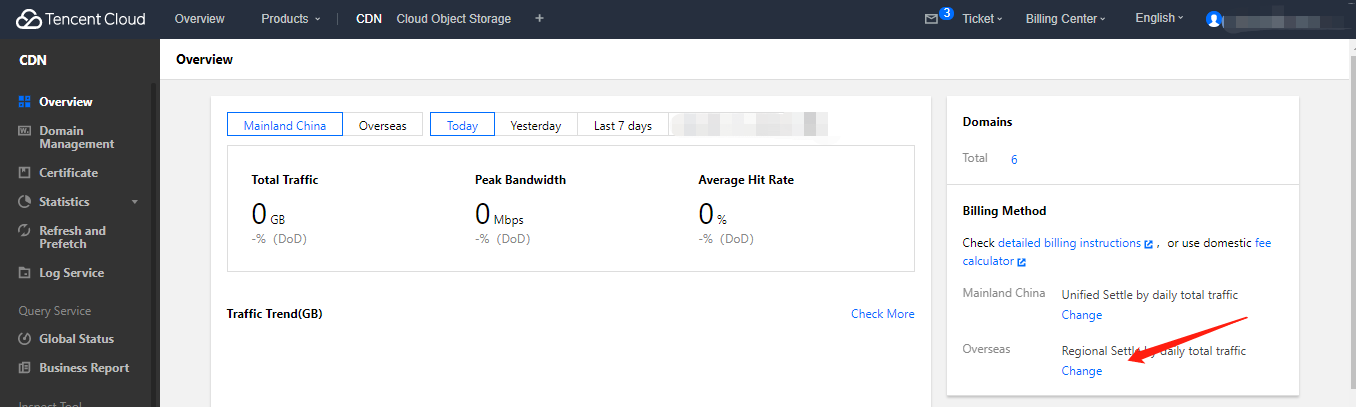
1. Log in to the CDN Console, access the service overview page, and click Change in the billing mode section on the right.


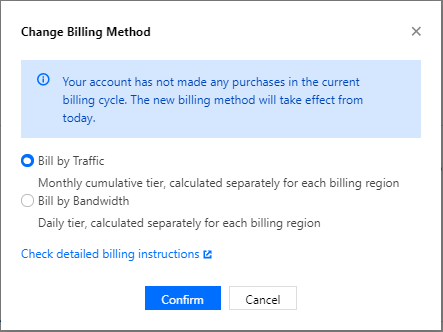
2. Change the original billing mode Bill by Traffic to Bill by Bandwidth.


3. After you change the billing mode to Bill by Bandwidth, the charge for total consumption generated on the current date will be billed and deducted on the next day:

If the origin server uses CVM, will I be charged for traffic generated by origin-pull from CDN to CVM?

No. CDN does not charge for this type of traffic.

What is the conversion rate from Gbps to Mbps in CDN billing?

In CDN billing, 1 Gbps = 1000 Mbps, 1 Mbps = 1000 Kbps, and 1 Kbps = 1000 bps.

Is only downstream traffic billable in CDN?

Yes. CDN only charges for downstream, not upstream traffic.

Is there a delay in using APIs to query data? How long is it?

There is a certain delay in using APIs to query data. Queries of real-time data such as access data and billing data have a delay of around 5–10 minutes, while queries of analytical data such as rankings will have delays of approximately half an hour. The data is calibrated on the backend at around 3 am Beijing Time.

Help and Support

Was this page helpful?

Help us improve! Rate your documentation experience in 5 mins.

Feedback