tencent cloud

Content Delivery Network

Updates and Announcements
Release Notes
Announcements
User Tutorial
Product Introduction
Product Overview
Strengths
Use Cases
Term
Use Limits
CDN Performance Descriptions (Spot-check)
Purchase Guide
CDN Purchase Guide
ECDN Purchase Guide
Getting Started
Configuring CDN from Scratch
Adding Domain Names
CNAME Configuration
Domain Name Ownership Verification
FAQs about Domain Name Connection
Configuration Guide
Domain Management
Domain Name Configurations
Statistical Analysis
Purge and Prefetch
Log Management
EdgeOne
Service Query
Offline Cache
Permission Management
Permission Configuration
Console Permissions
Activate Real-time Logging as Sub-account/Collaborator
Use Cases
Accelerating Resources on COS with CDN
Practical Tutorial
Guide to Using the EdgeOne Tool for Migrating Content Delivery Network (CDN) Related Services
CDN - CVM
CDN - COS
Configuring CNAME via DNSPod
Regularly Storing CDN Logs
API Documentation
History
Introduction
API Category
Content Management APIs
Real-time Log APIs
Service Query APIs
Data Query APIs
Making API Requests
Log Query APIs
StopCdnDomain
Configuration Management APIs
Obsoleted APIs
Other APIs
Data Types
Error Codes
FAQ
Features
Billing
FAQs about Domain Name Connection
Cache Configuration FAQs
Purge and Prefetch
Statistical Analysis
FAQs about HTTPS
Connection
Errors
Troubleshooting Methods
Status Codes and Solutions
Node Cache Inconsistency
Slow Access Speed After CDN Activation
Low Traffic Hit Rate
404 Status Code
Page Display - CORS error
Resource Cache Failure
Service Level Agreement
Glossary

Domain Name Operations

PDF
Focus Mode
Font Size
Last updated: 2023-06-29 17:45:01

Scenarios

To manage domain names connected to Tencent Cloud CDN, go to the CDN console and select Domain Management from the left sidebar.
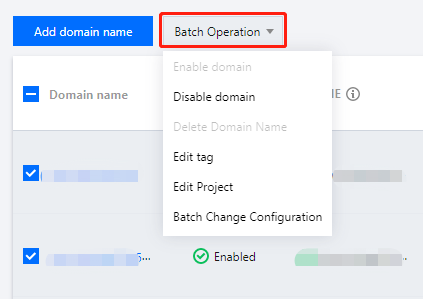
You can adjust the list column, batch enable/disable acceleration service for domain names, and batch change domain name projects, tags, and configurations.

Directions

Adjusting list volumes

Click the
img

icon on the right of the search bar to open the list field option list. You can choose to display or hide fields and adjust their display order:


Exporting the configuration list

Click the
img

icon on the right of the search bar to export an Excel file of the domain name list content. You can select up to 1000 domain names to export each time.
You can change the projects of normally-running domain names.
Single domain name: Click More > Modify Project.


Batch change the project: Select target domain names and click More Actions -> Edit Project on the top. Up to 50 domain names can be selected at a time.


Editing tags

Single domain name: Click the target domain name to enter its configuration page, open the Basic Configuration tab, click the pencil icon on the right of Tag in the Basic Information section.
Batch editing: Select domain names to modify, and click More Actions -> Edit Tag on the top. Up to 50 domain names are supported. Refresh the page to check the updated tags.


Disabling the acceleration service

When you disable the acceleration service for a domain name, it is deactivated on CDN cache nodes across the entire network. All access requests to the domain name get 404. Therefore, before disabling a domain name, make sure that its CNAME record is resolved to a non-CDN CNAME address.
Note:
Consumption will no longer be generated after the acceleration service is completely disabled.
Single domain name: More -> Disable.
Batch disable: Select domain names to disable, click More Actions -> Disable Acceleration on the top.

Enabling the acceleration service

When the acceleration service is enabled for a domain name, the domain name configuration is distributed to cache nodes across the entire network.
Single domain: Click More -> Enable.
Batch enable: Select domain names to enable, and click More Actions -> Enable Acceleration on the top.
Note:
If an enabled domain name has no operations or consumption for 3 months, it will be considered inactive and CDN will automatically disable its acceleration service.

Deleting domain names

To delete an accelerated domain name, you need to disable it first. After the deletion, all data of the domain names will be cleared and cannot be restored. You can no longer check their statistical data.
Single domain name: Locate the domain name, click More -> Delete.
Batch delete: Select domain names to delete, and click More Actions -> Delete on the top.

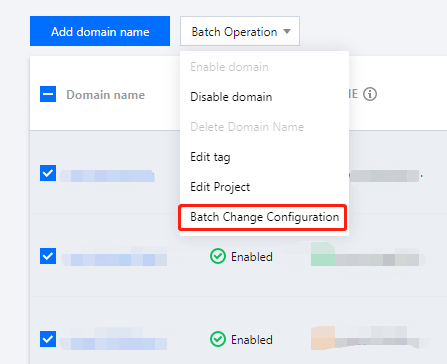
Batch changing configurations

The Batch Change Configuration feature allows you to change a configuration item of multiple domain names at the same time. For more information, please see Batch Changing Configuration.


Copying configurations

The Copy Configuration feature allows you to duplicate configurations of an existing acceleration domain name to one or multiple new acceleration domain names. For more information, please see Copying Configuration.


Purging all caches

To purge all cached resources on the CDN nodes under the current domain name, click More on the right of the domain name, and click Purge all caches in the pop-up window.


Help and Support

Was this page helpful?

Help us improve! Rate your documentation experience in 5 mins.

Feedback