Welcome to Tencent Cloud Software Development Kit (SDK) for Node.js 4.0, a companion tool for the TencentCloud API 3.0 platform. The new SDK 4.0 is unified and features the same SDK usage, API call methods, error codes, and returned packet formats for different programming languages.
This document takes SDK for Node.js 4.0 as an example to describe how to use the SDK with simple samples. It makes it easier for Node.js developers to debug and access Tencent Cloud product APIs.
This version currently supports various Tencent Cloud services such as CVM, VPC, and CBS and will support more services in the future.
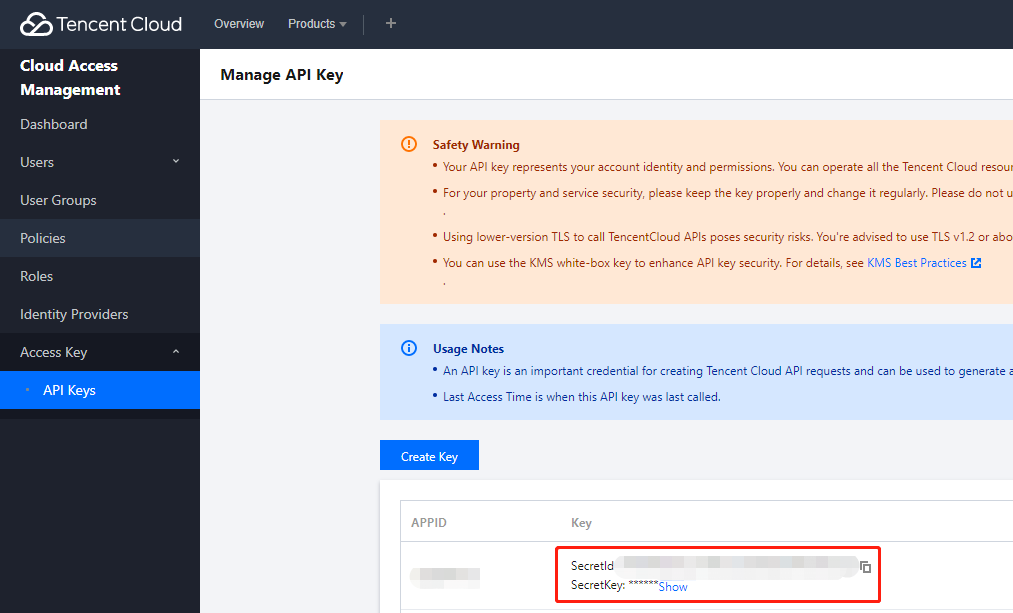
Get the security credential, which consists of SecretID and SecretKey. SecretID is used to identify the API requester, while SecretKey is a key used for signature string encryption and authentication by the server. You can get them on the API Key Management page as shown below:
Note:
Your security credential represents your account identity and granted permissions, which is equivalent to your login password. Do not disclose your SecretKey to others.
Get the calling address (endpoint), which is generally in the format of \\*.tencentcloudapi.com and varies by product. For example, the endpoint of CVM is cvm.tencentcloudapi.com. For specific endpoints, please see the API documentation of the corresponding product.
Installing SDK
Method 1. Install through npm
Installation through npm is the recommended way to use the SDK for Node.js. npm is a dependency manager for Node.js that supports the dependencies your project requires and installs them into your project. For more information, please visit npm official website.
1. Run the following installation command:
npminstall tencentcloud-sdk-nodejs --save
2. Import the corresponding module code into your code. For more information, please see the SDK sample below.
Note:
The above import method downloads the SDKs of all Tencent Cloud products to your local system. You can replace tencentcloud-sdk-nodejs with a specific product SDK name such as tencentcloud-sdk-nodejs-cvm/cbs/vpc to import the SDK of the specific product. In the code, you can change require("tencentcloud-sdk-nodejs") to require("tencentcloud-sdk-nodejs-cvm/cbs/vpc") and keep the rest unchanged, which can greatly save the storage space. For more information, please see the sample.
reqTimeout:30,// Request timeout period in seconds, which is 60s by default
},
},
}
// Instantiate the client object of the requested product (with CVM as an example)
const client = new CvmClient(clientConfig)
// Call the API you want to access through the client object; you need to passin the request objectand the response callback function
client.DescribeZones().then(
(data)=>{
console.log(data)
},
(err)=>{
console.error("error", err)
}
)
The input parameters for instantiating Client support the clientConfig data structure. For more information, please see ClientConfig.
More samples
For more demos, please go to the examples directory.
Relevant Configuration
Proxy
If there is a proxy in your environment, you need to set the system environment variable https_proxy; otherwise, it may not be called normally, and a connection timeout exception will be thrown.
Legacy SDK
We recommend you use the new version of the SDK for Node.js. If you have to use a legacy SDK, please go to the GitHub repository.