tencent cloud

Video on Demand

Release Notes and Announcements
Release Notes
Announcements
Product Introduction
Overview
Product Features
Features
Strengths
Scenarios
Solutions
Professional Edition
Introduction to Video On Demand Professional Edition
Quick Start
Console Guide
Development Guide
Purchase Guide
Billing Overview
Billing Modes
Purchase Guide
Viewing Bills
Renewal
Overdue Policy
Refund Policy
Getting Started
Console Guide
Console Overview
Service Overview
Application Management
Media Management
Package Management
License Management
Real-Time Log Analysis
Practical Tutorial
Media Upload
Smart Cold Storage of VOD Media Asset Files
Video Processing
Distribution and Playback
How to Receive Event Notification
How to Migrate Files from Origin Server to VOD
Live Recording
How to Pull from Custom Origin Servers
How to Use EdgeOne to Distribute Content in VOD
Development Guide
Media Upload
Media Processing
Video AI
Event Notification
Video Playback
Media Encryption and Copyright Protection
Broadcast Channel
CAM
Media File Download
Subapplication System
Error Codes
Player SDK
Overview
Basic Concepts
Features
Free Demo
Free Trial License
Purchase Guide
SDK Download
Licenses
Player Guide
Integration (UI Included)
Integration (No UI)
Advanced Features
API Documentation
Player Adapter
Player SDK Policy
Server APIs
History
Introduction
API Category
Other APIs
Media Processing APIs
Task Management APIs
Media Upload APIs
Media Management APIs
Event Notification Relevant API
Media Categorization APIs
Domain Name Management APIs
Distribution APIs
AI-based Sample Management APIs
Region Management APIs
Data Statistics APIs
Carousel-Related APIs
Just In Time Transcode APIs
No longer recommended APIs
Making API Requests
AI-based image processing APIs
Parameter Template APIs
Task Flow APIs
Data Types
Error Codes
Video on Demand API 2024-07-18
FAQs
Mobile Playback
Fees
Video Upload
Video Publishing
Video Playback
Web Playback
Full Screen Playback
Statistics
Access Management
Cold Storage
Agreements
Service Level Agreement
VOD Policy
Privacy Policy
Data Processing And Security Agreement
Contact Us
Glossary

Video Playback Overview

PDF
Focus Mode
Font Size
Last updated: 2024-12-04 10:19:48
VOD supports multiple methods to play back uploaded and transcoded videos, and video playback mainly involves three scenarios: short video, long video, and encrypted video playback.

Short video playback

Short videos generally refer to videos of less than 5 minutes in length, mainly including:
Videos shared on UGSV social media sites (such as TikTok).
Product promotion videos shared on ecommerce platforms.
Videos shared on WeChat Official Account and we media.


Long video playback

Long videos generally refer to videos produced by professional organizations and published on video websites, mainly including:
Exclusive TV series and variety shows published on video social media platforms (such as Tencent Video, Youku, and iQIYI).
Course videos published on online education websites (such as Tencent Class and Penguin Tutoring).
TV programs replayed on online TV platforms (such as CNTV and Mongo TV).


Encrypted video playback

Video encryption is a specific scenario of long video playback scenarios, where copyrighted videos such as exclusive TV series and online courses are encrypted to avoid unauthorized download and distribution.


Playback Architecture

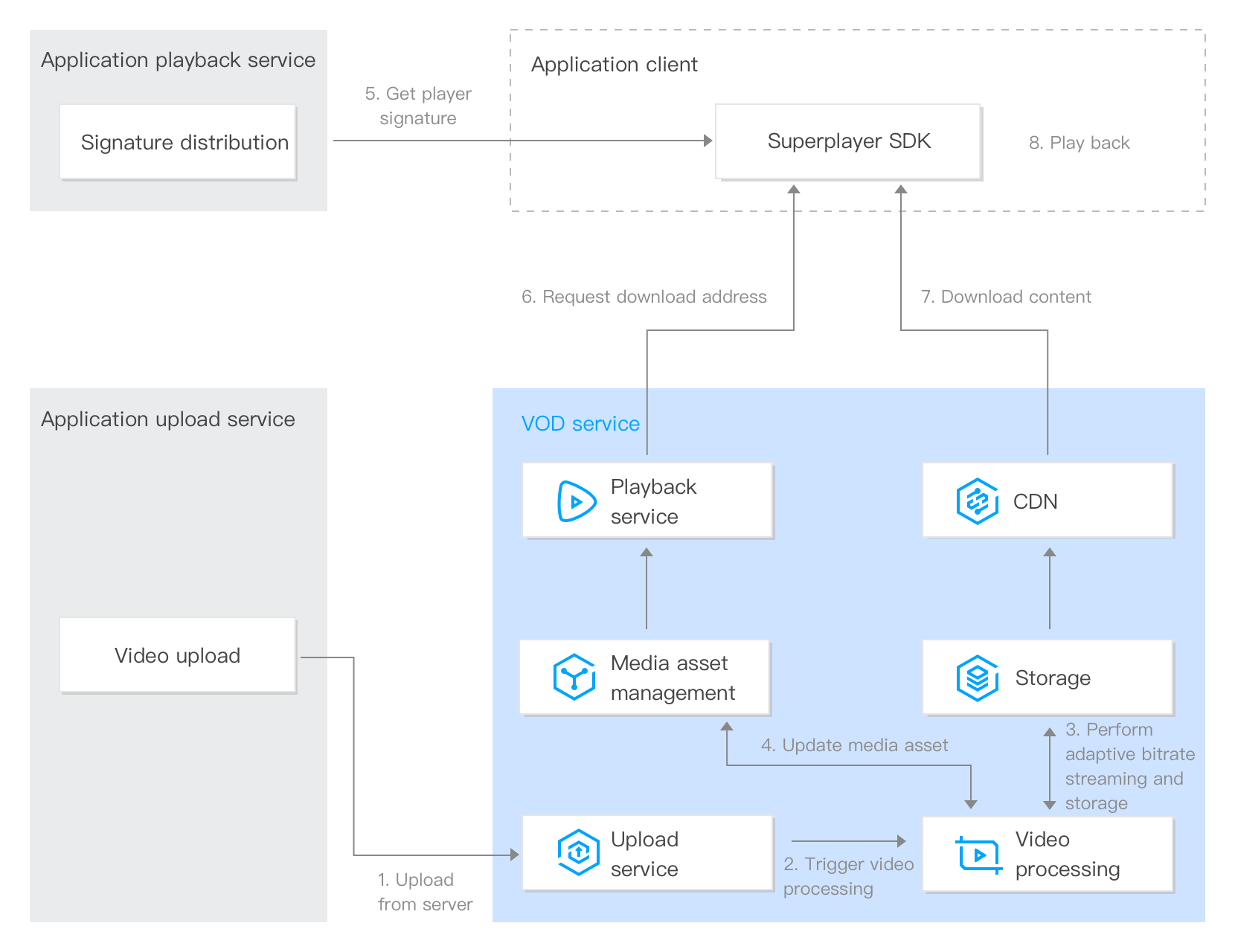
For various video playback scenarios, we recommend you use the Player SDK to play back the output video of adaptive bitrate streaming in VOD. The overall playback architecture is as follows:


1. Upload from server: The business backend uploads a video to VOD through the console, server API, or other means.
2. Trigger video processing: When the video is uploaded, adaptive bitrate streaming is specified. After the video is uploaded, video processing begins.
3. Transcode to adaptive bitstream and write to storage: After the video is transcoded to adaptive bitstream, the output video content is written to the VOD storage.
4. Update the media asset: The output video information is written into the media asset management module.
5. Distribute the signature: The business backend distributes the playback signature generated according to the player signature calculation rule.
6. Request the download address: The player gets the download address of the video from VOD's playback service after the video's FileId is specified.
7. Download the content: The player downloads the content from VOD CDN at the download address.
8. Play back the video: The player plays back the output adaptive bitstream.

Documentation

For the features supported by the Player SDK, see Feature Description. For the integration method, see SDK Download.
To help you quickly integrate the VOD Player, we provide an integration guide for the Player SDK to describe the integration steps by way of demos.
For more information on how video encryption works and the integration methods in video encryption and playback scenarios, see Overview and Stage 4. Play back an encrypted video.

Help and Support

Was this page helpful?

Help us improve! Rate your documentation experience in 5 mins.

Feedback