tencent cloud

Elastic MapReduce

Release Notes and Announcements
Release Notes
Announcements
Security Announcements
Product Introduction
Overview
Strengths
Architecture
Features
Use Cases
Constraints and Limits
Technical Support Scope
Product release
Purchase Guide
EMR on CVM Billing Instructions
EMR on TKE Billing Instructions
EMR Serverless HBase Billing Instructions
Getting Started
EMR on CVM Quick Start
EMR on TKE Quick Start
EMR on CVM Operation Guide
Planning Cluster
Administrative rights
Configuring Cluster
Managing Cluster
Managing Service
Monitoring and Alarms
TCInsight
EMR on TKE Operation Guide
Introduction to EMR on TKE
Configuring Cluster
Cluster Management
Service Management
Monitoring and Ops
Application Analysis
EMR Serverless HBase Operation Guide
EMR Serverless HBase Product Introduction
Quotas and Limits
Planning an Instance
Managing an Instance
Monitoring and Alarms
Development Guide
EMR Development Guide
Hadoop Development Guide
Spark Development Guide
Hbase Development Guide
Phoenix on Hbase Development Guide
Hive Development Guide
Presto Development Guide
Sqoop Development Guide
Hue Development Guide
Oozie Development Guide
Flume Development Guide
Kerberos Development Guide
Knox Development Guide
Alluxio Development Guide
Kylin Development Guide
Livy Development Guide
Kyuubi Development Guide
Zeppelin Development Guide
Hudi Development Guide
Superset Development Guide
Impala Development Guide
Druid Development Guide
TensorFlow Development Guide
Kudu Development Guide
Ranger Development Guide
Kafka Development Guide
Iceberg Development Guide
StarRocks Development Guide
Flink Development Guide
JupyterLab Development Guide
MLflow Development Guide
Practical Tutorial
Practice of EMR on CVM Ops
Data Migration
Practical Tutorial on Custom Scaling
API Documentation
History
Introduction
API Category
Cluster Resource Management APIs
Cluster Services APIs
User Management APIs
Data Inquiry APIs
Scaling APIs
Configuration APIs
Other APIs
Serverless HBase APIs
YARN Resource Scheduling APIs
Making API Requests
Data Types
Error Codes
FAQs
EMR on CVM
Service Level Agreement
Contact Us

Instance Information

PDF
Focus Mode
Font Size
Last updated: 2026-01-14 15:26:39

Overview

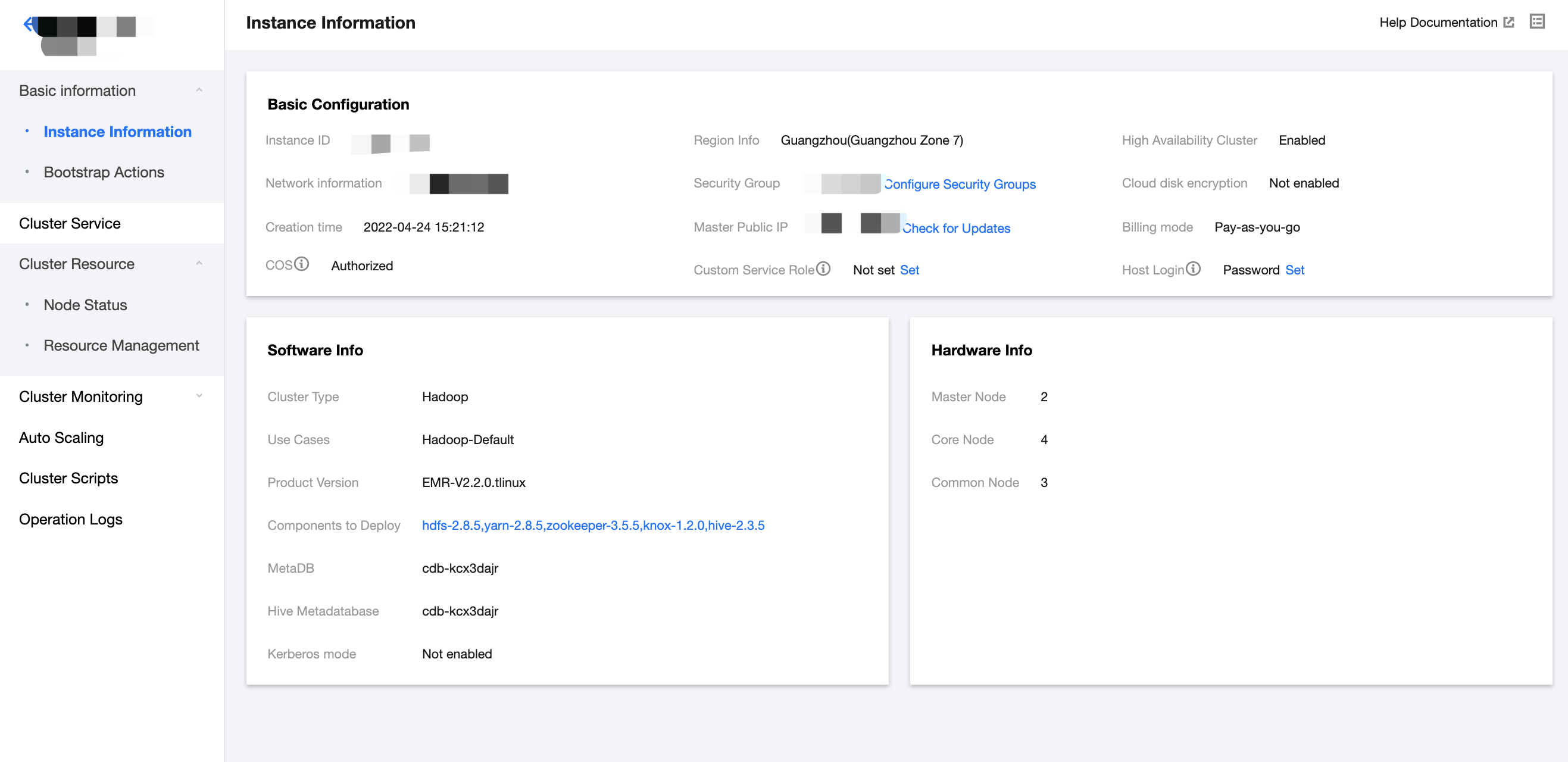
Instance information records the basic information of your EMR cluster. You can view the basic configurations, software information, and deployment information of the cluster on the Instance Information page.
The Basic Configuration section displays basic information of the cluster. The information includes the instance ID, region information, network information, creation time, security group, master public IP, billing mode, and host log-in method.
The authorization information includes whether the authorization granularity is at the cluster level. For example, grant access permissions on COS to specific accounts, grant access permissions on COS to specific clusters (cluster COS service role), or allow M Node to access Cloud HDFS.
The software information includes deployment information such as the cluster type, application scenario, product version, deployment component, MetaDB, Hive metadatabase, and whether the Kerberos mode is enabled.
The deployment information includes the quantity information of each node type.
This document describes how to view the cluster instance information in the console.

Directions

1. After successfully creating a cluster, log in to the EMR console and click the ID/Name of the cluster.
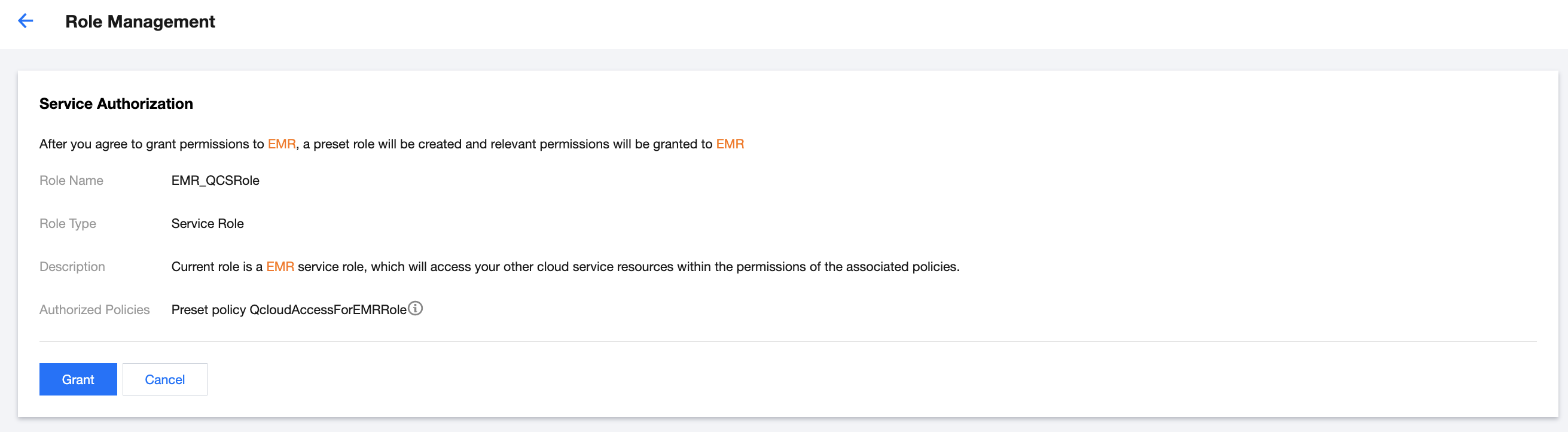
2. If COS is not enabled for the cluster, click Authorize.


Click Grant to complete the authorization.


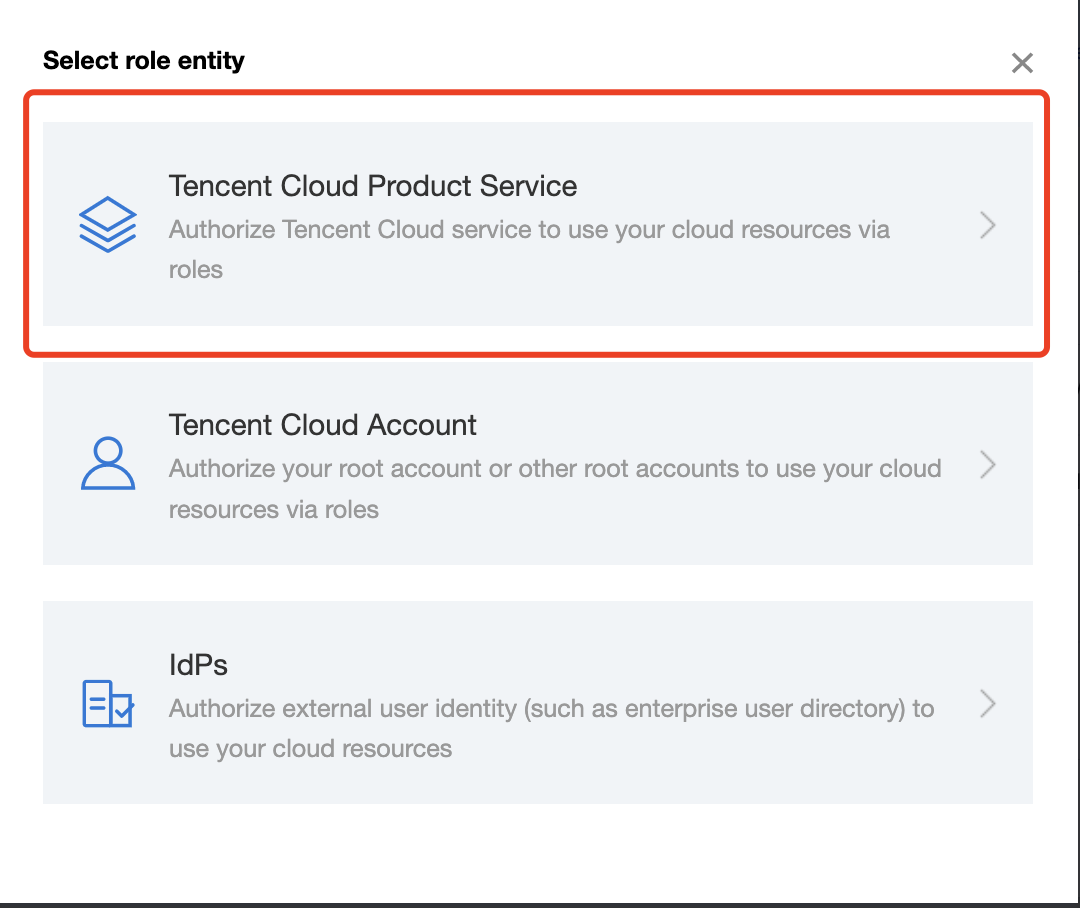
If refined authorization is required, you can set the cluster COS service role.


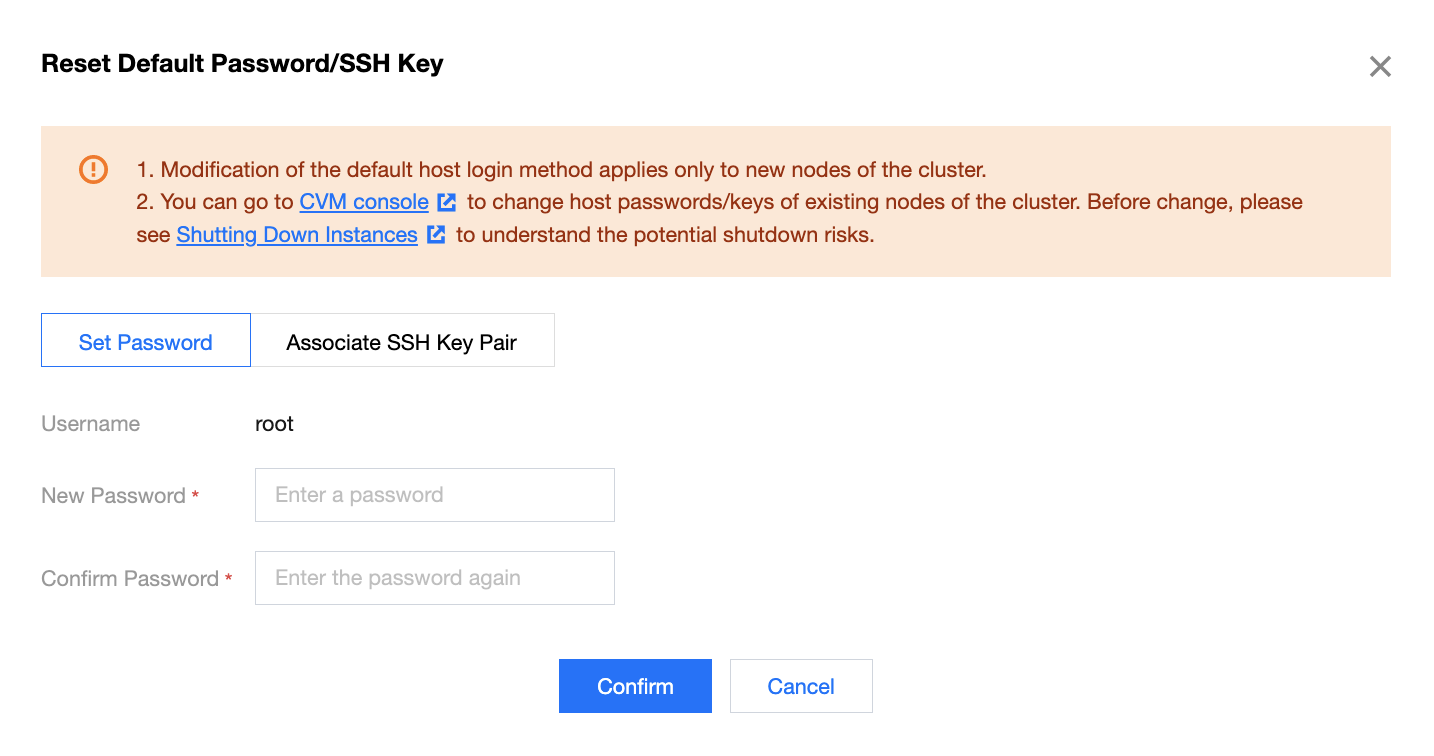
To change the host login password or method of cluster nodes after scale-out, click Change.


Note:
The login method set for initializing nodes in an EMR cluster. After the cluster is created, modification of the setting here applies only to new nodes.
You can go to the CVM console to change host passwords/keys of existing nodes of the cluster. Before change, see Shutting Down Instances to understand the potential shutdown risks.
Help and Support

Was this page helpful?

Help us improve! Rate your documentation experience in 5 mins.

Feedback