Stream Pushing Notification
Download
Focus Mode
Font Size
The stream pushing callback informs you whether stream pushing is successful or interrupted. You need to configure a server address for the callback in a callback template and bind the template with your push domain name. After push starts via a URL generated under the domain, the Tencent Cloud backend will send the callback to the server you set.
This document describes the parameters in a stream pushing callback notification sent to you by CSS.
Note
This guide assumes that you understand how to configure callbacks and receive callback notifications from CSS. For details, see How to Receive Event Notification.
Stream Pushing Event Parameters
Event type
Event Type | Value |
Successful push | event_type = 1 |
Push interrupted | event_type = 0 |
Common callback parameters
Parameter | Type | Description |
t | int64 | Expiration time, which is the Unix timestamp when the event notification signature expires. The default validity period of a callback notification from Tencent Cloud is 10 minutes. If the time specified by the t value in a notification has elapsed, then this notification is considered invalid. This prevents network replay attacks.The value of t is a decimal Unix timestamp, that is, the number of seconds that have elapsed since 00:00:00 (UTC/GMT time), January 1, 1970. |
sign | string | Security signature. sign = MD5(key + t). Note: Tencent Cloud splices the encryption key and t, generates the MD5 hash of the spliced string, and embeds it in callback messages. Your backend server can perform the same calculation when it receives a callback message. If the signature matches, it indicates the message is from Tencent Cloud. |
Note:
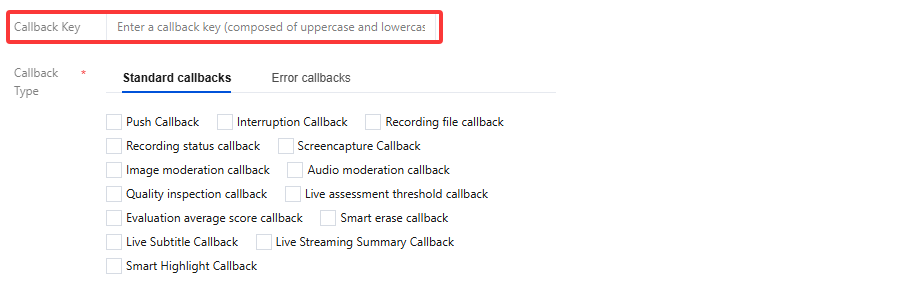
You can set the callback key in Feature Configuration > Live Stream Callback, which is used for authentication. We recommend you set this field to ensure data security.
Callback parameters
Parameter | Type | Description |
appid | int | User APPID |
app | string | Push domain name |
appname | string | Push path |
stream_id | string | Live stream name |
channel_id | string | Same as the live stream name |
event_time | int64 | UNIX timestamp when the event message is generated |
sequence | string | Message sequence number, which identifies a push. The notifications for a push, whether they are for successful push or stream interruption, have the same sequence number. |
node | string | IP of the live stream access point |
user_ip | string | User push IP |
stream_param | string | User push URL parameters |
push_duration | string | Push duration of the interrupted stream in milliseconds |
errcode | int | Stream pushing error code |
errmsg | string | Stream pushing error message |
set_id | int | Whether the push is from inside the Chinese mainland. 1-6: yes; 7-200: no. |
width | int | Video width. The value of this parameter may be 0 if the video header information is missing at the beginning of a push. |
height | int | Video height. The value of this parameter may be 0 if the video header information is missing at the beginning of a push. |
Causes of stream interruption
Sample callback
Live Stream Push Callback Message Example
{
    "app":"test.domain.com",
    "appid":12345678,
    "appname":"live",
    "channel_id":"test_stream",
    "errcode":0,
    "errmsg":"ok",
    "event_time":1703731478,
    "event_type":1,
    "height":0,
    "idc_id":34,
    "node":"42.81.194.37",
    "sequence":"2210464508206756938",
    "set_id":2,
    "sign":"df49************************f5d4",
    "stream_id":"test_stream",
    "stream_param":"stream_param=test",
    "t":1703732078,
    "user_ip":"1.1.1.1",
    "width":0
}
Live Stream Interruption Callback Message Example
{
    "app":"test.domain.com",
    "appid":12345678,
    "appname":"live",
    "channel_id":"test_stream",
    "errcode":1,
    "errmsg":"The push client actively stopped the push",
    "event_time":1703731606,
    "event_type":0,
    "height":0,
    "idc_id":34,
    "node":"42.81.194.37",
    "push_duration":"128581",
    "sequence":"2210464508206756938",
    "set_id":2,
    "sign":"3485************************56ae",
    "stream_id":"test_stream",
    "stream_param":"stream_param=test",
    "t":1703732206,
    "user_ip":"1.1.1.1",
    "width":0
}
Stream Pushing Error Code
Error Code | Description | |
1 | | The push client actively stopped the push. Note: The different error codes are only distinguished internally by the system and users do not need to pay attention to them. |
2 | | |
3 | | |
4 | | |
35 | | |
5 | | The live streaming system has an internal error. |
9 | | |
11 | | |
24 | | |
10 | | |
6 | | Abnormal RTMP protocol content. |
7 | | The size of a single RTMP frame exceeds the maximum value allowed by the configuration. |
8 | | The system actively stopped the push with no data for a long time. |
20 | | |
12 | | Abnormal stream pushing link network. |
13 | | |
14 | | |
15 | | |
16 | | |
17 | | |
19 | | Third-party authentication failure. |
23 | | Abnormal RTMP protocol content. |
33 | | Abnormal RTMP AMF data. |
0 | | |
22 | | |
25 | | |
26 | | |
27 | | |
28 | | |
29 | | |
30 | | |
31 | | |
32 | | |
34 | | |
Other unknown values | | |
Help and Support
Was this page helpful?
You can also Contact sales or Submit a Ticket for help.
Help us improve! Rate your documentation experience in 5 mins.
Feedback