Restoring Archived Objects
Download
Focus Mode
Font Size
Overview
You can restore an object from the ARCHIVE or DEEP ARCHIVE storage class through the COS console. The restoration operation will create a copy of the object in the STANDARD storage class. You can read, download, or perform other operations on the copy within its validity period. The copy will be deleted automatically after expiration. For more information about storage classes, see Storage Class Overview.
Note:
Object copy refers to the object version generated after a restored (thawed) archive type object. The difference from archive type objects is that an object copy is a temporary standard storage type object that supports operations such as access and storage type modification during the copy's validity period, meeting the business needs for temporary object access. The copy is automatically deleted upon expiration. If you want to modify storage class, you can change the archive type to standard type during the copy's validity period.
If you restore objects from ARCHIVE, the object copy will be billed at STANDARD rates. If you restore objects from DEEP ARCHIVE, the object copy will be charged request fees at the marked unit price, and traffic fees at STANDARD rates. For more information, see Product Pricing.
Directions
1. Log in to the COS console.
2. Click Bucket List on the left sidebar.
3. Locate the bucket where the object resides and click the bucket name.
4. Click File List on the left sidebar.
5. Locate the object to restore and click Recover in the Operation column. To restore multiple archived objects at a time, select them all in the object list, and click Recover from the More Actions drop-down list at the top.
6. In the pop-up window, configure the restoration mode and the validity period (in days) of the copy.
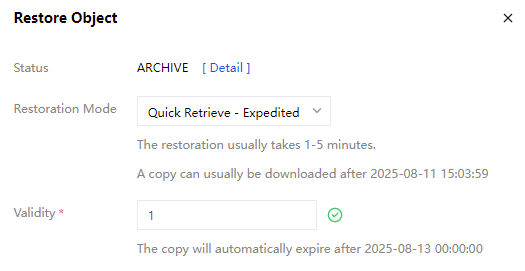
The parameters are described as follows:
Restoration Mode: Expedited, Standard, or Bulk retrieval.
Expedited retrieval: This is the fastest mode. Archived files can be restored within 1-5 minutes. If you need to access your archival data urgently, you can use this mode to greatly reduce the restoration time. Please note that the expedited retrieval mode is not available for DEEP ARCHIVE.
Standard retrieval: Files can be restored from ARCHIVE within 3-5 hours, and from DEEP ARCHIVE within 12-24 hours.
Bulk retrieval: This is the lowest-cost mode. If your need for the archival data is not urgent, this mode can usually restore massive amounts of data from ARCHIVE within 5-12 hours, and from DEEP ARCHIVE within 24-48 hours, both with an ultra-low cost.
Note:
The QPS of data restoration requests is limited to 100.
The data retrieval fees vary by mode; for details, please refer to Data Retrieval Fees.
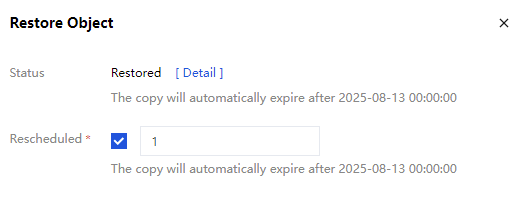
Validity: The number of days after which the copy will automatically expire and be deleted. The value range is 1 to 365 days. After the object is successfully restored, you can click OK again to change the validity period of the copy in the pop-up window.
7. Click OK. The object enters the restoration process. During this process, you can check the object recovery progress in the following two ways:
7.1 Refresh the page file list to view the recovery status and expected recovery time of the object in the storage type column.

7.2 You can click Details to go to the object details page to check the restoration progress.
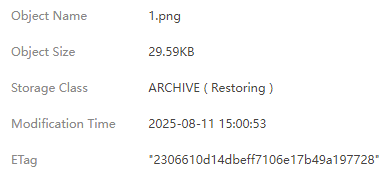
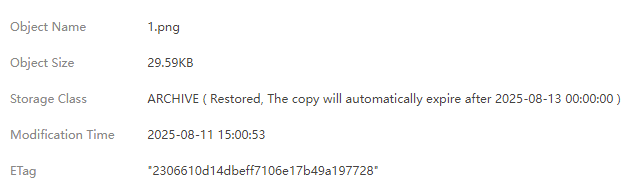
8. Once the object has been successfully restored, you can access, download, and modify the storage type of the object from its details page.
Note:
After the object recovery is complete, before deleting the expired copies, Modifying Storage Class (e.g., to standard storage). The original object type will be replaced from archive storage to standard storage type.
9. If you need to change the validity period of the copy, follow step 5 and click Recover again to modify the settings in the pop-up window.
Help and Support
Was this page helpful?
You can also Contact sales or Submit a Ticket for help.
Help us improve! Rate your documentation experience in 5 mins.
Feedback